NSG6101 (NSG6101)

South University

Here are the best resources to pass NSG6101 (NSG6101). Find NSG6101 (NSG6101) study guides, notes, assignments, and much more.

All 18 results

Sort by:
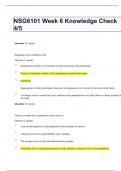
NSG6101 Week 6 Knowledge Check 4/5
  • Exam (elaborations)

    NSG6101 Week 6 Knowledge Check 4/5

  • NSG6101 Week 6 Knowledge Check 4/5 Question 1 (1 point) Sampling may be defined as the: Question 1 options: Identification of the set of elements used for selecting study participants Process of selecting a subset of the population to represent the entire population Aggregation of study participants who meet a designated set of criteria for inclusion in the study Technique used to ensure that every element in the population has an equal chance of being included in the stu...
  • TheInstructor
    $11.39 More Info
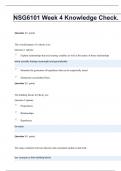
NSG6101 Week 4 Knowledge Check.
  • Exam (elaborations)

    NSG6101 Week 4 Knowledge Check.

  • NSG6101 Week 4 Knowledge Check. Question 1 (1 point) The overall purpose of a theory is to: Question 1 options: Explain relationships that exist among variables as well as the nature of those relationships Stimulate the generation of hypotheses that can be empirically tested Summarize accumulated facts Question 2 (1 point) The building blocks for theory are: Question 2 options: Propositions Relationships Hypotheses Question 3 (1 point) T...
  • TheInstructor
    $10.99 More Info
NSG6101 Week 10 Knowledge Check correct answers provided
  • Exam (elaborations)

    NSG6101 Week 10 Knowledge Check correct answers provided

  • NSG6101 Week 10 Knowledge Check correct answers provided
  • grade_bender
    $12.50 More Info
NSG6101 Week 9 Knowledge Check correctly answered
  • Exam (elaborations)

    NSG6101 Week 9 Knowledge Check correctly answered

  • NSG6101 Week 9 Knowledge Check
  • grade_bender
    $13.50 More Info
NSG6101 Week 6 Knowledge Check 4/5
  • Exam (elaborations)

    NSG6101 Week 6 Knowledge Check 4/5

  • NSG6101 Week 6 Knowledge Check 4/5
  • grade_bender
    $13.50 More Info
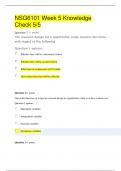
NSG6101 Week 5 Knowledge Check 5/5
  • Exam (elaborations)

    NSG6101 Week 5 Knowledge Check 5/5

  • NSG6101 Week 5 Knowledge Check 5/5
  • grade_bender
    $13.60 More Info
NSG6101 Week 6 Knowledge Check 4/5
  • Exam (elaborations)

    NSG6101 Week 6 Knowledge Check 4/5

  • NSG6101 Week 6 Knowledge Check 4/5 Question 1 (1 point) Sampling may be defined as the: Question 1 options: Identification of the set of elements used for selecting study participants Process of selecting a subset of the population to represent the entire population Aggregation of study participants who meet a designated set of criteria for inclusion in the study Technique used to ensure that every element in the population has an equal chance of being included in the stu...
  • QUICKEXAMINER
    $9.99 More Info
NSG6101 Week 4 Knowledge Check.
  • Exam (elaborations)

    NSG6101 Week 4 Knowledge Check.

  • NSG6101 Week 4 Knowledge Check. Question 1 (1 point) The overall purpose of a theory is to: Question 1 options: Explain relationships that exist among variables as well as the nature of those relationships Stimulate the generation of hypotheses that can be empirically tested Summarize accumulated facts Question 2 (1 point) The building blocks for theory are: Question 2 options: Propositions Relationships Hypotheses Question 3 (1 point) T...
  • QUICKEXAMINER
    $11.99 More Info
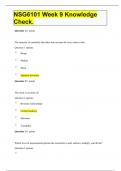
NSG6101 Week 9 Knowledge Check.
  • Exam (elaborations)

    NSG6101 Week 9 Knowledge Check.

  • NSG6101 Week 9 Knowledge Check. Question 1 (1 point) The measure of variability that takes into account all score values is the: Question 1 options: Range Median Mean Standard deviation Question 2 (1 point) The mode is an index of: Question 2 options: Bivariate relationships Central tendency Skewness Variability
  • MedTestPro
    $5.49 More Info
NSG6101 Week 4 Knowledge Check.
  • Exam (elaborations)

    NSG6101 Week 4 Knowledge Check.

  • NSG6101 Week 4 Knowledge Check. Question 1 (1 point) The overall purpose of a theory is to: Question 1 options: Explain relationships that exist among variables as well as the nature of those relationships Stimulate the generation of hypotheses that can be empirically tested Summarize accumulated facts Question 2 (1 point) The building blocks for theory are: Question 2 options: Propositions Relationships Hypotheses Question 3 (1 point) T...
  • MedTestPro
    $10.49 More Info
And that's how you make extra money
Did you know that on average a seller on Stuvia earns $82 per month selling study resources? Hmm, hint, hint.