Trh st - Study guides, Class notes & Summaries

Looking for the best study guides, study notes and summaries about Trh st? On this page you'll find 43 study documents about Trh st.

Page 4 out of 43 results

Sort by:
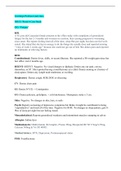
Exam (elaborations) NR 507 PATHOPHYSIOLOGY WEEK 7 TD3 Behavioral, Neurologic, and Digestive Disorders Discussion Part Three
  • Exam (elaborations)

    Exam (elaborations) NR 507 PATHOPHYSIOLOGY WEEK 7 TD3 Behavioral, Neurologic, and Digestive Disorders Discussion Part Three

  • Discussion Part Three Disorders - Loading... This week's graded topics relate to the following Course Outcomes (COs). 1 Analyze pathophysiologic mechanisms associated with selected disease states. (PO 1) 2 Differentiate the epidemiology, etiology, developmental considerations, pathogenesis, and clinical and laboratory manifestations of specific disease processes. (PO 1) 3 Examine the way in which homeostatic, adaptive, and compensatory physiological mechanisms can be supported and/or alt...
  • GradeMaster1
    $15.99 More Info
NR 507 PATHOPHYSIOLOGY WEEK 7 TD1 Behavioral, Neurologic, and Digestive Disorders Discussion Part One (NR507)
  • Exam (elaborations)

    NR 507 PATHOPHYSIOLOGY WEEK 7 TD1 Behavioral, Neurologic, and Digestive Disorders Discussion Part One (NR507)

  • Exam (elaborations) NR 507 PATHOPHYSIOLOGY WEEK 7 TD1 Behavioral, Neurologic, and Digestive Disorders Discussion Part One (NR507) Week 7: Behavioral, Neurologic, and Digestive Disorders One - Discussion Part Loading... This week's graded topics relate to the following Course Outcomes (COs). 1 Analyze pathophysiologic mechanisms associated with selected disease states. (PO 1) 2 Differentiate the epidemiology, etiology, developmental considerations, pathogenesis, and clinical and laboratory...
  • Expert001
    $8.49 More Info
Exam (elaborations) NR 507 PATHOPHYSIOLOGY WEEK 6 TD3 Dermatologic and Musculoskeletal Disorders Discussion Part Three
  • Exam (elaborations)

    Exam (elaborations) NR 507 PATHOPHYSIOLOGY WEEK 6 TD3 Dermatologic and Musculoskeletal Disorders Discussion Part Three

  • Week 6: Dermatologic and Musculoskeletal Disorders - Discussion Part Three Loading... Loading... This week's graded topics relate to the following Course Outcomes (COs). 1 Discussion Discussion Part Three (graded) Responses Lorna Durfee 6/6/2016 8:33:06 PM Discussion Part Three aK efeisvhear ,o af a1b3o-yueta 1r0-o4l.d0 fCem. aSlhee, haalsso c hoamse a i nratos hy oounr h uerrg feancte c aa rpeo csesinbtleyr .t hSeh eb ehgaisn nreindg c oofn aju rnacstihv ao,n a h ceor uagrhm as.n d Ab...
  • GradeMaster1
    $15.99 More Info
NR 507 PATHOPHYSIOLOGY WEEK 4 TD2 Alterations in Renal Function Discussion Part Two (NR507)
  • Exam (elaborations)

    NR 507 PATHOPHYSIOLOGY WEEK 4 TD2 Alterations in Renal Function Discussion Part Two (NR507)

  • Exam (elaborations) NR 507 PATHOPHYSIOLOGY WEEK 4 TD2 Alterations in Renal Function Discussion Part Two (NR507) Week 4: Alterations in Renal Function - Discussion Part Two Loading... Discussion This week's graded topics relate to the following Course Outcomes (COs). 1 Analyze pathophysiologic mechanisms associated with selected disease states. (PO 1) 2 Differentiate the epidemiology, etiology, developmental considerations, pathogenesis, and clinical and laboratory manifestations of spe...
  • Expert001
    $8.49 More Info
NR511 Week 6 Case Study Discussion
  • Exam (elaborations)

    NR511 Week 6 Case Study Discussion

  • A 56-year-old Caucasian female presents to the office today with complaints of generalized fatigue for the last 2-3 months and worsens on exertion, thus causing progressive worsening since onset. She reports feeling tired all of the time, sleep 8hrs per night, but does not feel well- rested. She stated that she has no energy to do the things she usually does and reported missing “1 day of work 2 weeks ago” because she could not get out of bed. She denies pain and reported no treatments or re...
  • FLOYYD
    $15.99 More Info
RNSG Nclex practive 100 Prepu (RATED A) Questions and Answers | (Nursing, Diabetes, Correct Response) | Highly Rated Paper .
  • Exam (elaborations)

    RNSG Nclex practive 100 Prepu (RATED A) Questions and Answers | (Nursing, Diabetes, Correct Response) | Highly Rated Paper .

  • Question 1: (see full question) A client with acquired immunodeficiency syndrome (AIDS) develops Pneumocystis carinii pneumonia. Which nursing diagnosis has the highest priority? Impaired oral mucou s membranes Impaired gas exchange Although all of these nursing diagnoses are appropriate for a client with AIDS, Impaired gas exchange is the priority nursing diagnosis for a client with P. carinii pneumonia. Airw ... (more) Pneumocystis jiroveci (carinii) pneumonia Pneumocystis carinii pneumonia Yo...
  • ProfGoodlucK
    $11.49 More Info
NUR 210, 242 Exam 3 pharm study ,100% CORRECT
  • Exam (elaborations)

    NUR 210, 242 Exam 3 pharm study ,100% CORRECT

  • NUR 210, 242 Exam 3 pharm study guide Loop,potassium-sparing, and thiazide diuretics Drug classification Thiazides Thiazide-like diuretics Loop High ceiling diuretics Thiazide Action Potassium-sparing Potassium sparing diuretics Acts on the distal convoluted renal tube. Promotes sodium, chloride, and water excretion Indications Hydrochlorothiazide Decrease blood pressure Decrease amount of fluid within the body Treats peripheral edema Side effects Hyperglyc...
  • paulhans
    $16.99 More Info
NUR 2004 Exam 3 Study Guide.
  • Exam (elaborations)

    NUR 2004 Exam 3 Study Guide.

  • Pathophysiology Exam 3 Study Guide Hematopoiesis ~9 Questions Distinct features of erythrocytes, what they do, how they do it. • RBCs: responsible for oxygen transport. o Once mature, have no or ganelles, no protein synthesis, do not go through mitosis. Discoid in shape, flexible structure. Life span changes, what happens as they age • Life span of 120 days, +- 20 days o Altered by conditions, decreased in certain conditions. o As RBCs age ▪ Lose flexibility ▪ Lysed or phagocytized ▪ R...
  • ProfGoodlucK
    $11.49 More Info
Pharmacology Exam 4Questions and Answers,100% CORRECT
  • Exam (elaborations)

    Pharmacology Exam 4Questions and Answers,100% CORRECT

  • Pharmacology Exam 4Questions and Answers CH 30-37 PPT Questions 1. Which effect does the nurse expect to see in a patient receiving hydrocortisone (Solu-Cortef) ? a. Increase in inflammatory leukocyte function b. Reduction of scar tissue formation c. Renal excretion of sodium d. Hypotension 2. When administering octreotide (Sandostatin) to a patient, it is most important for the nurse to assess which parameter? a. Urine output b. Blood sugar c. Liver function tests d. Electrocardi...
  • paulhans
    $17.99 More Info
TEAS TEST 101 Chapter 16 exam (Spring 2020) | Human Anatomy & Physiology_The Endocrine System
  • Exam (elaborations)

    TEAS TEST 101 Chapter 16 exam (Spring 2020) | Human Anatomy & Physiology_The Endocrine System

  • TEAS TEST 101 Chapter 16 exam (Spring 2020) – St. Augustine College (A Grade) Human Anatomy & Physiology, 10e (Marieb) Chapter 16 The Endocrine System 16.1 Matching Questions Figure 16.1 Using Figure 16.1, match the following: 1) Produces the hormones that promote the development of the female secondary sexual characteristics at puberty. D-Ovaries 2) Storehouse for the hormones produced by the hypothalamus of the brain. B-Pituitary Gland 3) Produces the hormones t...
  • Academiks
    $15.49 More Info
Make study stress less painful
Study stress? For sellers on Stuvia, these are actually golden times. KA-CHING! Earn from your study resources too and start uploading now.