

Nataliedillon
On this page, you find all documents, package deals, and flashcards offered by seller nataliedillon.
- 67
- 0
- 1
Community
- Followers
- Following
68 items
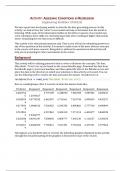
Assessing Conditions - Regression
We have spent time developing models to describe the data generating process. In this activity, we look at how the “noise” in our model can help us determine how the model is behaving. While some of the information hidden in the leftover aspects of our model may seem redundant, these skills are extremely important when working in higher dimensions where visualizing the raw data is more difficult.
- Class notes
- • 13 pages •
We have spent time developing models to describe the data generating process. In this activity, we look at how the “noise” in our model can help us determine how the model is behaving. While some of the information hidden in the leftover aspects of our model may seem redundant, these skills are extremely important when working in higher dimensions where visualizing the raw data is more difficult.
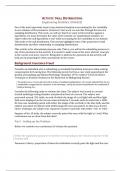
Null Distributions
One of the most important steps in any statistical analysis is accounting for the variability in our estimate of the parameter of interest. Last week, we saw this through the lens of a sampling distribution. This week, we will see that if we want to find evidence against a hypothesis, we must determine the value of the statistic (or standardized statistic) we expect when the null hypothesis is true while accounting for the variability in our statistic. This leads to the null distribution. This a...
- Class notes
- • 4 pages •
One of the most important steps in any statistical analysis is accounting for the variability in our estimate of the parameter of interest. Last week, we saw this through the lens of a sampling distribution. This week, we will see that if we want to find evidence against a hypothesis, we must determine the value of the statistic (or standardized statistic) we expect when the null hypothesis is true while accounting for the variability in our statistic. This leads to the null distribution. This a...
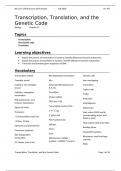
Chapter 15: Transcription & Translation
Topics: Transcription The Genetic code Translation Learning Objectives: • Explain the process of transcription in bacteria; identify differences found in eukaryotes. • Explain the process of translation in bacteria; identify differences found in eukaryotes. • Transcribe and translate given sequences of DNA.
- Class notes
- • 18 pages •
Topics: Transcription The Genetic code Translation Learning Objectives: • Explain the process of transcription in bacteria; identify differences found in eukaryotes. • Explain the process of translation in bacteria; identify differences found in eukaryotes. • Transcribe and translate given sequences of DNA.
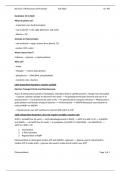
Notes on light dependent/independent reactions
Light Dependent Reactions: requires sunlight Electron Transport Chain and Chemiosmosis Light Independent Reactions: does not requires sunlight, requires CO2
- Class notes
- • 1 pages •
Light Dependent Reactions: requires sunlight Electron Transport Chain and Chemiosmosis Light Independent Reactions: does not requires sunlight, requires CO2
Macromolecules Problems
7 questions about macromolecules, answers included
- Class notes
- • 3 pages •
7 questions about macromolecules, answers included
Genetics Practice
Six practice problems for genetics, mainly diagram the cross problems
- Class notes
- • 2 pages •
Six practice problems for genetics, mainly diagram the cross problems
Understanding the role of the cell membrane in COVID-19 infection
For this activity, you will use scholarly articles and reports to learn about how the COVID-19 virus takes advantage of existing features on the cell membrane to enter cells and, ultimately, hijack cellular machinery to make additional copies of itself (virions). The resources provided are definitely beyond the Bio 110 level, but you should be able to skim them to extract relevant information.
- Class notes
- • 1 pages •
For this activity, you will use scholarly articles and reports to learn about how the COVID-19 virus takes advantage of existing features on the cell membrane to enter cells and, ultimately, hijack cellular machinery to make additional copies of itself (virions). The resources provided are definitely beyond the Bio 110 level, but you should be able to skim them to extract relevant information.
Chapter 11: Reproduction
Topics: Sexual reproduction Meiosis Learning Objectives: • Relate crossing-over, independent assortment, and random fertilization to the goals of sexual reproduction. • Identify and describe the steps of meiosis, comparing to the steps of mitosis.
- Class notes
- • 10 pages •
Topics: Sexual reproduction Meiosis Learning Objectives: • Relate crossing-over, independent assortment, and random fertilization to the goals of sexual reproduction. • Identify and describe the steps of meiosis, comparing to the steps of mitosis.
Protein Concentration Lab
1. In lab, you used an assay called the BCA assay to quantify total protein. Use the internet to summarize the basis for the BCA assay. 2. Another common colormetric assay for protein concentration is the Bradford (or Coomassie) assay. Use the internet to summarize the basis for the Bradford assay. 3. SDS-Page is a technique to separate and visualize proteins by mass. Using the provided 1977 paper, summarize in one paragraph the principle behind SDS-Page.
- Class notes
- • 1 pages •
1. In lab, you used an assay called the BCA assay to quantify total protein. Use the internet to summarize the basis for the BCA assay. 2. Another common colormetric assay for protein concentration is the Bradford (or Coomassie) assay. Use the internet to summarize the basis for the Bradford assay. 3. SDS-Page is a technique to separate and visualize proteins by mass. Using the provided 1977 paper, summarize in one paragraph the principle behind SDS-Page.
Chromatography Lab
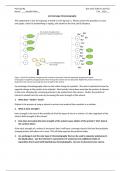
1. What does “elution” mean? 2. What is ionic strength? 3. How does increasing the ionic strength of the solvent cause elution of the protein? Hint: look at the cartoon above. 4. Ion exchange is not the only type of chromatography that can be used to separate substances in the liquid phase. Use the internet to summarize (3-5 sentences) one additional mode of separation that is used with liquid phase chromatography
- Class notes
- • 2 pages •
1. What does “elution” mean? 2. What is ionic strength? 3. How does increasing the ionic strength of the solvent cause elution of the protein? Hint: look at the cartoon above. 4. Ion exchange is not the only type of chromatography that can be used to separate substances in the liquid phase. Use the internet to summarize (3-5 sentences) one additional mode of separation that is used with liquid phase chromatography