Exam (elaborations) TEST BANK FOR Microeconomics 8th Edition David Colander
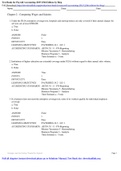
1. The answers to an economy's three central economic problems are determined by the interaction of three forces: economic forces, political forces, and social forces. True False 2. Scarcity exists because economies cannot produce enough to meet the perceived desires of all individuals. True False 3. Only marginal costs, not sunk costs, should affect economic decisions if individuals are rational. True False 4. The economic decision rule is to undertake an action only when the marginal benefits of that action are greater than its total costs. True False 5. The opportunity cost of undertaking an activity includes any sunk cost. True False 6. Opportunity cost is the same as marginal cost. True False 7. The "invisible hand" is the price mechanism that guides our actions in the market. True False 1-1 Full file at 8. Social and political forces affect the way in which the invisible hand works. True False 9. Macroeconomics is the study of how individual choices are affected by economic forces. True False 10. Deciding what the distribution of income should be is an example of normative economics. True False Multiple Choice Questions 11. Say a pill existed that made people selfless. After taking it they were only interested in others not themselves. Under the coordination definition of economics: A. no economic problem would exist. B. there would still be an economic problem. C. there would be a political problem but not an economic problem. D. there would be a social problem but not an economic problem. 12. According to the text, economics is the study of how: A. governments allocate resources in the face of constraints. B. government policies can be used to meet individuals' wants and desires. C. human beings coordinate their wants and desires in the face of constraints. D. scarce resources are allocated to their most productive uses. 13. Dorm rooms are not usually allocated by markets. Allocating dorm rooms is: A. not an economic problem. B. an economic problem. C. not affected by economic forces. D. determined by prices. 1-2 Full file at 14. If allocating dorm rooms changes from allocation by lottery to allocation by the market: A. it becomes an economic problem. B. it becomes a political problem but not an economic problem. C. it becomes a social problem but not an economic problem. D. the allocation problem is still an economic problem. 15. Which of the following is not one of the three central coordination problems of the economy given in the book? A. What. B. Whether. C. For whom. D. How. 16. The quantity of goods and services available to society: A. is fixed. B. depends on human action. C. is not of economic importance. D. will always grow to meet individuals' wants and desires. 17. Any economic system: A. can eliminate scarcity. B. addresses the questions what is produced, how it is produced, and for whom it is produced. C. provides all the goods people want and desire. D. provides equal distribution of well-being among its participants. 18. Scarcity exists because: A. individuals can't solve the three central coordination problems. B. governments can't solve the three central coordination problems. C. the supply of goods is always less than the demand. D. new wants continue to develop. 1-3 Full file at 19. People can reasonably expect that an economic system will decide all of the following except: A. what goods to produce. B. how to produce the goods. C. how to assign initial property rights. D. for whom to produce the goods. 20. A method of reasoning in which one deduces a theory based on a set of almost selfevident principles is known as: A. intuition. B. abduction. C. deduction. D. induction. 21. Deduction is a method of reasoning in which one develops a theory based on: A. patterns that suggest general principles. B. a set of almost self-evident principles. C. the application of theorems combined with precepts. D. insights derived from combining equation into a model. 22. An economist develops a model of consumption by assuming that people spend 90 percent of their monthly income and 3 percent of their savings. Their income depends on the number of hours they work. In developing the model, this economist is using: A. induction. B. abduction. C. reduction. D. deduction. 23. A method of reasoning in which one develops general principles by looking for patterns in the data is known as: A. intuition. B. abduction. C. deduction. D. induction. 1
Written for
Document information
- Uploaded on
- November 15, 2021
- Number of pages
- 107
- Written in
- 2021/2022
- Type
- Exam (elaborations)
- Contains
- Unknown
Subjects
-
exam elaborations
-
test bank for microeconomics 8th edition david colander