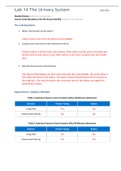
Lab 14 The Urinary System BIO202L
Student Name: Click here to enter text.
Access Code (located on the lid of your lab kit): Click here to enter text.
Pre-Lab Questions
1. What is the function of the ureter?
Ureter carries urine from the kidneys to the bladder.
2. Compare and contrast the male and female urethra.
Female urethra is shorter than male urethra. Male urethra carries urine and semen but
female urethra only carries urine. Male urethra is also more complex than the female
ones.
3. Describe the two layers of the kidneys.
Two layers of the kidneys are the renal cortex and the renal medulla. The renal cortex is
the outermost layer of the kidney. This space contains blood vessels which connect to
the nephrons. The renal medulla is the innermost layer of the kidney, arranged into
pyramid-like shapes.
Experiment 1: Kidney Filtration
Table 1: Solutions Present in Each Container Before 60 Minutes Submersion
Solution Dialysis Tubing Beaker
Congo Red Yes No
Yellow Food Coloring Yes No
Table 2: Solutions Present in Each Container After 60 Minutes Submersion
Solution Dialysis Tubing Beaker
Congo Red Yes No
Yellow Food Coloring Yes Yes
, Lab 14 The Urinary System BIO202L
Post-Lab Questions
1. What specific part of the kidney does the dialysis tubing represent? What is this part’s
function?
Ureter and its function is to transport urine from the kidneys to the urinary bladder.
2. What does the yellow food coloring represent at the end of the experiment? What does the
Congo Red represent?
Yellow food coloring represents urine. Congo red represents blood.
3. Why is it important that the kidney filters the blood?
To remove waste and maintain the body’s fluid balance.
Experiment 2: Urinalysis
Table 3: Urine Test
Test Normal Abnormal
Acidic Urine (below 4.5) - Diabetes, starvation, dehydration,
respiratory acidosis.
pH 4.5 - 7.5
Alkaline Urine (above 7.5) - Kidney disease, kidney failure, urinary
tract infection, respiratory alkalosis.
Glucose None Glucose present (red or green color after test); diabetes mellitus.
Protein None Protein present (violet color after test); kidney disease.
Yeast present (bubbles form after test); yeast infection in urinary
Yeast None
tract.
Large amount of ketones present (sweet smell of urine); starvation,
Little or
Ketones prolonged vomiting, diabetes, hyperthyroidism, and other metabolic
None
disorders.
Table 4: Simulated Urine pH Test
Simulated Urine Sample pH
A 6.0
B 6.5
C 7.0
Student Name: Click here to enter text.
Access Code (located on the lid of your lab kit): Click here to enter text.
Pre-Lab Questions
1. What is the function of the ureter?
Ureter carries urine from the kidneys to the bladder.
2. Compare and contrast the male and female urethra.
Female urethra is shorter than male urethra. Male urethra carries urine and semen but
female urethra only carries urine. Male urethra is also more complex than the female
ones.
3. Describe the two layers of the kidneys.
Two layers of the kidneys are the renal cortex and the renal medulla. The renal cortex is
the outermost layer of the kidney. This space contains blood vessels which connect to
the nephrons. The renal medulla is the innermost layer of the kidney, arranged into
pyramid-like shapes.
Experiment 1: Kidney Filtration
Table 1: Solutions Present in Each Container Before 60 Minutes Submersion
Solution Dialysis Tubing Beaker
Congo Red Yes No
Yellow Food Coloring Yes No
Table 2: Solutions Present in Each Container After 60 Minutes Submersion
Solution Dialysis Tubing Beaker
Congo Red Yes No
Yellow Food Coloring Yes Yes
, Lab 14 The Urinary System BIO202L
Post-Lab Questions
1. What specific part of the kidney does the dialysis tubing represent? What is this part’s
function?
Ureter and its function is to transport urine from the kidneys to the urinary bladder.
2. What does the yellow food coloring represent at the end of the experiment? What does the
Congo Red represent?
Yellow food coloring represents urine. Congo red represents blood.
3. Why is it important that the kidney filters the blood?
To remove waste and maintain the body’s fluid balance.
Experiment 2: Urinalysis
Table 3: Urine Test
Test Normal Abnormal
Acidic Urine (below 4.5) - Diabetes, starvation, dehydration,
respiratory acidosis.
pH 4.5 - 7.5
Alkaline Urine (above 7.5) - Kidney disease, kidney failure, urinary
tract infection, respiratory alkalosis.
Glucose None Glucose present (red or green color after test); diabetes mellitus.
Protein None Protein present (violet color after test); kidney disease.
Yeast present (bubbles form after test); yeast infection in urinary
Yeast None
tract.
Large amount of ketones present (sweet smell of urine); starvation,
Little or
Ketones prolonged vomiting, diabetes, hyperthyroidism, and other metabolic
None
disorders.
Table 4: Simulated Urine pH Test
Simulated Urine Sample pH
A 6.0
B 6.5
C 7.0