OB Postpartum NCLEX Questions all answered correctly.
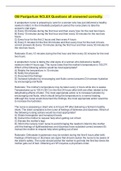
A postpartum nurse is preparing to care for a woman who has just delivered a healthy newborn infant. In the immediate postpartum period the nurse plans to take the woman's vital signs: A) Every 30 minutes during the first hour and then every hour for the next two hours. B) Every 15 minutes during the first hour and then every 30 minutes for the next two hours. C) Every hour for the first 2 hours and then every 4 hours D) Every 5 minutes for the first 30 minutes and then every hour for the next 4 hours. correct answers B) Every 15 minutes during the first hour and then every 30 minutes for the next two hours. Rationale: Every 15 minutes during the first hour and then every 30 minutes for the next two hours. A postpartum nurse is taking the vital signs of a woman who delivered a healthy newborn infant 4 hours ago. The nurse notes that the mother's temperature is 100.2*F. Which of the following actions would be most appropriate? A) Retake the temperature in 15 minutes B) Notify the physician C) Document the findings D) Increase hydration by encouraging oral fluids correct answers D) Increase hydration by encouraging oral fluids Rationale: The mother's temperature may be taken every 4 hours while she is awake. Temperatures up to 100.4 (38 C) in the first 24 hours after birth are often related to the dehydrating effects of labor. The most appropriate action is to increase hydration by encouraging oral fluids, which should bring the temperature to a normal reading. Although the nurse would document the findings, the most appropriate action would be to increase the hydration. The nurse is assessing a client who is 6 hours PP after delivering a full-term healthy infant. The client complains to the nurse of feelings of faintness and dizziness. Which of the following nursing actions would be most appropriate? A) Obtain hemoglobin and hematocrit levels B) Instruct the mother to request help when getting out of bed C) Elevate the mother's legs D) Inform the nursery room nurse to avoid bringing the newborn infant to the mother until the feelings of lightheadedness and dizziness have subsided correct answers B) Instruct the mother to request help when getting out of bed Rationale: Orthostatic hypotension may be evident during the first 8 hours after birth. Feelings of faintness or dizziness are signs that should caution the nurse to be aware of the client's safety. The nurse should advise the mother to get help the first few times the mother gets out of bed. Obtaining an H/H requires a physicians order.
Written for
- Institution
- OB Postpartum NCLEX
- Course
- OB Postpartum NCLEX
Document information
- Uploaded on
- December 13, 2022
- Number of pages
- 16
- Written in
- 2022/2023
- Type
- Exam (elaborations)
- Contains
- Questions & answers
Subjects
-
a postpartum nurse is preparing to care for a woman who has just delivered a healthy newborn infant in the immediate postpartum period the nurse plans to take the womans vital signs

Also available in package deal