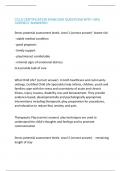
SUMMARY ATLS EXAMINATION ATLS Chapters 1-3 ( LATEST)2023
SUMMARY ATLS EXAMINATION ATLS Chapters 1-3 Question Patients with a GSC of less than usually require intubation. 8 Answer The "A" in ABCD stands for . You should assume that any patient in a multisystem trauma with an altered level of consciousness or blunt injury above the clavicle has what type of injury? Flail chest is invariably accompanied by which can interfere with blood oxygenation. Hypotension is caused by until proven otherwise. When you don't have/can't get a blood pressure, what are three things to look for when evaluating perfusion. Elderly patients have a limited ability to to compensate for blood loss. Resuscitation fluids should be warmed 39 degrees Celsius (102.2 F). Can you use a microwave to do this? Urinary catheters are good for assessing renal perfusion and volume status. List 5 signs of urethral injury that might prevent you from inserting one. Which arm should you NOT put a pulse-ox on? Name two anatomical things that can interfere with doing a FAST scan. When should radiographs be obtained? How do you get an ample patient history? Why might you want a Bair Hugger for a patient who smells of alcohol? What things are you looking for when you do a DRE in a trauma? What should you do for every female patient? Adult patients should maintain UOP of at least Airway maintenance with CERVICAL SPINE PROTECTION Cervical spine injury pulmonary contusion - do NOT over fluid resuscitate these patients! hypovolemia 1. Level of consciousness (brain perfusion), 2. Skin color (ashen face/grey extremities) 3. Pulse (bilateral femoral - thready/tachy) increase heart rate YES - for CRYSTALLOID ONLY (but NOT for blood products). Blood at urethral meatus, perineal ecchymosis, blood in scrotum, highriding/ non-palpable prostate, pelvic fracture The arm with a blood pressure cuff on it Obesity & intraluminal bowel gas During the SECONDARY survey. A=Allergies, M=Medications, P=PMH/Pregnancy, L=Last meal, E=Events/Environment of injury Vasodilation can lead to hypothermia Blood, high-riding prostate (in males), and sphincter tone Pregnancy test (females of childbearing age) Adults 0.5 mL/kg/hr, Kids 1.0 ml/kg/hr Downloaded by: CHRISJAY | Distribution of this document is illegal Want to earn $103 per month? mL/kg/hr. Kids should have at least mL/kg/hr. Preventing hypercarbia is critical in patients who have sustained a injury. head What two places would you LOOK at a patient if Lips and fingernail beds you suspect hypoxemia? Patients may be abusive and belligerent because of , so don't just assume it's due to drugs, alcohol, or the fact that they are just inherently a jerk. hypoxia Yes, if the phrenic nerves (C3-C5) are Can a patient breathe on their own after complete spared. This will result in "abdominal" cervical cord transection? Can you use an OPA (Guedel) in a conscious patient? Bougies are typically inserted blindly, how do you know you are in the trachea and not the esophagus? breathing. The intercostal muscles will be paralyzed though. No, it could make them vomit. An NPA (trumpet) would be okay. You can feel the "clicks" as the distal tip rubs against the cartilaginous tracheal rings, or it will deviate right or left when entering either bronchus (usually at 50 cm). What do you NOT want to hear if you ascultate a Borborygmi - rumbling or gurgling noises patient after placement of an ET tube? What is the RSI dose for etomidate? What is the RSI dose for sux? How does etomidate affect blood pressure? A RSI dose of sux usually lasts about minutes. What hypnotic/sedative/induction agent do you NOT want to use for a severely burned patient? Oxygen should flow at 15L for needle cricothyroidotomy, and have a Y-connector for insufflation if possible. What size needle do you use for adults? Kids? Cricoid cartilage is the only circumferential support for the upper trachea in kids, therefore surgical cricothyroidotomy is not recommended in kids under the age of . In a "normal" patient without significant chest wall injury or lung disease, needle cricothyroidotomy can provide adequate oxygenation for approximately minutes. For a patient with difficulty breathing, what things might you try before you provide a suggesting esophageal insertion. 0.3 mg/kg (usually 20 mg) 1-2 mg/kg (usually 100 mg) It doesn't - at least it SHOULDN'T have any significant effect on BP. Ketamine will increase BP, and propofol and thiopental will both drop BP. 5 SUX - patients with severe burns, crush injuries, hyperkalemia, or chronic paralytic/neuromuscular diseases should NOT get sux because of hyperkalemia risk. Adults 12-14 gauge, kids 16-18 gauge 12 30-45 Chin-lift, jaw-thrust (NOT head-tilt while maintaining c-spine precautions), OPA Downloaded by: CHRISJAY | Distribution of this document is illegal Want to earn $103
Geschreven voor
- Instelling
- Physician, taking ATLS
- Vak
- Physician, taking ATLS
Documentinformatie
- Geüpload op
- 3 januari 2023
- Aantal pagina's
- 15
- Geschreven in
- 2022/2023
- Type
- Tentamen (uitwerkingen)
- Bevat
- Vragen en antwoorden
Onderwerpen
-
summary atls examination atls chapters 1 3 latest approved by summary atls examination atls chapters 1 3 question patients with a gsc of less than usually require intubation 8 answer the a