WGU C985 - Topic 2 Questions and Answers Solved 100%
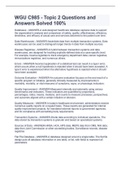
Databases - ANSWER-A well-designed healthcare database captures data to support the organization's analysis and comparison of safety, quality, effectiveness, efficiency, timeliness, and efficacy of actual care and services delivered to the patient over time. Data Warehouses - ANSWER-Assimilate data from multiple transaction systems. Data warehouses can be used to distinguish larger trends in data from multiple sources. Disease Registries - ANSWER-A hybrid between transaction systems and data warehouses, are designed for tracking explicitly-defined data at a case-specific level. For example, trauma registries to track emergency department data; cancer registries, immunizations registries, and numerous others. Errors - ANSWER-Incorrect application of a statistical test can result in a type I error, which occurs when a null hypothesis is rejected when it should have been accepted. A type II error is experienced when the alternative hypothesis is rejected when it should have been accepted. Outcome Evaluation - ANSWER-An outcome evaluation focuses on the end result of a specific program or initiative, generally clinically measured by improvements in morbidity, mortality, or vital measures of symptoms, signs, or physiologic indicators. Quality Improvement - ANSWER-Measured internally and externally using various benchmarks and indicators. These indicators are quantified by proportions, percentages, ratios, means, medians, and counts to measure processes, perspectives, and outcomes aligned with a certain initiative or decision. Quality Measures - ANSWER-In today's healthcare environment, administrators receive numerous quality reports on a regular basis. These reports are generated for internal quality improvement projects, for mandated external reports to government agencies, and for compliance with accrediting body requirements. Transaction Systems - ANSWER-Divide data according to individual operations. The data stored by transaction systems is granular and based on specialized systems. Sources of Data - ANSWER-HRSA, HCA, HPS data, MEPS data from CMS, NIH data, data from Joint Commission or other accrediting bodies, Surveillance records, disease registries Flat File Database - ANSWER-A database designed around a single table. The flat file design puts all database information in one table, or list, with fields to represent all parameters.
Written for
- Institution
- WGU C985 - Topic 2
- Course
- WGU C985 - Topic 2
Document information
- Uploaded on
- January 19, 2023
- Number of pages
- 2
- Written in
- 2022/2023
- Type
- Exam (elaborations)
- Contains
- Questions & answers
Subjects
- wgu c985 topic 2
- wgu c985
- databases
- data warehouses
- disease registries
-
wgu c985 topic 2 questions and answers
-
wgu c985 topic 2 questions and answers solved 100

Also available in package deal