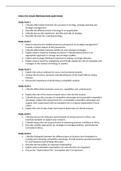
Chapter 7 HBO questions and answers.Graded A+
Chapter 7 HBO questions and answers.Graded A+ Ability refers to the knowledge, skills, and receptiveness to learning that a person brings to a task or job. Role Perceptions refer to how well an individual understands their organizational role. performance environment refers to those factors that impact employees' performance but are essentially out of their control. Motivation is a force within or outside of the body that energizes, directs and sustains human behavior. Movere, "to move" The word stems from its Latin root ________ which means "__________" 1. fulfill unmet needs 2. resolve conflicting thoughts that provide anxiety (an unpleasant experience) Motivation arises as a consequence of a person's desire to: Work Motivation is the amount of effort a person exerts to achieve a certain level of job performance Direction is what a person wants to achieve, what they intend to do. It implies a target that motivated people try to "hit." Intensity is how hard people try to achieve their targets. Is what we think of as effort. Content Motivation theories Focus on the content of what motivates people. Other theorists focus on the process by which people are motivated Process Motivation Theories Address how people become motivated- that is, how people perceive and think about a situation. Content and Process Theories _______ and _______ theories endeavor to predict motivation in a variety of situations. Need A human condition that becomes energized when people feel deficient in some respect. Hedonism one of the first motivation theories, assumes that people are motivated to satisfy mainly their own needs. Clarifies the idea that needs provide direction for motivation. Manifest Need Is whatever need is motivating us at a given time. Dominate our other needs. Instinct Are our natural, fundamental needs, basic to our survival. Henry A. Murray recognized this problem and condensed the list into few instinctive and learned needs. Instincts which Murray called primary needs, include physiological needs for food, water sex (procreation Learned Needs which Murry called secondary needs, are learned throughout one's life and are basically psychological in nature. Manifest needs theory assumes that human behavior is driven by the desire to satisfy needs. Latent Need cannot be inferred from a person's behavior at a given time, yet the person may still posses that need. McClelland studied three needs in depth: need for achievement, need for affiliation, need for power Need for Achievement how much people are motivated to excel at the tasks they are performing, especially tasks that are difficult. 1. They feel personally responsible for completing the tasks they are assigned 2. They like situations where the probability of satisfaction is moderate. 3. They have very strong desires for feedback about how well they are doing. Three major Characteristics of High-nAch People Need for Affiliation reflects a desire to establish and maintain warm and friendly relationships with other people. Need for Power is the need to control things, especially other people. It reflects a motivation to influence and be responsible for other people. *Personal Power Seeker *Social Power Seeker Two faces of Power Personal Power Seeker endeavors to control others mostly for the sake of dominating them. They want others to respond to their wishes whether or not it is good for the organization. Social Power Seeker satisfies needs for power by influencing others, like the personal power seeker. They differ in that they feel best when they have influenced a work group to achieve the group's goals, and not some personal agenda. 1. Physiological and Survival Need 2. Safety and Security Needs 3. Social Needs 4. Ego and Esteem 5. Self-actualization Maslow's Hierarchy of Needs Alderfer During the process of refining and extending Maslow's theory, he provided another need-based theory and a somewhat more useful perspective on motivation. Alderfer's ERG Theory compresses Maslow's hierarchy of need categories from 5 into three: Existence, Relatedness, Growth Growth Needs include self-esteem and self-actualization Relatedness Needs include all of Maslow's social needs, plus social safety and social esteem needs. Existence Needs include physiological and material safety needs. 1. Satisfaction Progression 2. Frustration 3. Frustration Regression 4. Aspiration Four Components to Understand Alderfer's EGR Theory Satisfaction progression Is in basic agreement with Maslow's process of moving through the needs. Frustration Occurs when we attempt but fail to satisfy a particular need. Frustration Regression Can cause us to shift our attention to a previously satisfied, more concrete, and verifiable need. Aspiration notes that, by its very nature, growth is intrinsically satisfying. The more we grow the more we want to grow. Herzberg Argued that there are two sets of needs, instead of five sets theorized by Maslow. Motivators which relate to the jobs we perform and our ability to feel a sense of achievement as a result of performing them, are rooted in our need to experience growth and self-actualization. Hygienes relate to the work environment and are based in the basic human need to "avoid pain" Self-determination Theory seeks to explain not only what causes motivation, but also how extrinsic rewards affect intrinsic motivation. Extrinsic Motivation refers to the performance of an activity in order to attain some valued outcome Intrinsic Motivation refers to performing an activity for the inherent satisfaction of the activity itself. Process Theories of Motivation try to explain why behaviors are initiated. These theories focus on the mechanism by which we choose a target, and the effort that we exert to "hit" the target. 1. Operant Conditioning Theory 2. Equity Theory 3. Goal Theory 4. Expectancy Theory Four Major Process Theories
Written for
- Institution
- Hbo
- Course
- Hbo
Document information
- Uploaded on
- February 21, 2023
- Number of pages
- 6
- Written in
- 2022/2023
- Type
- Exam (elaborations)
- Contains
- Questions & answers
Subjects
- skills
-
chapter 7 hbo questions and answersgraded a
-
ability refers to the knowledge
-
and receptiveness to learning that a person brings to a task or job
-
1 fulfill unmet needs 2 resolve conflictin

Also available in package deal