EOR exam Women's health 100% Correct
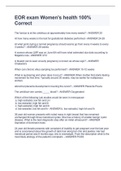
A. Threatened abortion B. Inevitable abortion C. Incomplete abortion D. Complete abortion - ANSWER (u) A. Threatened abortion is characterized by bleeding in the first trimester without loss of fluid or tissue. CORRECT: B. Inevitable abortion is the gross rupture of membranes in the presence of cervical dilation. (u) C. Incomplete abortion is when the cervical os is open and allows passage of blood. The products of conception may remain in utero or may partially extrude through the open os. (u) D. Complete abortion refers to a documented pregnancy that spontaneously passes all of the products of conception. Which of the following is recommended to reduce the risk for perinatal transmission of HIV in a patient with a viral load of 1000 copies/mL? A. Vaginal delivery with female condom B. Episiotomy to shorten second stage of labor C. Use of forceps or vacuum extractor to shorten second stage of labor D. Cesarean section prior to onset of labor and rupture of membranes - ANSWER D. Cesarean section performed prior to the onset of labor and rupture of membranes significantly reduces the risk of perinatal HIV transmission. Planned cesarean section delivery at 38 weeks of gestation to prevent perinatal transmission of HIV is recommended in women with a viral load of 1000 copies/mL. On physical examination of a pregnant patient, which can be considered a normal finding? A. Increased second heart sound split with inspiration B. Diastolic murmur C. Facial edema D. Hyperreflexia - ANSWER CORRECT: A. Increased second heart sound split with inspiration is common in pregnancy due to the increased blood flow across the aortic and pulmonic valves. (u) B. Diastolic murmurs in pregnancy should be considered pathological and evaluated further. (u) C. Facial edema in uncommon in pregnancy and if it occurs, the medical provider should consider preeclampsia. (u) D. Hyperreflexia occurs with preeclampsia and does not occur in a normal pregnancy. When is the recommendation for the next Pap smear in a 36 year-old patient with a history of 3 consecutive negative annual Pap smears and no history of cervical dysplasia? A. Yearly Pap smears B. Pap smear in 4 years C. Pap smear in 3 years D. Patient does not need any further Pap smears - ANSWER C. Women who have had 3 consecutive negative annual Pap smears results may be screened every 2 or 3 years if they are 30 or older with no history of CIN 2 or 3, immunosuppression, HIV infection, or diethystilbestrol (DES) exposure in utero. A 48 year-old G3P3003 female presents to the office complaining of severe secondary dysmenorrhea and menorrhagia over the last 6 months. On physical examination her uterus feels enlarged and irregular. Which of the following is the most likely diagnosis? A. Endometritis B. Endometriosis C. Uterine leiomyomata D. Endometrial hyperplasia - ANSWER (u) A. Endometritis is an infection of the endometrium. It occurs most commonly postpartum. (u) B. Endometriosis most commonly presents with dysmenorrhea, dyschezia, and dyspareunia. Usually the uterus is not enlarged. CORRECT: C. Uterine leiomyomata (fibroid) typically presents with severe dysmenorrhea and menorrhagia. An enlarged, irregular uterus is noted on examination. (u) D. Endometrial hyperplasia can cause menorrhagia but is not usually a cause of dysmenorrhea. Your patient has just delivered her baby vaginally without difficulty. The patient has a laceration of the vaginal mucosa including the perineal body. You repair it without difficulty. On the chart you document this as what type of tear? A. First degree B. Second degree C. Third degree D. Fourth degree - ANSWER (u) A. A first degree tear involves the vaginal mucosa or perineal skin, but does not involve the underlying tissue. CORRECT: B. A second degree tear involves the underlying subcutaneous tissues, but not the rectal sphincter or rectal mucosa. (u) C. A third degree tear extends through the rectal sphincter, but not into the rectal mucosa. (u) D. A fourth degree tear extends into the rectal mucosa. What phase of the female menstrual cycle occurs at the time of elevated estrogen and LH/FSH surge? A. Follicular phase B. Proliferative phase C. Ovulation D. Secretory phase - ANSWER (u) A. The follicular phase begins with the onset of menses (day 1 of the menstrual cycle) and ends on the day of the LH surge. (u) B. Progesterone causes differentiation of the endometrial components and converts proliferative endometrium into a secretory endometrium. CORRECT: C. Ovulation occurs within 30-36 hours of the LH surge and at the time of elevated estrogen. (u) D. Secretory phase occurs when estrogen is elevated Colposcopic examination of the cervix of a 38 year-old woman with a high-grade lesion on Papanicolaou (Pap) smear yields a positive endocervical canal curettage (ECC) as its only abnormality. Which of the following is the most appropriate next step in this patient? A. Repeat the Pap smear in 3 months B. Perform a conization of the cervix C. Repeat the colposcopic examination in 3 months D. No follow-up is required - ANSWER B. A conization of the cervix is recommended in this case because there is a substantial discrepancy between the screening Pap test and the histologic data from biopsy and ECC. Additionally the ECC is positive for disease in this case. Which of the following physical examination findings is present in a 12 week singleton pregnancy? A. Chadwick's sign B. Uterus palpable at the level of the umbilicus C. Blood pressure lower than non-pregnant state D. Hyperreflexia - ANSWER CORRECT: A. Chadwick's sign is a bluish discoloration of the vagina early in pregnancy; it usually appears by 12 weeks of gestation. (u) B. The uterus is palpable at the level of the umbilicus at 20 weeks in a singleton pregnancy. (u) C. Blood pressure lower than non-pregnant state occurs in the second trimester. (u) D. Hyperreflexia is an uncommon finding and may occur with preeclampsia You are following a patient in labor at term. You evaluate the fetal monitoring tracing and note the presence of variable, repetitive decelerations in the heart rates. The contractions have a sharp deceleration slope. What is the recommended treatment for these decelerations? A. Change maternal position B. Administer tocolytic therapy C. Apply vibroacustic stimulation D. Perform cesarean section - ANSWER A. Variable decelerations occur from umbilical cord compression and oligohydramnios. They are treated by changing maternal positioning to relieve pressure on the umbilical cord. Additionally, amnioinfusion may be used to relieve umbilical cord compression in cases of oligohydramnios. What is the recommended initial first trimester screening test for fetal aneuploidy? A. Amniocentesis B. Pregnancy-associated plasma protein A (PPA), beta-hCG, and ultrasound of nuchal transparency C. Maternal serum alpha feto protein, beta-hCG, estriol, and inhibin-A D. Level II ultrasound - ANSWER (u) A. Amniocentesis is a diagnostic test not a screening test. CORRECT: B. Pregnancy-associated plasma protein A (PPA), beta-hCG, and ultrasound of nuchal transparency are screening tests done at 10-13 weeks of gestation. (u) C. Maternal serum alpha feto protein, beta hCG, estriol, and inhibin-A, are included in the quad screen which is a screening test done in the second trimester from 15-20 weeks of gestation. (u) D. Level II ultrasound is done in the second trimester. In which of the following conditions would human chorionic gonadotropin (hCG) level be lower than expected for gestational age? A. Choriocarcinoma B. Hydatidiform mole C. Ectopic pregnancy D. Twin gestation - ANSWER (u) A. Choriocarcinoma is a persistent form of gestational trophoblastic neoplasia and will have an elevated hCG level. (u) B. Quantitative hCG levels are excessively elevated for the gestational age of the pregnancy. CORRECT: C. An ectopic pregnancy will have an abnormally low hCG level because the hCG will not double every 48 hours as a normal pregnancy would. (u) D. A twin gestation will have a higher hCG level because of the presence of two fetuses. A 47 year-old perimenopausal female with vasomotor symptoms complains of vulvar itching and copious vaginal discharge with a rancid odor. Physical examination reveals erythema of the vulva and petechiae on the cervix. The pH of the vaginal discharge is five. Which of the following is the recommended treatment for this patient? A. Topical metronidazole (Metrogel) B. Oral fluconazole (Diflucan) C. Topical estradiol (Estrace) cream D. Oral metronidazole (Flagyl) - ANSWER D. This is a classic description of trichomonas vulvovaginitis. This condition must be treated with oral metronidazole or tinidazole. A 28 year-old female presents with lower abdominal pain and vaginal discharge. On examination the patient is toxic appearing and her temperature is 39°C. Pelvic examination reveals cervical motion tenderness. What is the next best step in the evaluation of this patient? A. Abdominal x-ray B. Endocervical culture C. Laparoscopy D. Hysterosalpingogram - ANSWER (u) A. Abdominal x-rays are not helpful in the diagnosis of pelvic inflammatory disease. CORRECT: B. Endocervical culture would be helpful in the diagnosis of pelvic infection. (u) C. Laparoscopy is invasive and would not be the next best step in evaluation of this patient. (u) D. Hysterosalpingogram is indicated in the evaluation of abnormal uterine bleeding and infertility A 16 year-old female G1P0Ab0 is 30 weeks pregnant. Her last two monthly prenatal exams have shown a trace to 1 plus proteinuria. The patient denies any previous history of hypertension, seizures, headache, visual disturbances or spotting. On examination, blood pressure is 150/98. The fundal height is 32 cm, the uterus is soft and nontender and fetal heart tones are 160 bpm. DTRs are 4 plus out of 4 plus in the upper and lower extremities, and there is moderate pedal edema bilaterally. The skin examination is unremarkable. Based upon these findings what is the most likely diagnosis? A. Eclampsia B. Pre-eclampsia C. Gestational hypertension D. HELLP Syndrome - ANSWER (u) A. Eclampsia is the occurrence of seizures in a pre-eclamptic patient. CORRECT: B. Pre-eclampsia is the hypertension associated with proteinuria. This occurs in greater frequency in nulliparous, adolescent and black women. (u) C. Gestational hypertension is hypertension that continues after pre-eclampsia for 12 weeks post-partum then returns to normal. If hypertension continues after 12 weeks then the patient is said to have chronic hypertension and is often predictive of later development of essential hypertension. (u) D. HELLP syndrome is a subcategory of pre-eclampsia in which the patient develops hemolytic anemia, elevated liver enzymes and low platelets. A 34 year-old female G2P1Ab0 at 36 weeks gestation presents to the clinic with a complaint of a sudden gush of fluid from the vagina 18 hours ago. The patient denies any blood in the discharge but describes the fluid as watery. Examination reveals that there is a collection of fluid in the posterior fornix, the Nitrazine test is blue as well as the fluid giving a fern-like crystallization pattern on a slide. Given these findings what is the appropriate clinical intervention? A. Observation B. Induce labor C. Antibiotics D. Corticosteroids - ANSWER (u) A. With premature rupture of the membranes, the patient is at risk for the development of amnionitis. CORRECT: B. Since the patient is 36 weeks gestation and it has been greater than 12 hours since the leakage of fluid, labor should be induced to minimize infection. (u) C. If the patient was less than 33 weeks pregnant and amnionitis had been ruled out, then antibiotics along with corticosteroids would be advisable. Favorable outcomes utilizing both of these drugs have been demonstrated. In the treatment of endometriosis, which of the following medications has a side effect profile that includes loss of bone mineral density, vasomotor symptoms, vaginal dryness and mood changes? A. Oral contraceptives B. Dantrolene (Danazol) C. Leuprolide (Lupron) D. Progestational agents - ANSWER (u) A. Oral contraceptives, dantrolene, and progestational agents do not have this side effect profile. (u) B. See A for explanation. CORRECT: C. Leuprolide is a gonadotropin releasing hormone analogue that results in suppression of gonadotropic secretion. This suppression leads to a hypoestrogenic state which contributes to these side effects. A 28 year-old woman is complaining of heavy uterine bleeding and pelvic pressure that has progressively worsened over the past year. Evaluation reveals multiple moderate-sized uterine fibroids. The
Written for
- Institution
- Women\\\'s Health EOR
- Course
- Women\\\'s Health EOR
Document information
- Uploaded on
- March 20, 2023
- Number of pages
- 41
- Written in
- 2022/2023
- Type
- Exam (elaborations)
- Contains
- Questions & answers

Document also available in package deal