AP Biology: DNA Question and answer already solved 2023
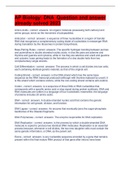
AP Biology: DNA Question and answer already solved 2023Amino Acids An organic molecule possessing both carboxyl and amino groups; serve as the monomers of polypeptides. Anticodon a sequence of three nucleotides in a region of transfer RNA that recognizes a complementary coding triplet of nucleotides in messenger RNA during translation by the ribosomes in protein biosynthesis. Base-Pairing Rules The specific hydrogen bonding between purines and pyrimidines in double stranded nucleic acids. in dna the pairs are adenine and thymine and guanine and cytosine, while in rna they are adenine and uracil and guanine and cytosine. base pairing leads to the formation of a dna double helix from two complementary single strands. Cell Differentiation The process in which a cell divides into two cells, each containing identical genetic material, as that of the original cell. Coding Strand is the DNA strand which has the same base sequence as the RNA transcript produced (although with thymine replaced by uracil). It is this strand which contains codons, while the non-coding strand contains anti-codons. Codon is a sequence of three DNA or RNA nucleotides that corresponds with a specific amino acid or stop signal during protein synthesis. DNA and RNA molecules are written in a language of four nucleotides; meanwhile, the language of proteins includes 20 amino acids. DNA A double-stranded nucleic acid that contains the genetic information for cell growth, division, and function. DNA Ligase An enzyme that eventually joins the sugar-phosphate backbones of the Okazaki fragments DNA Polymerase The enzyme responsible for DNA replication. DNA Replication is the process by which a double-stranded DNA molecule is copied to produce two identical DNA molecules. Replication is an essential process because, whenever a cell divides, the two new daughter cells must contain the same genetic information, or DNA, as the parent cell. Exons is any nucleotide sequence encoded by a gene that remains present within the final mature RNA product of that gene after introns have been removed by RNA splicing. The term exon refers to both the DNA sequence within a gene and to the corresponding sequence in RNA transcripts. Genetic Code is a set of rules defining how the four-letter code of DNA is translated into the 20-letter code of amino acids, which are the building blocks of proteins. Helicase A class of enzymes vital to all living organisms. Their main function is to unpackage an organism's genes. Hydrogen Bonding a weak type of chemical bond formed when the slightly positive hydrogen atom of a polar covalent bond is attracted to the slightly negative atom of a polar covalent bond in another molecule; a common bond in organisms that has an attractive force between a hydrogen atom and another molecule. Inducible Genes is a gene whose expression is either responsive to environmental change or dependent on the position in the cell cycle.
Written for
- Institution
- AP Biology
- Course
- AP Biology
Document information
- Uploaded on
- April 27, 2023
- Number of pages
- 4
- Written in
- 2022/2023
- Type
- Exam (elaborations)
- Contains
- Questions & answers
Subjects
-
ap biology dna question and answer already solved 2023
-
amino acids an organic molecule possessing both carboxyl and amino groups serve as the monomers of polypeptides
-
anticodon a sequence of three

Also available in package deal