FINRA Questions and Answers 100% correct 2023
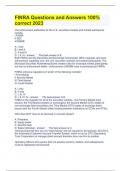
FINRA Questions and Answers 100% correct 2023 The enforcement authorities for the U.S. securities markets and market participants include: I FINRA II SEC III MSRB A. I only B. I and II C. II and III D. I, II, III The best answer is B. Both FINRA and the Securities and Exchange Commission (SEC) regulate, and have enforcement capability over, the U.S. securities markets and market participants. The Municipal Securities Rulemaking Board creates rules for municipal market participants, but has no enforcement ability - enforcement of MSRB rules is performed by FINRA. FINRA enforces regulations in which of the following markets? I First Market II Second Market III Third Market IV Fourth Market A. I only B. II only C. I, III, IV D. I, II, III, IV The best answer is D. FINRA is the regulator for all of the securities markets - the Primary Market (new issues); the First Market (trades on exchanges); the Second Market (OTC trades of non-exchange listed securities); the Third Market (OTC trades of exchange listed issues) and the Fourth Market (direct trading between institutions on ECNs and ATSs). Who does NOT have to be licensed in a broker-dealer? A. President B. Equity trader C. ACATS clerk D. Sales individual The best answer is C. Clerical personnel who are not "client facing" are not required to be licensed. ACATS is the Automated Customer Account Transfer System, which is run by DTC (Depository Trust Corporation) to manage client account transfers from one firm to another. Operating officers and owners (but not passive owners), traders, and salespersons must be registered and licensed. Registered representatives may be compensated based on all of the following EXCEPT: A. salary paid by the brokerage firm to the representative B. asset based fees paid by the customer to the brokerage firm C. trading commissions paid by the customer to the brokerage firm D. trading commissions paid by the customer to the representative The best answer is D. Compensation cannot be paid by the customer to the registered representative. Only the broker-dealer may pay compensation to the registered representative. To take a second job, under FINRA rules, prior written approval must be obtained from: I Branch Manager II FINRA III Securities and Exchange Commission A. I only B. I and II C. II and III D. I, II, III The best answer is A. For a registered representative to take a second job requires approval of the branch manager under FINRA rules. The manager is acting for the member firm when doing so. There is no requirement to get approval from FINRA or the SEC. A registered representative at a FINRA member firm has been elected to his cooperative apartment building's Board of Directors. Which statement is TRUE? A. This event must be reported to FINRA B. This event must be reported to his or her employer C. This event must be reported to both FINRA and his or her employer D. No report is required to either FINRA or the employing member firm The best answer is B. Any "OBA" - Outside Business Activity - must be reported to the firm and must be approved by the firm. Furthermore, it must be reported on that registered representative's U4 Form and is disclosed in that individual's BrokerCheck report. Remember that an individual does not have to be paid for an OBA to exist. If the representative is in the position to steer investment activities of the outside business entity - that makes it an OBA. The fact that the registered representative, on the Board of Directors of the cooperative apartment house, would be in a position to steer the investment activities of the coop's operating and reserve funds - makes this an OBA. A customer has generated a lot of business this year, and the representative wants to give the customer an appropriate "thank you" gift. Knowing that FINRA has a $100 gratuity limit, the representative arranges to have a friend who works outside the securities industry buy the customer a $400 gift certificate. For this, the representative will reimburse the friend. Which statement is TRUE? A. This action is acceptable because the payment was not made by an associated person B. This action is acceptable only if FINRA approves in advance C. This action is acceptable only if the payment is made by the representative and not by the friend D. This action is a violation of FINRA rules The best answer is D. One cannot get around the gift limit rules by having a third party give the gift! A registered representative is provided with an all-expenses paid trip by a mutual fund sponsor to a resort in Hawaii. FINRA defines this as: A. a gift B. a gratuity C. non-cash compensation D. business entertainment The best answer is C. FINRA prohibits registered representatives from accepting a gift in the amount of more than $100. This does not prohibit business entertainment where the cost is greater than $100, but such "entertainment" requires that the registered representative and the client are together, say at a ball game or at dinner. If a registered representative accepts "non-cash compensation" - such as this all-expense paid trip - this is a violation of FINRA rules. Which are permitted under FINRA rules? I A registered representative accepts a $300 gift from a customer II A registered representative pays for a $300 meal with a customer III A registered representative gives a customer $200 tickets to a show IV A registered representative accompanies a customer to a show, for which the representative paid $200 for the tickets A. I and III B. I and IV C. II and III D. II and IV The best answer is D. Business entertainment does not fall under the $100 gift limit. Business entertainment is permitted as long as it is not too excessive or too frequent and it must comply with the firm's policies and procedures. Business entertainment means that the representative and the customer are together at some type of event. A client of a registered representative refers a new potential customer. This customer is interested in purchasing an oil and gas limited partnership unit. What percentage of the purchase amount can the representative share with the referring client as a finder's fee? A. 0% B. 5% C. 10% D. 15% The best answer is A. Registered representatives cannot share commissions, sales charges, or pay referral fees, to anyone other than another registered person at the same member firm. The Firm Element component of the "Continuing Education" requirement: I is administered by the compliance department II must be completed by all registered persons III must be completed annually IV must communicate information that is understood by the participants A. I only B. I and II only C. III and IV only D. I, II, III, IV The best answer is D. The Firm Element of the Continuing Education requirement obligates member firms to deliver annual training to all registered representatives on product, regulation, and compliance issues. The firm must maintain a record that shows that the participant understood the information presented. The Regulatory Element component of the "Continuing Education" requirement must be completed: I on the registrant's 2nd anniversary of registration II on the registrant's 3rd anniversary of registration III every 2 years after the initial review IV every 3 years after the initial review A. I and III B. I and IV C. II and III D. II and IV The best answer is B. The Regulatory Element of the Continuing Education requirement must be completed by registered persons on their 2nd anniversary of registration and every 3rd year thereafter. This involves completing a computerized "training experience" that covers relevant rules and regulations. The Regulatory Element component of the "Continuing Education" requirement must be completed: I on the registrant's 1st anniversary of registration II on the registrant's 2nd anniversary of registration III every 2 years after the initial review IV every 3 years after the initial review A. I and III B. I and IV C. II and III D. II and IV The best answer is D. The Regulatory Element of the Continuing Education requirement must be completed by registered persons on their 2nd anniversary of registration and every 3rd year thereafter. This involves completing a computerized "training experience" that covers relevant rules and regulations. Failure to complete the Regulatory Element within the stated time period will result in a registered representative's: A. termination B. censure C. expulsion D. suspension The best answer is D. If a registered representative fails to complete the Regulatory Element of the Continuing Education requirement within 120 days of the notification date, that person's registration is suspended and that person cannot continue to perform any of the functions of a registered representative. Registered representatives are required to attend a compliance meeting at their firm: A. Semi-annually B. Annually C. Every 2 years D. Every 3 years The best answer is B. Every member firm must hold an annual compliance meeting with each registered employee, covering compliance issues that have arisen over the past year, and the procedures and policies that have been put in place to address those issues. Which of the following statements are TRUE regarding a registered individual who recently left the employment of a FINRA member firm? I The individual is allowed to maintain his license at another member firm without being employed by that firm II The individual cannot maintain his license at another member firm without being employed by that firm III The license remains active for an indefinite time period if the individual does not affiliate with another member firm IV The license lapses if the individual remains unaffiliated for 2 years A. I and III B. I and IV C. II and III D. II and IV The best answer is D. FINRA prohibits "parking" of licenses when an individual is not affiliated with a member firm. If that person remains unaffiliated for 2 years, all licenses lapse. A registered representative is about to retire and has asked a younger representative in the same branch office if she wants to buy his book of business. The younger representative is very interested and the two RRs have negotiated a sale price and have agreed in a written contract that continuing commissions will be paid to the retiring representative for a period of 5 years following retirement, based on the clients named as of the date of retirement. Which statement is TRUE about such an arrangement? A. The retired representative is only permitted to be paid continuing commissions if the firm maintains the registration of that individual for the 5-year life of the agreement B. Such an arrangement is a permitted private contract as long as the contract is executed prior to the retirement date C. The written agreement must be filed with the FINRA District office at least 10 business days prior to its effective date D. Such an arrangement is prohibited because commissions cannot be paid to unregistered individuals The best answer is B. Even though FINRA does not permit commissions to be shared with unregistered individuals, it gives an exception to this under Rule 2040. The intent is to allow a retiring representative to get income in retirement by selling his or her book of business. The rule allows continuing commissions to be paid to a "RRR" (Retired Registered Representative) from accounts held for continuing customers, regardless of whether funds or securities are added during the period of retirement, provided that: a bona-fide contract is entered into between the member firm and the RRR prior to retirement providing for the payments; and the contract prohibits the RRR from soliciting new business, new accounts or servicing those accounts that generate the continuing commission payments. Also note that the contract can permit the payments to continue to a beneficiary designated in the contract upon the RRR's death (a nice thing for widow(er)s). There is no notice to FINRA or FINRA approval. Note, however, that the member firm must approve such an arrangement. A registered representative is the subject of a written complaint from a customer alleging that he stole $12,000 from her account. Which statement is TRUE? A. This must be reported to FINRA promptly B. No report to FINRA is required because this complaint is not verified C. No report to FINRA is required because the amount involved is under $15,000 D. The representative can settle the complaint by offering to pay the customer $12,000 The best answer is A. "Reportable events" to FINRA include the case where a registered representative is the subject of a customer complaint that alleges a felony - and stealing is a felony. A report must be made to FINRA promptly, but no later than 30 days after the event occurs. The report basically lays out the representative's side of the story - and FINRA uses this to decide whether to take follow-up action. Note that the fact that the allegation is not proven is meaningless here - the report is still required. The list of reportable events is long. If one is the subject of a written customer complaint involving theft or embezzlement; if one is arrested, arraigned, indicted, convicted, or pleads guilty to any criminal offense (except for minor traffic violations); or if one is sued under the Securities Acts; notification to FINRA is required. In addition, notification to FINRA is required if the registered representative is suspended or expelled by any other self-regulatory organization; is denied registration by another self-regulatory organization; or is the subject of a customer complaint that is settled for more than $15,000; or is the subject of disciplinary action by the member firm involving suspension, termination, or the withholding of commissions in excess of $2,500. When FINRA gets the report, they review it to see if they should do nothing, suspend the person's registration, or expel the registered representative.
Written for
- Institution
- FINRA
- Course
- FINRA
Document information
- Uploaded on
- July 16, 2023
- Number of pages
- 36
- Written in
- 2022/2023
- Type
- Exam (elaborations)
- Contains
- Questions & answers
Subjects
-
finra questions and answers 100 correct 2023
-
the enforcement authorities for the us securitie
-
finra enforces regulations in which of the followi
-
who does not have to be licensed in a broker deale
-
r

Also available in package deal