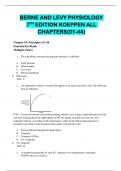
BERNE AND LEVY PHYSIOLOGY 7TH EDITION KOEPPEN ALL CHAPTERS(01-44)
BERNE AND LEVY PHYSIOLOGY 7 TH EDITION KOEPPEN ALL CHAPTERS(01-44) Chapter 01: Principles of Cell FunctionTest Bank Multiple Choice 1. The subcellular structure that degrades proteins is called the: A. Tight junction B. Mitochondria C. Lysosome D. Plasma membrane E. Ribosome ANS: C 2. An experiment is done to measure the uptake of an amino acid into a cell. The following data are obtained: If Na+ is removed from the extracellular bathing solution, or if a drug is added that prevents the cell from making adenosine triphosphate (ATP), the uptake of amino acid into the cell is markedly reduced. According to this information, which of the followingmechanisms is probably responsible for the transport ofthe amino acid into the cell? A. Passive diffusion through the lipid bilayer B. Uniporter C. Transport ATPase D. Na+ symporter E. Na+ antiporter ANS: D 3. A membrane permeable by only Na+ separates two compartments containing Na2SO4,shown as follows: U S N T Electrodes are placed in both compartments, and a voltage is applied (that of compartment A is held at 0 mV). What voltage applied to compartment B would resultin no net movement of Na+ across the membrane separating the compartments? A. –60 mV B. –30 mV C. 0 mV D. +30 mV E. +60 mV ANS: E 4. The resting membrane potentNial oRf aIcellGis –B85.CmV. The intracellular and extracellular concentrations ofseveral ions are indicated in the following table, as is the calculated Nernst equilibrium potential (Ei) for each of these ions: Ion Concentration Inside Cell Concentration Outside Cell Ei Na+ 12 mEq/L 145 mEq/L 66 mV K+ 150 mEq/L 4 mEq/L –96 mV Cl– 30 mEq/L 105 mEq/L –33 mV Ca++ 0.0001 mmol/dL 1 mmol/dL 122 mV The membrane has channels for Na+ , K+ , Cl– , and Ca++. The conductance of the membrane is the greatest for which ion? A. Na+ B. K + C. Cl– D. Ca++ ANS: B 5. A cell contains the following membrane transporters: Na+ channelK+ channel Na+ ,K+ -ATPase The resting membrane voltage of the cell is –80 mV, and the intracellular and extracellular ion concentrations are as follows: Ion Intracellular Concentration Extracellular Concentration Na+ 10 mEq/L 145 mEq/L K+ 120 mEq/L 4 mEq/L The cell is treated with a drug to inhibit the Na+ ,K+ -ATPase. What would be the effect ofthis drug on the following parameters? Intracellular [Na+ ] Intracellular [K+ ] Cell Volume Membrane Voltage A. Decrease Decrease Decrease Depolarize B. Increase Decrease Increase Depolarize C. Increase Increase Increase No change D. Decrease Increase Decrease Hyperpolarize E. Increase Increase Decrease Hyperpolarize ANS: B 6. Which ofthe labeled proteins (shaded) is attached to the membrane by a glycosylphosphatidylinositol (GPI) anchor? ANS: E 7. A cell has channels for Na+ , K+ , and Cl– in its plasma membrane. The resting membrane potential is –60 mV (cell interior negative). The intracellular and extracellular concentrations for these ions, as well as the calculated Nernst potentials, are listed as follows: Ion Intracellular Concentration Extracellular Concentration Ei Na+ 14 mEq/L 140 mEq/L 60 mV K+ 150 mEq/L 5 mEq/L –89 mV Cl– 10 mEq/L 100 mEq/L –60 mV A drug is applied to the cell that increases the permeability of the cell by Cl– (i.e., it opens Cl– channels). What effect will this drug have on the net movement of Cl– acrossthe plasma membrane? A. Net Cl– movement out ofthe cell will be increased. B. Net Cl– movement into the cell will be increased. C. There will be no change in the net movement of Cl– . ANS: C 8. Reducing the extracellular [K+ ] would be expected to have which of the following effects on the resting membrane potential and on the excitability of ventricular myocytes? Membrane Potential Excitability A. Unchanged Unchanged B. Hyperpolarized GDTecBre .aCseOd C. Hyperpolarized Increased D. Depolarized Decreased E. Depolarized Increased ANS: B 9. A cell is bathed in an isotonic NaCl solution that contains 5 mmol/L of glucose. The intracellular concentration of glucose is 10 mmol/L. What is the most likely mechanism for the transport of glucose across the plasma membrane into this cell? A. Glucose uniporter B. Na+ -glucose symporter C. Na+ -glucose antiporter D. Diffusion of glucose through the lipid bilayer of the membrane ANS: B 10. A blood sample is taken from an individual whose blood osmolality is 295 mOsm per kilogram of water. Red blood cells from this sample are then placed in the following solutions: 1-5 Solution Osmolality (mOsm/kg H2O) Reflection Coefficient ( of Solute 1. NaCl 300 1 2. Fructose 300 0.5 3. Urea 300 0 4. CaCl2 100 1 5. KCl 150 1 The red blood cells in which of these solutions will swell to the greatest degree? A. 1 B. 2 C. 3 D. 4 E. 5 ANS: C 11. A solution that causes a cell to shrink is: A. Isotonic B. Hypotonic C. Hypertonic ANS: C 12. Osmosis is: A. The active transport of water B. The number of solute particles in 1 kg of water C. The diffusion of water across cell membranes D. The defined as the weight of a volume of a solution divided by the weight of an equivalent volume of distilled water E. The amount of a substance relative to its molecular weight ANS: C Koeppen: Berne and Levy Physiology, 7th Edition Chapter 02: Homeostasis of Body FluidsTest Bank Multiple Choice 1. A 100 mmol/L solution of MgCl2 would be expected to have an osmolality of which ofthe following? A. 50 mOsm/kg H2O B. 100 mOsm/kg H2O C. 200 mOsm/kg H2O D. 300 mOsm/kg H2O E. 350 mOsm/kg H2O ANS: D 2. Three individuals, each weighing 55 kg and each having a plasma [Na+ ] of 145 mEq/L, receive infusions of different solutions. Individual A receives 1 L of isotonic NaCl (290 mOsm/kg H2O); individual BNrUecReiSvIesN1GLToBf .a mCOanMnitol solution (290 mOsm/kg H2O); and individual C receives 1 L of a 5% dextrose in water (D5W) solution (290 mOsm/kg H2O). Assuming that there is no urine output, and after complete equilibration of the extracellular and intracellular fluid, which of these individuals will have a lower plasma[Na+ ]? A. Individual A (NaCl infusion). B. Individual B (mannitol infusion). C. Individual C (D5W infusion). D. Individuals A, B, and C will have the same plasma [Na+ ]. ANS: B 3. Intravenous infusion of 2 L of which of the following solutions will lead to the largest increase in intracellular fluid volume? A. D5W B. Isotonic NaCl C. Hypotonic NaCl D. Hypertonic NaCl ANS: A 4. Intracellular fluid volume is normally what percentage of bodyweight? A. 60% B. 40% C. 20% D. 10% E. 5% ANS: B Koeppen: Berne & Levy Physiology, 7th Edition Chapter 03: Signal Transduction, Membrane Receptors, Second Messengers, andRegulation of Gene Expression Test Bank Multiple Choices 1. Molecules that are produced by cells and act locally on other cells are called: A. Steroid hormones. B. Receptors. C. Paracrine hormones. D. Phosphatases. E. Iodothyronines. ANS: C 2. A typical flow of information in a signal transduction pathway would be which of the following? A. Receptor G protein secoNnUdRmSes IsNenGgeTrB.CbiOolMogical response B. Hormone second messenger G protein–coupled receptor (GPCR) biological response C. Hormone second messenger GPCR D. Hormone receptor second messenger GPCR biological respons
Geschreven voor
- Instelling
- BERNE AND LEVY PHYSIOLOGY 7 TH EDITION KOEPPEN
- Vak
- BERNE AND LEVY PHYSIOLOGY 7 TH EDITION KOEPPEN
Documentinformatie
- Geüpload op
- 1 augustus 2023
- Aantal pagina's
- 139
- Geschreven in
- 2023/2024
- Type
- Tentamen (uitwerkingen)
- Bevat
- Vragen en antwoorden
Onderwerpen
- berne and levy
- berne and levy physiology
-
berne and levy physiology 7th edition koeppen all
-
berne and levy physiology 7th edition
-
berne and levy physiology 7th

Ook beschikbaar in voordeelbundel