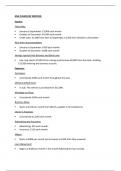
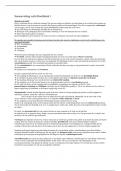
COKO Jurisprudence Modules 1-5 Questions and Correct Solutions Graded A+
6 Public safeguards - 1) Public members 2)College 3) Government (2 bodies:Fairness commissioner and Minister fo Health and LTC) 4) Council meetings and discipline hearings 5) Committee decisions 6) Ontario Minister of Health and Long-term Care Duties of a kinesiologist - -honesty -good service -explain what you're about to do -ask for consent -cooperate with college -obey laws -collaborate w/ health professionals --respect colleagues --share info --attempt to coordinate treatment --make compromises --put best interest of patient 1st --receive consent duties of patients/clients (interprofessional collab) - -control extent of inter collab -may direct kins not to share personal health info -some exceptions Duties of COKO - -develop policies to ensure kins act honestly and competently -NOT to serve with self-interest (that's OKA) -NOT to set fees or advocate to government for kins -promote interprofessional collab -works w/ other health colleges by sharing info on investigations and developing standards to promote consistency -helps kin's collab RHPA - Regulated Health Professions Act -requires COKO to promote interprofessional collaboration OKA - Ontario Kinesologists Association -serve kins with self-interest Duties of council members - -loyalty and good faith -serve best interests of public Code of ethics - *takes precedence over codes of other orgs -be honest -respect confidentiality -treat ppl w/ sensitivity -maintain competence -enable patients to make informed choices Professional Standards - -help practice safely, ethically and competently -always changing professional misconduct - -conduct falls below expectations -e.g. practicing while not registered -consequences: --investigation by COKO leading to: ---discipline proceedings ---fines ---suspension/revocation of registration incompetence - -serious lack of knowledge, skill or judgement when assessing/treating incapacity - -health condition preventing clear thinking and safe practice -investigated by COKO and then Fitness to Practice Committee *not professional misconduct Informed consent - an ethical principle that research patients be told enough to enable them to choose whether they wish to participate in the assessment/treatment *must be received or face criminal, civil or professional conseqs effective communication - -listening -asking clarifying qs -clearly expressing what you are going to do, why and what is likely to happen effective communication is important for 4 reasons: - 1)Informed consent 2)Boundaries and sexual abuse 3) Interprofessional collaboration 4) Billing 4 criteria for valid consent (FIVS) - FACTUAL: -no false claims, would be misrepresentation or fraud INFORMED: -explain everything they need to know before asking for consent -must be aware of: --nature of assessment/procedure (e.g. is there any touching involved) --who will perform the procedure --reasons for procedure (potential benefits and conseqs of not doing it) --material risk and side-effects (s/t patient would want to know) --alternative procedures (must be told) --relevant personal concerns (if procedure would violate religious beliefs) VOLUNTARY: -can't be forced/coerced into consenting -emphasize it is their decision and they can't be pressured SPECIFIC: -consent obtained before each assessment or procedure -can't ask for broad/"blanket" consent -every proposed treatment must be fully explained to patient 3 ways of receiving consent - written verbal implied written consent - -person knowingly, without duress or coercion, clearly and explicitly consents to the proposed therapy in writing with a signature -when s/o who hasn't understood doc still signs, it isn't consent -may discourage both kin and patient from asking questions verbal consent - -best way to ensure patient understands -good to make a note of consent in patient records implied consent - -consent through actions (nodding) -actions may be misunderstood -not actual consent Patient is incapable of consent when... - -does not understand they info -does not appreciate the consequences fo the decision -may be capable of giving consent for one procedure but not another -if incapable: --tell patient --advise who substitute decision maker will be --include patient in discussions (AMAP) Substitute Decision Maker - A person who is authorized under this PHIPA to consent on behalf of the individual to the collection, use or disclosure of personal health information about the individual. If they are not following the rules, kind should: -1)Speak to substitute decision-maker -2) Call the office of the Public Guardian and Trustee (contact info online)
Geschreven voor
- Instelling
- COKO
- Vak
- COKO
Documentinformatie
- Geüpload op
- 20 september 2023
- Aantal pagina's
- 8
- Geschreven in
- 2023/2024
- Type
- Tentamen (uitwerkingen)
- Bevat
- Vragen en antwoorden
Onderwerpen
- coko jurisprudence
- coko
-
coko jurisprudence modules 1 5