CPCU 553 Test Questions with Correct Answers
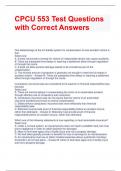
CPCU 553 Test Questions with Correct Answers One disadvantage of the tort liability system for compensation of auto accident victims is that Select one: A. It does not provide a remedy for victims of irresponsible drivers who cause accidents. B. There are substantial time delays in reaching a settlement either through negotiation or through the courts. C. It does not allow punitive damage awards to be included as part of the compensation. D. The minimal amount of protection is generally not enough to meet the full needs of accident victims. - Answer-B. There are substantial time delays in reaching a settlement either through negotiation or through the courts. Compulsory insurance laws are considered to be superior to financial responsibility laws because Select one: A. There are minimal delays in compensating the victim of an automobile accident through effective use of compulsory auto insurance. B. Compulsory insurance laws do not require that the victims of an automobile insurance accident prove fault to receive compensation. C. States enforce compulsory insurance laws more effectively than financial responsibility laws. D. Motorists must provide proof of financial responsibility before an accident occurs, rather than afterward. - Answer-D. Motorists must provide proof of financial responsibility before an accident occurs, rather than afterward. Which one of the following statements is true regarding no-fault automobile insurance? Select one: A. Under a no-fault system, an injured person does not need to establish fault, but must prove negligence in order to collect payment for damages. B. Most no-fault laws apply only to bodily injury and not to property damage. C. No-fault laws typically provide no benefits for loss of earnings for an injured person. D. An injured party must sue to obtain medical expenses above a particular monetary threshold in all no-fault plans. - Answer-B. Most no-fault laws apply only to bodily injury and not to property damage. Marcia has sustained serious injuries in an automobile accident with another driver. If the no-fault automobile insurance law in Marcia's state permits her to sue the other driver for economic damages only if her economic damages exceed her no-fault coverage limit, what type of no-fault law applies in Marcia's state? Select one: A. Modified no-fault B. Pure no-fault C. Add-on no-fault D. Personal injury protection - Answer-A. Modified no-fault In a state with a reinsurance facility for high-risk drivers, a private insurer that does not want to bear the risk of a high-risk applicant may Select one: A. Assign the application to the reinsurance facility to be underwritten and serviced. B. Accept and service the policy, but collect excess losses from the reinsurance facility. C. Assign the premium and losses to the reinsurance facility, and continue to service the policy. D. Accept the application, but assign servicing and losses to members of the reinsurance facility pool on a proportional basis. - Answer-C. Assign the premium and losses to the reinsurance facility, and continue to service the policy. The Part B—Medical Payments Coverage of the Personal Auto Policy (PAP) contains an Other Insurance provision. If two automobile policies from different insurers cover the same owned vehicle, Select one: A. The policy with the lower limit of liability is primary. B. The policy with the lower limit of liability is excess. C. Each insurer pays its pro rata share. D. The first insurer to receive notice of the claim becomes primarily liable. - Answer-C. Each insurer pays its pro rata share. Jerry was driving his car that is insured with a Personal Auto Policy (PAP) with a $10,000 limit on medical payments coverage. Sally, his passenger, has her own car that is insured with a Personal Auto Policy (PAP) with a $5,000 limit on medical payments coverage. Jerry rear-ended a bus, injuring Sally in the accident. Sally's medical expenses total $12,000. How much will each insurer pay? Select one: A. Jerry's pays $4,000 and Sally's pays $8,000. B. Jerry's pays $7,000 and Sally's pays $5,000. C. Jerry's pays $8,000 and Sally's pays $4,000. D. Jerry's pays $10,000 and Sally's pays $2,000. - Answer-D. Jerry's pays $10,000 and Sally's pays $2,000. Which one of the following best identifies an insured under Part C—Uninsured Motorists Coverage of the Personal Auto Policy (PAP)? Select one: A. Occupants of an uninsured vehicle that collides with the insured vehicle B. Passengers in a covered auto who suffer bodily injury caused by an insured motorist C. A surviving neighbor of an insured killed in an accident caused by an uninsured driver D. Members of the named insured's family who as pedestrians are injured by an uninsured motorist - Answer-D. Members of the named insured's family who as pedestrians are injured by an uninsured motorist In states that apply the limits trigger in underinsured motorists (UIM) coverage situations, the UIM endorsement applies Select one: A. When the negligent driver carries liability limits below the limits provided by the UIM coverage of the injured party. B. When the negligent driver carries liability limits that are equal to the limits provided by the UIM coverage of the injured party. C. When the negligent driver carries liability limits that are lower than the injured party's actual damages. D. When the negligent driver carries liability limits above the limits provided by the UIM coverage of the injured party. - Answer-A. When the negligent driver carries liability limits below the limits provided by the UIM coverage of the injured party. Marti fell asleep on a towel while sunbathing on the beach. A driver of a motorized allterrain vehicle designed for off-road use ran over her, severely injuring her. No liability insurance coverage pertained to the accident. Marti made an uninsured motorist (UM) coverage claim under her Personal Auto Policy (PAP). Marti's claim Select one: A. Should be denied because the all-terrain vehicle owner would be considered selfinsured. B. Should be paid under the public or livery conveyance provision. C. Should be denied because it involves no uninsured motor vehicle as defined by the PAP. D. Should be paid under the Other Insurance clause. - Answer-C. Should
Written for
- Institution
- CPCU 553
- Course
- CPCU 553
Document information
- Uploaded on
- January 20, 2024
- Number of pages
- 8
- Written in
- 2023/2024
- Type
- Exam (elaborations)
- Contains
- Questions & answers
Subjects
- cpcu 553
- cpcu 553 test questions
-
cpcu 553 test questions with correct answers

Also available in package deal