NUR 1290 Pharmacology Final exam (100% correct and graded A+)
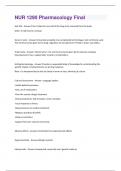
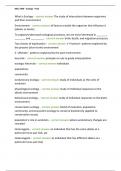
Half-Life - Answer-Time it takes for one half of the drug to be removed from the body. Other: 5 half-lives for removal Generic name - Answer-Universally accepted, less complicated terminology, most commonly used. The chemical name given to the drug, regardless of manufacturer. Printed in lower case letters. Trade name - Answer-"Brand name"; the commercial name given by the pharma company (manufacturer). Has a capital letter or/and is in bold letters. Enthopharmacology - Answer-Provides an expanded body of knowledge for understanding the specific impact of cultural factors on pt drug response. Note: It is hampered by the lack of clarity in terms of race, ethnicity, & culture. Cultural Assessment - Answer--Language spoken -Health beliefs & practices -Past use of medications -Over the counter drugs/ treatment -Herbal treatments, folk remedies, home remedies -Usual response to illness -Responsiveness to medical treatment -Religious practices & beliefs -Dietary restrictions -Support from pt's cultural community Adverse effects - Answer-Unintended, but expected side effects Hypersensitivity - Answer-Allergic reaction Idiosyncratic - Answer-Unexpected, caused by one's genetic make upAbsorption - Answer-The movement of the drug from the site of administration into the bloodstream Route: Enteral - Answer-(Slowest) Absorption through GI tract (oral) ex. tablets, capsules, elixirs, syrups, suppositories First pass effect - Answer-Liver breaks down drug before it reaches blood stream Route: Sublingual, Buccal - Answer-(Between Enteral & Topical) Absorbs quickly through oral mucosa (not GI) Route: Topical - Answer-(Medium speed) Application/ absorption through skin, eyes, ears, nose, lungs, vagina, rectum ex. aerosols, ointments, creams, pastes, inhalers, suppositories Route: Parenteral - Answer-(Fastest) Injections (IV, IM, SC) ex. solutions, suspensions, emulsions, powder for reconstituting Distribution - Answer-The transport of a drug by the bloodstream to its site of action ex. Protein-binding, water vs fat affinity, blood supply(rapid distribution to: heart, liver, kidneys, brain)(slow distribution to: muscle, skin, fat) Metabolism - Answer-Biochemical alteration of a drug into an inactive metabolite, or a more/less potent active metabolite. Organs involved Liver, Kidneys, Muscles, Lungs, Intestines Factors that decrease metabolism - Answer-1. CV dysfunction 2. Renal insufficiency 3. Starvation 4. Obstructive jaundice 5. Genetics (slow acetylator)6. P-450 enzyme inhibitors 7. Drugs
Written for
- Institution
- NUR 1290 Pharmacology
- Course
- NUR 1290 Pharmacology
Document information
- Uploaded on
- February 20, 2024
- Number of pages
- 25
- Written in
- 2023/2024
- Type
- Exam (elaborations)
- Contains
- Questions & answers
Subjects

Also available in package deal