NSG 526 Clin Modal. EXAM 1 verified already passed 2024/2025
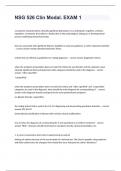
NSG 526 Clin Modal. EXAM 1 a syndrome characterized by clinically significant disturbance in an individual's cognition, emotion, regulation, or behavior that reflects a dysfunction in the psychological, biological, or developmental process underlying mental funcioning they are associated with significant distress, disability in social occupational, or other important activities - correct answer mental disorder/psychiatric illness criteria that are offered as guidelines for making diagnoses - correct answer Diagnostic Criteria when the symptom presentation does not meet full criteria for any disorder and the symptom cause clinically significant distress/impairment what categories should be used in the diagnosis - correct answer "other specified" "unspecified" when the symptom presentation does not meet full criteria and "other specified" and "unspecified" categories are used in the diagnosis, what should the main diagnosis be corresponding to? - correct answer main diagnosis should correspond to the most predominant symptoms. ex: Bipolar disorder, unspecified the coding system that is used in the U.S. for diagnosing and documenting psychiatric disorders - correct answer ICD-10-CM (international classification of disease-10th revision-clinical modification) true or false: the diagnosis of a mental disorder is not equivalent to a need for treatment - correct answer TRUE - clinicians should treat based on symptom severity, clinical presentation, etc. 1. A nurse is assessing a client who is experiencing occasional feelings of sadness because of the recent death of a beloved pet. The client's appetite, sleep patterns, and daily routine have not changed. How should the nurse interpret the client's behaviors? 1. The client's behaviors demonstrate mental illness in the form of depression. 2. The client's behaviors are extensive, which indicates the presence of mental illness. 3. The client's behaviors are not congruent with cultural norms. 4. The client's behaviors demonstrate no functional impairment, indicating no mental illness. - correct answer 4. The client's behaviors demonstrate no functional impairment, indicating no mental illness. 2. At what point should the nurse determine that a client is at risk for developing a mental illness? 1. When thoughts, feelings, and behaviors are not reflective of the DSM-5 criteria. 2. When maladaptive responses to stress are coupled with interference in daily functioning. 3. When a client communicates significant distress. 4. When a client uses defense mechanisms as ego protection. - correct answer 2. When maladaptive responses to stress are coupled with interference in daily functioning. 6. During an intake assessment, a nurse asks both physiological and psychosocial questions. The client angrily responds, "I'm here for my heart, not my head problems." Which is the nurse's best response?
Geschreven voor
- Instelling
- NSG 526
- Vak
- NSG 526
Documentinformatie
- Geüpload op
- 19 maart 2024
- Aantal pagina's
- 45
- Geschreven in
- 2023/2024
- Type
- Tentamen (uitwerkingen)
- Bevat
- Vragen en antwoorden
Onderwerpen

Ook beschikbaar in voordeelbundel