WGU C458 Health Wellness -Exam With Verified Solutions
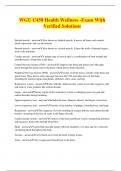
WGU C458 Health Wellness -Exam With Verified Solutions Striated muscle - answerAlso known as skeletal muscle. It moves all bones and controls facial expressions and eye movements. Smooth muscle - answerAlso known as visceral muscle. It lines the walls of internal organs, such as the intestines. Cardiac muscle - answerA unique type of muscle that is a combination of both striated and smooth muscle, found only in the heart. Central Nervous System (CNS) - answerComprises the brain and spinal cord. Messages travel through the spinal cord to the brain, which directs body functions. Peripheral Nervous System (PNS) - answerConsists of all the nerves outside of the brain and spinal cord. These nerves relay messages between the CNS and other areas of the body, including the internal organs and glands, abdomen, chest, arms, and legs Respiratory system - answerWorks with the cardiovascular system to provide oxygen to cells and remove waste products like carbon dioxide. Lungs - answerPrimary organs of the respiratory system, exchanging gases (oxygen and carbon dioxide) during breathing. Upper respiratory tract - answerIncludes the nose, pharynx (throat), and larynx (voice box). Lower respiratory tract - answerConsists of the trachea (windpipe), bronchial tree, and lungs. Respiration - answerThe sequence of events resulting in oxygen delivery and carbon dioxide transfer, occurring in the tiny air sacks in the lungs (alveoli). Cardiovascular system - answerConsists of the heart and blood vessels, transporting nutrients and oxygen to body cells through blood flow. Heart - answerA powerful muscular pump with four chambers: two atria and two ventricles, circulating blood throughout the body. Arteries - answerCarry blood away from the heart to body tissues. Veins - answerCarry oxygen-poor blood back to the heart. Capillary - answerThe tiniest of all blood vessels, allowing oxygen-rich blood to enter cells and exchanging carbon dioxide. Digestive system - answerIncludes the digestive tract and accessory organs, processing food into molecules for absorption and eliminating waste products. Functions of the digestive system - answerIngestion, digestion, absorption, and elimination. Salivary glands - answerLocated in the mouth, moisten and lubricate food and begin the breakdown of carbohydrates. Liver - answerMetabolizes macronutrients, produces bile, and detoxifies the body. Gallbladder - answerStores bile, a yellow-green fluid, which helps digest and absorb fats. Pancreas - answerEndocrine gland that secretes enzymes and hormones (such as insulin) that help with digestion and the use of carbohydrates, proteins, and fats, and regulating blood sugar levels Urinary system - answerBalances body fluids by producing, storing, and eliminating urine. Kidneys - answerMajor organs in the urinary system, filtering waste products from the bloodstream and producing urine. Ureter - answerConnected to each kidney. The urine flows out of the kidneys through the it to the urinary bladder. Bladder - answerTemporary holding reservoir for urine, prompting the urge to urinate when full. Joint - answerA location where two bones come together (aka articulation), categorized by their range of movement into immovable, slightly movable, and freely movable, such as the shoulder, which is freely movable and moves in many directions. Cartilage - answerThe tough but flexible tissue that covers the ends of bones in freely movable joints, preventing bones from rubbing against each other, and also gives shape and support to parts of the body like the ears, nose, and windpipe. Ligament - answerA connective tissue that binds one bone to another, providing side-to-side stability and holding structures together. Tendon - answerA connective tissue that attaches muscle to bone, aiding in the movement of the bone or structure. The Respiratory System - answerWorks with the cardiovascular system to provide oxygen to the cells and to remove the waste products (e.g., carbon dioxide). Respiratory System Organs - answerConsists of the lungs, passageways for air flow, blood vessels, and muscles. These elements work together to bring oxygen into the body and expel carbon dioxide that is produced during metabolism. Respiratory Passages - answerDivided into the upper respiratory tract and the lower respiratory tract. The upper respiratory tract includes the nose, pharynx (throat), and larynx (voice box). The lower respiratory tract consists of the trachea (windpipe), bronchial tree, and lungs. Respiration/Respiratory Process - answerSequence of events that results in the delivery of oxygen into the body followed by the transfer of carbon dioxide out of the body. The exchange occurs in the tiny air sacks in the lungs, called alveoli The Cardiovascular System - answerConsists of the heart (a powerful muscular pump) and blood vessels. The primary function is to transport a constant supply of nutrients and oxygen to body cells through the flow of blood. Aorta - answerLargest of all arteries, branches off into smaller arteries that lead to all the organs in the body. The Digestive System - answerProcesses food into molecules that can be absorbed and utilized by the cells of the body. Food is broken down until the molecules are small enough to be absorbed and the waste products are eliminated. Bacteria - answerOne-celled germs that multiply quickly and may emit harmful toxins. Toxins - answerHarmful chemicals emitted by bacteria that can cause sickness. Antibiotics - answerMedications used to treat diseases caused by bacterial infection. Vaccines - answerPreventive measures to avoid certain bacterial and viral infections. Strep throat - answerA common bacterial disease affecting the throat. Viruses - answerTiny capsules containing genetic material that invade cells and cause sickness. Fungi - answerPrimitive plant-like organisms including mushrooms, mold, and yeasts. Athlete's foot - answerA common fungal infection affecting the feet. Parasites - answerAnimals or plants that survive by living on or in other living things. Malaria - answerAn infection caused by a parasite. Direct contact - answerTransmission of germs through physical interaction with a sick individual. Indirect contact - answerTransmission of germs through contact with contaminated surfaces or objects. Bites - answerInfection transmission through bites of insects or animals. Contamination - answerGerms infecting food, water, soil, or plants. Common Cold - answerInfections of the nose and throat caused by various viruses. Spread by infected droplets of fluid that can be inhaled or transferred via touch. There is no vaccine developed to prevent or treat it. Common Cold Symptoms - answerWatery eyes Nasal and chest congestion Sneezing Sore or scratchy throat Influenza (Flu) - answerIllness caused by influenza viruses affecting the nose, throat, and lungs. Influenza (Flu) Symptoms - answerFatigue Muscle stiffness Coughs, sore throat, and nasal congestion Headaches High fever Mononucleosis (Mono) - answerInfection caused by the (((((((((Epstein)))))))))-Barr virus, transmitted through saliva. Mononucleosis (Mono) Symptoms - answerFatigue Swollen lymph nodes in your neck and armpits Swollen tonsils, sore throat Soft, swollen spleen Fever, headache Skin rash Nervous System - answerComplex system consisting of the brain, spinal cord, nerves, and neuron cells. Meningitis - answerInflammation of the tissue surrounding the brain and spinal cord. Several types are caused by either a virus or bacteria. The most common is the viral version. It can cause
Geschreven voor
- Instelling
- WGU C458
- Vak
- WGU C458
Documentinformatie
- Geüpload op
- 3 april 2024
- Aantal pagina's
- 38
- Geschreven in
- 2023/2024
- Type
- Tentamen (uitwerkingen)
- Bevat
- Vragen en antwoorden
Onderwerpen
-
wgu c458 health wellness exam with verified solut

Ook beschikbaar in voordeelbundel