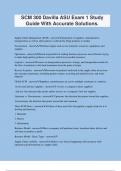
SCM 300 Davilla ASU Exam 1 Study Guide With Accurate Solutions.
SCM 300 Davilla ASU Exam 1 Study Guide With Accurate Solutions. Supply Chain Management (SCM) - answerintegration of suppliers, manufacturers, transportation as well as other parties to collectively bring products to market Procurement - answerPurchases inputs such as raw materials, resources, equipment, and supplies Operations - answerBranch responsible for making business processes more efficient, trying to make high-quality products or services with fewest possible resources Logistics - answerFocuses on transportation processes, storage, and transportation needs for the flow of materials to the final destination from the point of origin Reverse Logistics - answerMovement of products backward in the supply chain away from the consumer (upstream), including product returns, recycling and material reuse, and waste disposal Global SCM - answerSuppliers, manufacturers etc across multiple continents or countries 1st-tier and 2nd-tier suppliers - answer-1st tier: a company's direct suppliers. -2nd tier: firm that provides goods and/or services to a company's first-tier supplier. Upstream vs. Downstream - answer-Upstream: the direction that points toward the suppliers. -Downstream: the direction that points toward the end consumer Three SCM Flows - answerAll three of these must flow throughout a supply chain for it to develop and function: 1. Materials 2. Money 3. Information Business Model - answerHow a company will purchase items, transform them, deliver and sell them to produce a profit Business Model - Basic Types - answer? Supply Chain visibility - answerAbility to see what is happening with inventory both upstream and downstream in a supply chain Profit and ROI's relationship to SCM - answer-Increasing efficiency and reducing costs can be prioritized until they are detrimental to the experience of the customer, which would surely reduce revenue if the quality of a product dropped. -ROI is determined by the total profit/total investment, increase profit or reduce investment for better returns Stakeholders - answerAll the people who stand to gain or lose by the policies and activities of a business and whose concerns the business needs to address. Competitive priorities - answerCompanies/supply chains compete and are evaluated based on these four areas. 1. Cost (materials, wages) 2. Quality (design, reliability) 3. Speed (delivery) 4. Flexibility (customization, size of order) Core competencies - answerThe primary advantage a company has over its competitors. Typically, a core competency would be difficult, if not impossible, to replicate Productivity vs. Value - answer-Productivity: maximize the amount of outputs that can be produced and delivered to market while minimizing the required inputs -Value: ratio of "output purchased"/ "inputs used to purchase" Primary Supply Chain Goals - answer1. Effectiveness 2. Efficiency 3. Adaptability Seven types of waste - answer1. Defects 2. Overproduction 3. Transportation (moving products too much) 4. Motion (employees moving too much or injured) 5. Waiting 6. Inventory 7. Over-processing Keys to being a successful SC Manager - answerSupply chains strive to do three things on a daily basis: a. Satisfy the needs of the customer b. Satisfy the needs of the company c. Be prepared for the future SC Strategy - answer1. understanding the
Written for
- Institution
- SCM 300
- Course
- SCM 300
Document information
- Uploaded on
- July 3, 2024
- Number of pages
- 12
- Written in
- 2023/2024
- Type
- Exam (elaborations)
- Contains
- Questions & answers
Subjects
-
scm 300 davilla asu exam 1 study guide with accura

Also available in package deal