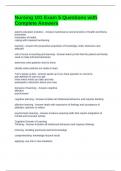
Nursing 101 Exam 5 Questions with
Complete Answers
patient education includes: - Answer-maintenance and promotion of health and illness
prevention
restoration of health
coping with impaired functioning
learning - Answer-the purposeful acquisition of knowledge, skills, behaviors and
attitudes
role of nurse in teaching and learning - Answer-teach pt info that the patient and family
need to make informed decisions.
determine what patients need to know
identify when patients are ready to learn
TJC's speak up tips - Answer-speak up if you have question or concerns
pay attention to care you get
know which meds you take and why
participate in decisions about your care
domains of learning: - Answer-cognitive
affective
psychomotor
cognitive learning - Answer-includes all intellectual behaviors and requires thinking
affective learning - Answer-deals with expression of feelings and acceptance of
attitudes, opinions or values
psychomotor learning - Answer-involves acquiring skills that require integration of
mental and muscular activity
Cognitive Domain of Learning
Thinking - Answer-includes all intellectual behaviors and requires thinking:
knowing- recalling previously learned knowledge
comprehending- knowledge beyond recall
applying- use info in new situations
,analysis- break down info into parts
synthesis- puts parts together to form whole
evaluation- conscious value judgements
affective domain 'the feeling domain' - Answer-specifies the degree of a persons depth
of emotional response to tasks:
feelings
emotions
interests
attitudes
appreciations
psychomotor domain 'the skill domain' - Answer-involves acquiring skills that require the
integration of mental and muscular activity
motor skills
A patient newly diagnosed with diabetes needs to learn how to use a glucometer. This
constitutes? what learning - Answer-
teaching methods for domains of learning - Answer-cognitive: discussion (one on one or
group), lecture, question and answer session, role play, ind project, field experience
affective: role play, discussion- one on one or group
psychomotor: demonstration, practice, return demonstration, ind projects, games
Basic learning principles - Answer-motivation to learn
ability to learn
learning environment
motivation to learn: - Answer-Addresses the patient's desire or willingness to learn: use
of theory to enhance motivation and learning
additional set: the mental state that allows the learner to focus on and comprehend a
learning activity
motivation: a force that acts on or within a person (idea, emotion, physical need) to
cause the person to behave in a particular way
self-efficacy: refers to a persons perceived ability to successfully complete a task
, Basic learning principle- Ability to learn - Answer-depends on physical and cog abilities,
developmental level, physical wellness, though processes
motivation to learn cont: - Answer-psychosocial adaptation to illness: difficult for patients
to accept, need to grieve, learning occurs in the acceptance stage
active participation: learning occurs when the pt is actively involved in the educational
session
ability to learn cont: - Answer-developmental capability:
cog development, prior knowledge
learning in children:
developmental stage
adult learning:
self directed, patient centered
physical capability:
level of personal development
physical health
fatigue
learning environment: - Answer-well lit
good ventilation
appropriate furniture
comfortable temp
private
quiet
factors that facilitate learning - Answer-feedback: positive-
information r/t performance to a desired goal
must be meaningful to learner
positively worded corrections
suggestions for alternative
non-judgement support:
increases in atmosphere of acceptance- need time to assimilate ideas, right to make
mistakes without losing face
successful learners have increased confidence with which to accept failure.
factors that inhibit learning - Answer-physiological:
ill
pain/discomfort
restless
Complete Answers
patient education includes: - Answer-maintenance and promotion of health and illness
prevention
restoration of health
coping with impaired functioning
learning - Answer-the purposeful acquisition of knowledge, skills, behaviors and
attitudes
role of nurse in teaching and learning - Answer-teach pt info that the patient and family
need to make informed decisions.
determine what patients need to know
identify when patients are ready to learn
TJC's speak up tips - Answer-speak up if you have question or concerns
pay attention to care you get
know which meds you take and why
participate in decisions about your care
domains of learning: - Answer-cognitive
affective
psychomotor
cognitive learning - Answer-includes all intellectual behaviors and requires thinking
affective learning - Answer-deals with expression of feelings and acceptance of
attitudes, opinions or values
psychomotor learning - Answer-involves acquiring skills that require integration of
mental and muscular activity
Cognitive Domain of Learning
Thinking - Answer-includes all intellectual behaviors and requires thinking:
knowing- recalling previously learned knowledge
comprehending- knowledge beyond recall
applying- use info in new situations
,analysis- break down info into parts
synthesis- puts parts together to form whole
evaluation- conscious value judgements
affective domain 'the feeling domain' - Answer-specifies the degree of a persons depth
of emotional response to tasks:
feelings
emotions
interests
attitudes
appreciations
psychomotor domain 'the skill domain' - Answer-involves acquiring skills that require the
integration of mental and muscular activity
motor skills
A patient newly diagnosed with diabetes needs to learn how to use a glucometer. This
constitutes? what learning - Answer-
teaching methods for domains of learning - Answer-cognitive: discussion (one on one or
group), lecture, question and answer session, role play, ind project, field experience
affective: role play, discussion- one on one or group
psychomotor: demonstration, practice, return demonstration, ind projects, games
Basic learning principles - Answer-motivation to learn
ability to learn
learning environment
motivation to learn: - Answer-Addresses the patient's desire or willingness to learn: use
of theory to enhance motivation and learning
additional set: the mental state that allows the learner to focus on and comprehend a
learning activity
motivation: a force that acts on or within a person (idea, emotion, physical need) to
cause the person to behave in a particular way
self-efficacy: refers to a persons perceived ability to successfully complete a task
, Basic learning principle- Ability to learn - Answer-depends on physical and cog abilities,
developmental level, physical wellness, though processes
motivation to learn cont: - Answer-psychosocial adaptation to illness: difficult for patients
to accept, need to grieve, learning occurs in the acceptance stage
active participation: learning occurs when the pt is actively involved in the educational
session
ability to learn cont: - Answer-developmental capability:
cog development, prior knowledge
learning in children:
developmental stage
adult learning:
self directed, patient centered
physical capability:
level of personal development
physical health
fatigue
learning environment: - Answer-well lit
good ventilation
appropriate furniture
comfortable temp
private
quiet
factors that facilitate learning - Answer-feedback: positive-
information r/t performance to a desired goal
must be meaningful to learner
positively worded corrections
suggestions for alternative
non-judgement support:
increases in atmosphere of acceptance- need time to assimilate ideas, right to make
mistakes without losing face
successful learners have increased confidence with which to accept failure.
factors that inhibit learning - Answer-physiological:
ill
pain/discomfort
restless