C Syntax and Structure
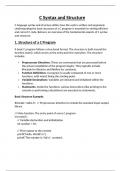
C language syntax and structure define how the code is written and organized.
Understanding the basic structure of a C program is essential for writing efficient
and correct C code. Below is an overview of the fundamental aspects of C syntax
and structure.
1. Structure of a C Program
A basic C program follows a structured format. The structure is built around the
function main(), which serves as the entry point for execution. The structure
includes:
Preprocessor Directives: These are commands that are processed before
the actual compilation of the program begins. They typically include
#include for libraries and #define for constants.
Function Definitions: A program is usually composed of one or more
functions, with main() being the starting point.
Variable Declarations: Variables are declared and initialized within the
functions.
Statements: Inside the functions, various instructions (like printing to the
console or performing calculations) are executed as statements.
Basic Structure Example:
#include <stdio.h> // Preprocessor directive to include the standard input-output
library
// Main function: The entry point of every C program
int main() {
// Variable declaration and initialization
int number = 10;
// Print output to the console
printf("Hello, World!\n");
printf("The number is: %d\n", number);
, // Return statement to end the program
return 0;
}
In this example:
#include <stdio.h> is a preprocessor directive that includes the Standard
Input-Output header, necessary for functions like printf().
int main() is the main function. The execution of the program begins here.
Inside main(), the integer variable number is declared and initialized, and
the printf() function is used to output text to the console.
The return 0; statement ends the program and signals that it executed
successfully.
2. Components of a C Program
Comments: Comments in C are used to explain the code and make it more
readable.
o Single-line comment: // This is a comment
o Multi-line comment: /* This is a multi-line comment */
Keywords: C has reserved words that have specific meanings. Examples
include int, char, return, if, for, etc.
Identifiers: Identifiers are names given to various program elements, such
as variables, functions, arrays, etc.
o An identifier must start with a letter (A-Z, a-z) or an underscore (_),
followed by letters, digits (0-9), or underscores.
o Identifiers are case-sensitive (e.g., variable and Variable are
different).
Data Types: C uses several data types to store values, such as int, char,
float, double, and void. These types define the nature and size of the data.
Semicolon (;): A semicolon marks the end of a statement. Every statement
in C (such as variable declarations, assignments, and function calls) must
end with a semicolon.
3. Functions in C
C language syntax and structure define how the code is written and organized.
Understanding the basic structure of a C program is essential for writing efficient
and correct C code. Below is an overview of the fundamental aspects of C syntax
and structure.
1. Structure of a C Program
A basic C program follows a structured format. The structure is built around the
function main(), which serves as the entry point for execution. The structure
includes:
Preprocessor Directives: These are commands that are processed before
the actual compilation of the program begins. They typically include
#include for libraries and #define for constants.
Function Definitions: A program is usually composed of one or more
functions, with main() being the starting point.
Variable Declarations: Variables are declared and initialized within the
functions.
Statements: Inside the functions, various instructions (like printing to the
console or performing calculations) are executed as statements.
Basic Structure Example:
#include <stdio.h> // Preprocessor directive to include the standard input-output
library
// Main function: The entry point of every C program
int main() {
// Variable declaration and initialization
int number = 10;
// Print output to the console
printf("Hello, World!\n");
printf("The number is: %d\n", number);
, // Return statement to end the program
return 0;
}
In this example:
#include <stdio.h> is a preprocessor directive that includes the Standard
Input-Output header, necessary for functions like printf().
int main() is the main function. The execution of the program begins here.
Inside main(), the integer variable number is declared and initialized, and
the printf() function is used to output text to the console.
The return 0; statement ends the program and signals that it executed
successfully.
2. Components of a C Program
Comments: Comments in C are used to explain the code and make it more
readable.
o Single-line comment: // This is a comment
o Multi-line comment: /* This is a multi-line comment */
Keywords: C has reserved words that have specific meanings. Examples
include int, char, return, if, for, etc.
Identifiers: Identifiers are names given to various program elements, such
as variables, functions, arrays, etc.
o An identifier must start with a letter (A-Z, a-z) or an underscore (_),
followed by letters, digits (0-9), or underscores.
o Identifiers are case-sensitive (e.g., variable and Variable are
different).
Data Types: C uses several data types to store values, such as int, char,
float, double, and void. These types define the nature and size of the data.
Semicolon (;): A semicolon marks the end of a statement. Every statement
in C (such as variable declarations, assignments, and function calls) must
end with a semicolon.
3. Functions in C