BIOD 171 Essential Microbiology Portage Learning
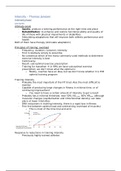
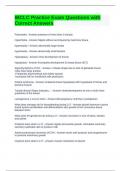
Due No due date Points 100 Questions 27 Time Limit 60 Minutes Requires Respondus LockDown Browser Attempt History Attempt Time Score LATEST Attempt 1 10 minutes 33 out of 100 * * Some questions not yet graded Score for this quiz: 33 out of 100 * Cofactors are usually metal ions and assist enzymes during the catalysis reaction. Your Answer: cofactors What is the term for metal ions that assist enzymes during the catalysis reaction? Question 3 Not yet graded / 5 pts Define anabolism. Your Answer: Anabolism is the process of building up macromolecules from smaller units to create larger complexes. Question 4 Not yet graded / 5 pts True Correctt! False Enzyme catalyze (speed up) chemical reactions. The anabolic process would be active as it (by definition) is involved in the building up of small complexes into larger complexes. Your Answer: Anabolism Upon cellular injury, which metabolic process is involved during the growth and repair phases of the cell? Question 5 Not yet graded / 5 pts Describe the energy transfer process relative to both ATP and ADP. Your Answer: ATP is able to donate energy, while ADP is able to accept energy Question 6 Not yet graded / 10 pts Anabolism is the process of building up or biosynthesis of macromolecules from small molecular units into much larger complexes. Phototrophic microorganism Your Answer: Phototrophic microorganism An organism that derives its energy (generates ATP) from photons of light is called a ? Question 7 Not yet graded / 2 pts Lithotroph Your Answer: Lithotroph An organism that derives its energy by removing electrons from elemental sulfur would be classified as a ? Question 8 Not yet graded / 2 pts ATP has the energy (phosphate group) to donate while ADP can accept energy in the form of a phosphate group. Thus, ATP can be dephosphorylated (ATP ADP + Pi), while ADP can be phosphorylated into ATP (ADP + Pi ATP). The breakdown of glucose goes through (1) Glycolysis then (2) Fermentation or Respiration and finally through (3) the electron transport chain (ETC). Your Answer: 1. Glycolysis 2. Fermentation or Respiration 3. ETC or Electron Transport Chain The catabolism of a single molecule of glucose goes through what 3 distinct transitions? Question 10 Not yet graded / 5 pts Question 11 Not yet graded / 5 pts ou Answered orrect Answe r Substrate-level phosphorylation Oxidative phosphorylation Photophosphorylation A reactive intermediate would be present in which phosphorylation process? Question 9 0 / 2 pts The reactants are to the left of the arrow: Glucose and 2NAD+ Your Answer: glucose, 2NAD+ Glucose + 2NAD+ 2 NADH + 2 Pyruvate + 2 ATP Identify the reactants of the following chemical equation: Question 12 Not yet graded / 2 pts What are the main two roles of glucose-6-phosphate in the cell? Your Answer: Question 13 Not yet graded / 2 pts What is the most energetic transition in the catabolism of glucose? Your Answer: The ETC as it yields 34 ATP while Glycolysis and Fermentation only yield 2 ATP. The electron transport chain yields 34 ATP while both glycolysis and fermentation (or respiration) each yield only 2 ATP. Correctt! False Pyruvate can be converted into either lactic acid or ethanol and then eliminated from the cell. True True or False: During fermentation one means of eliminating pyruvate is by converting it into lactic acid. Question 14 2 / 2 pts What is the primary byproduct of the TCA cycle? Select all that apply. NAD+ Correctt! FADH2 FAD Question 15 2 / 2 pts 1. It aids in making sure that required glucose is unable to leave the cell 2. G6P indicates to the cell that glycolysis is about to occur Glucose-6-phosphate, also known as G6P (1) prevents glucose from diffusing out of the cell as well as (2) serves as the signal molecule to the cell that glycolysis is about to begin. Correctt! The products of the TCA cycle (reduced electron carriers) enter and drive the production of ATP via the electron transport system. False True True or False. The reactants of the TCA cycle directly enter and fuel the electron transport system. Question 16 2 / 2 pts In the absence of glucose, which of the following cannot be used as alternative energy sources? Select all that apply. Lactose Fatty acid chains Correctt! Nucleic acids Carbohydrates Question 17 2 / 2 pts Correctt! NADH The TCA cycle produces an abundance of reduced electron carriers (NADH and FADH2). Correctt! Correctt! Proteases breakdown proteins while lipases breakdown lipids. Lipases Ligases Transferases Proteases For the catabolism of proteins and lipids, which of the following enzymes are used? Select all that apply. Question 18 2 / 2 pts Correctt! The β-oxidation pathway is responsible for the catabolism of fatty acid chains.
Geschreven voor
Documentinformatie
- Geüpload op
- 11 april 2025
- Aantal pagina's
- 15
- Geschreven in
- 2024/2025
- Type
- Tentamen (uitwerkingen)
- Bevat
- Vragen en antwoorden
Onderwerpen
- biod 171
- biod
- essential microbiology
-
essential microbiology portage learning
-
biod 171 essential microbiology portage learning

Ook beschikbaar in voordeelbundel