Memory
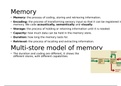
• Memory: the process of coding, storing and retrieving information.
• Encoding: the process of transforming sensory input so that it can be registered in
memory. We code acoustically, semantically and visually.
• Storage: the process of holding or retaining information until it is needed.
• Capacity: how much data can be held in the memory store.
• Duration: how long the memory lasts for.
• Retrieval: the process of locating and extracting information.
Multi-store model of memory
• The duration and coding are different, it shows the
different stores, with different capabilities.
, Sensory Register
• The memory store where information comes in through the senses. It is an automatic response
sensory information.
• It retains the impression of information through the senses, each senses has a separate store.
duration of each store is 1 second. Information that is paid attention to, it passed to the STM o
forgotten
• Coding: stimulus will be passed into the register, in this store there is a separate store for eac
the senses.
• Capacity: it is large, with a constant flow of information which is unprocessed and highly deta
• Duration: very short
Short-term memory
• STM: temporary store for information, memories are actively processed or forgotte
• Coding: visually, semantically and acoustically (most common)
• Capacity: it is limited, we can only hold a small amount of information in it.
• Duration: it is limited, it has a max. Of 30 seconds without any repetition.
• Memory: the process of coding, storing and retrieving information.
• Encoding: the process of transforming sensory input so that it can be registered in
memory. We code acoustically, semantically and visually.
• Storage: the process of holding or retaining information until it is needed.
• Capacity: how much data can be held in the memory store.
• Duration: how long the memory lasts for.
• Retrieval: the process of locating and extracting information.
Multi-store model of memory
• The duration and coding are different, it shows the
different stores, with different capabilities.
, Sensory Register
• The memory store where information comes in through the senses. It is an automatic response
sensory information.
• It retains the impression of information through the senses, each senses has a separate store.
duration of each store is 1 second. Information that is paid attention to, it passed to the STM o
forgotten
• Coding: stimulus will be passed into the register, in this store there is a separate store for eac
the senses.
• Capacity: it is large, with a constant flow of information which is unprocessed and highly deta
• Duration: very short
Short-term memory
• STM: temporary store for information, memories are actively processed or forgotte
• Coding: visually, semantically and acoustically (most common)
• Capacity: it is limited, we can only hold a small amount of information in it.
• Duration: it is limited, it has a max. Of 30 seconds without any repetition.