The Strategic Internal Environment
Approaches to Strategic Management
Resource-based Strategy
The resource-based view (RBV) of strategy states that the competitive advantage and superior
performance of an organisation are explained by the distinctiveness/uniqueness of its capabilities.
What are Strategic Capabilities?
Strategic capabilities are the capabilities of an organisation that contribute to its long-term survival
or competitive advantage. Resources and competences are the two components of strategic
capability.
How to Perform a Resource Analysis in an Organisation?
Types of Strategic Resources
Strategic resources are the building blocks of competitive advantage in business.
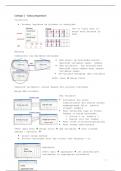
, What are Resources?
Resources are the assets that organisations have or can call upon i.e. what the organisation has.
Resources can be either tangible (physical resources) or intangible (non-physical resources).
What are Competences?
Competences are the ways those assets (resources) are used or deployed effectively i.e. what the
organisation does well.
Examples of Resources and Competences
Threshold and Distinctive Capabilities
Threshold capabilities are those needed for an organisation to meet the necessary requirements to
compete in a given market and achieve parity (the state or condition of being equal)
/equality/equivalence with competitors in that market. Identifying and managing threshold
capabilities raises a significant challenge because threshold levels of capability will change as critical
success factors change or through the activities of competitors and new entrants.
Distinctive capabilities are required to achieve competitive advantage. These are dependent on an
organisation having distinctive or unique capabilities that are of value to customers and which
competitors find difficult to imitate. This could be because the organisation has distinctive resources
or distinctive competences.
Approaches to Strategic Management
Resource-based Strategy
The resource-based view (RBV) of strategy states that the competitive advantage and superior
performance of an organisation are explained by the distinctiveness/uniqueness of its capabilities.
What are Strategic Capabilities?
Strategic capabilities are the capabilities of an organisation that contribute to its long-term survival
or competitive advantage. Resources and competences are the two components of strategic
capability.
How to Perform a Resource Analysis in an Organisation?
Types of Strategic Resources
Strategic resources are the building blocks of competitive advantage in business.
, What are Resources?
Resources are the assets that organisations have or can call upon i.e. what the organisation has.
Resources can be either tangible (physical resources) or intangible (non-physical resources).
What are Competences?
Competences are the ways those assets (resources) are used or deployed effectively i.e. what the
organisation does well.
Examples of Resources and Competences
Threshold and Distinctive Capabilities
Threshold capabilities are those needed for an organisation to meet the necessary requirements to
compete in a given market and achieve parity (the state or condition of being equal)
/equality/equivalence with competitors in that market. Identifying and managing threshold
capabilities raises a significant challenge because threshold levels of capability will change as critical
success factors change or through the activities of competitors and new entrants.
Distinctive capabilities are required to achieve competitive advantage. These are dependent on an
organisation having distinctive or unique capabilities that are of value to customers and which
competitors find difficult to imitate. This could be because the organisation has distinctive resources
or distinctive competences.