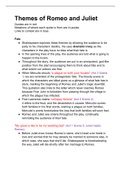
Themes of Romeo and Juliet
Quotes are in red.
Notations of where each quote is from are in purple.
Links to context are in blue.
Fate
● Shakespeare explores these themes by allowing the audience to be
party to his characters' destiny. He uses dramatic irony as the
characters in the play have no idea what their fate is.
● In the opening lines of the play, the audience are told what is going to
happen to the lovers.
● Throughout the story, the audience are put in an omnipotent, god-like
position from the start encouraging them to think about fate and to
what extent our actions are free.
● When Mercutio shouts “a plague on both your houses” (Act 3 Scene
1) we are reminded of the protagonists’ fate. The bloody scene in
which the characters are killed gives us a glimpse of what fate has in
store, marking the beginning of Romeo and Juliet’s tragic downfall.
This quotation also links to the letter which never reaches Romeo
because Friar John is forbidden from passing through the village in
which the plague has infected.
● Friar Lawrence claims “unhappy fortune” (Act 5 Scene 2)
it refers to the feud, and the devastation it causes. Mercutio curses
both families in his final words, wishing a plague on both families.
Mercutio’s words foreshadow the loss that both families will soon feel.
● Romeo and Juliet see omens throughout the play, continually
reminding the audience of their fate.
“My grave is like to be my wedding bed” (Act 1 Scene 5: Juliet meets
Romeo)
● Before Juliet even knows Romeo’s name, she’s head over heels in
love and worries that he may already be married to someone else, in
which case, she says that she’ll die. Shakespeare is foreshadowing
the way Juliet will die shortly after her marriage to Romeo.
, “O, I am fortune’s fool!” (Act 3, Scene1)
● Immediately after he kills Tybalt, Romeo declares he is “fortune's
fool”. This seems to suggest that fate or “fortune” is responsible for
Tybalt’s death, not Romeo. Romeo is discreetly referencing the
prologue, where the audience learns that Romeo and Juliet are fated
for misfortune. But Romeo also feels fortune is being especially cruel;
he just got married, and he might be put to death. His words bring the
idea of fate and destiny back into the audience’s mind.
“Then I defy you, stars!” (Act 5, Scene 1)
● When Romeo hears from Balthasar that Juliet is dead, he exclaims
“Then I defy you, stars!”. He has a plan to make sure that he and
Juliet end up together despite the stars. The irony here is that death
has already been determined by the stars at the start of the play,
“star-crossed lovers take their life” (Act 1, Prologue)
No matter what the lovers do, what plans they make, or how much they
love each other, their struggles against fate only help propel it.
It is Romeo and Juliet’s determination to struggle against fate in order to be
together, whether in life or death that shows the fiery passion of their love,
and which makes that love eternal.
Fate is also experienced by the audience through Shakespeare’s use of
foreshadowing.
Their death is a catalyst for change in Verona: the dueling families are
united in their grief creating a political shift in the city.
Perhaps Romeo and Juliet were fated to love and die for the greater good
of Verona.
Quotes are in red.
Notations of where each quote is from are in purple.
Links to context are in blue.
Fate
● Shakespeare explores these themes by allowing the audience to be
party to his characters' destiny. He uses dramatic irony as the
characters in the play have no idea what their fate is.
● In the opening lines of the play, the audience are told what is going to
happen to the lovers.
● Throughout the story, the audience are put in an omnipotent, god-like
position from the start encouraging them to think about fate and to
what extent our actions are free.
● When Mercutio shouts “a plague on both your houses” (Act 3 Scene
1) we are reminded of the protagonists’ fate. The bloody scene in
which the characters are killed gives us a glimpse of what fate has in
store, marking the beginning of Romeo and Juliet’s tragic downfall.
This quotation also links to the letter which never reaches Romeo
because Friar John is forbidden from passing through the village in
which the plague has infected.
● Friar Lawrence claims “unhappy fortune” (Act 5 Scene 2)
it refers to the feud, and the devastation it causes. Mercutio curses
both families in his final words, wishing a plague on both families.
Mercutio’s words foreshadow the loss that both families will soon feel.
● Romeo and Juliet see omens throughout the play, continually
reminding the audience of their fate.
“My grave is like to be my wedding bed” (Act 1 Scene 5: Juliet meets
Romeo)
● Before Juliet even knows Romeo’s name, she’s head over heels in
love and worries that he may already be married to someone else, in
which case, she says that she’ll die. Shakespeare is foreshadowing
the way Juliet will die shortly after her marriage to Romeo.
, “O, I am fortune’s fool!” (Act 3, Scene1)
● Immediately after he kills Tybalt, Romeo declares he is “fortune's
fool”. This seems to suggest that fate or “fortune” is responsible for
Tybalt’s death, not Romeo. Romeo is discreetly referencing the
prologue, where the audience learns that Romeo and Juliet are fated
for misfortune. But Romeo also feels fortune is being especially cruel;
he just got married, and he might be put to death. His words bring the
idea of fate and destiny back into the audience’s mind.
“Then I defy you, stars!” (Act 5, Scene 1)
● When Romeo hears from Balthasar that Juliet is dead, he exclaims
“Then I defy you, stars!”. He has a plan to make sure that he and
Juliet end up together despite the stars. The irony here is that death
has already been determined by the stars at the start of the play,
“star-crossed lovers take their life” (Act 1, Prologue)
No matter what the lovers do, what plans they make, or how much they
love each other, their struggles against fate only help propel it.
It is Romeo and Juliet’s determination to struggle against fate in order to be
together, whether in life or death that shows the fiery passion of their love,
and which makes that love eternal.
Fate is also experienced by the audience through Shakespeare’s use of
foreshadowing.
Their death is a catalyst for change in Verona: the dueling families are
united in their grief creating a political shift in the city.
Perhaps Romeo and Juliet were fated to love and die for the greater good
of Verona.