Chapter 4 - Enzymes
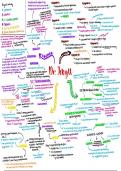
What are enzymes? Specificity of the active site
• Enzyme is formed from many AA’s but only a few
• Globular proteins with specific 3º (max 10) make a bond with the substrate
• Biological catalysts • Each human cell can contain over 1000 different
• Interact with substrate molecules causing them enzymes and each is specific to a reaction
to react at faster rates
• Enzyme activity can be extracellular or
intracellular Specific enzymes
• Lactase ——> Lactose
• Catalase ——-> Hydrogen peroxide
Metabolism • Ribulose Bisphosphate carboxylase oxygenase (rubisco)
——-> catalyse binding of CO2 to ribulose bisphosphate in
photosynthesis
• All anabolic (growth) and catabolic reactions • ATP-ase ——> ADP+Pi for releasing energy
in the body •Glycogen synthetase ——> Binding glucose molecules
Enzyme theory
• Most reactions need energy to start the reaction. This is called the activation energy. Enzymes help molecules
collide successfully (the right orientation)
• There are two theories for how enzymes do this…
• 1. Lock and key theory
• An area within the tertiary structure of the enzyme has a shape complementary to the shape of the substrate
molecule called the ACTIVE SITE.
• When the substrate binds to the active site an enzyme-substrate complex is formed. The substrate(s) react forming the
enzyme-product complex.
• The substrate is held in such a way that the right atom groups are close enough to react. The R groups within the active site
of the enzyme will also interact forming temporary bonds. This puts a strain on the bonds within the substrate, which also
helps the reaction take place
•2. Induced fit theory
• Enzymes are physically flexible
• Active site of the enzyme changes shape slightly as the substrate enters
• Initial interaction between the enzyme and the substrate is relatively weak but these weak interactions rapidly induce changes
in the enzymes 3º that strengthen binding, putting strain on the substrate molecule. This can weaken particular bonds in
the substrate making it less stable
• In turn this lowers activation energy for the reaction
What are enzymes? Specificity of the active site
• Enzyme is formed from many AA’s but only a few
• Globular proteins with specific 3º (max 10) make a bond with the substrate
• Biological catalysts • Each human cell can contain over 1000 different
• Interact with substrate molecules causing them enzymes and each is specific to a reaction
to react at faster rates
• Enzyme activity can be extracellular or
intracellular Specific enzymes
• Lactase ——> Lactose
• Catalase ——-> Hydrogen peroxide
Metabolism • Ribulose Bisphosphate carboxylase oxygenase (rubisco)
——-> catalyse binding of CO2 to ribulose bisphosphate in
photosynthesis
• All anabolic (growth) and catabolic reactions • ATP-ase ——> ADP+Pi for releasing energy
in the body •Glycogen synthetase ——> Binding glucose molecules
Enzyme theory
• Most reactions need energy to start the reaction. This is called the activation energy. Enzymes help molecules
collide successfully (the right orientation)
• There are two theories for how enzymes do this…
• 1. Lock and key theory
• An area within the tertiary structure of the enzyme has a shape complementary to the shape of the substrate
molecule called the ACTIVE SITE.
• When the substrate binds to the active site an enzyme-substrate complex is formed. The substrate(s) react forming the
enzyme-product complex.
• The substrate is held in such a way that the right atom groups are close enough to react. The R groups within the active site
of the enzyme will also interact forming temporary bonds. This puts a strain on the bonds within the substrate, which also
helps the reaction take place
•2. Induced fit theory
• Enzymes are physically flexible
• Active site of the enzyme changes shape slightly as the substrate enters
• Initial interaction between the enzyme and the substrate is relatively weak but these weak interactions rapidly induce changes
in the enzymes 3º that strengthen binding, putting strain on the substrate molecule. This can weaken particular bonds in
the substrate making it less stable
• In turn this lowers activation energy for the reaction