100% satisfaction guarantee Immediately available after payment Both online and in PDF No strings attached 4.6 TrustPilot
logo-home
Exam (elaborations)

BIOS 135 Lab Report Format for ModelChem Labs

Rating
-
Sold
-
Pages
3
Grade
A+
Uploaded on
29-03-2022
Written in
2022/2023

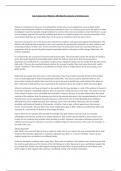
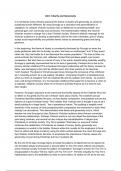
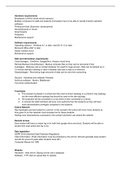
BIOS 135 Lab Report Format for ModelChem Labs I. Title Leaf Lab Week 5 iLab II. Introduction Photosynthesis is a process that allows plants to capture the energy of light from the sun and utilizes it in order to change things like carbon dioxide and water into carbohydrates and oxygen. The following experiment will show the reactions of photosynthesis as they occur inside the tomato leaf compared to the corn leaf. The tomato leaf will perform a C-3 photosynthesis, but the corn leaf performs a C-4 photosynthesis. In the following experiment, I will show what light intensity does between the two leaves and how they take in CO2 in different lightings. There are two stages of photosynthesis that primarily depend on light. The rate of photosynthesis is directly proportional with the intensity of the light until there is a point where all the pigments are occupied and cannot absorb any more light energy. Below, you can find the overall reaction for photosynthesis and its product: 6 C02 + 12H20 + light energy - C6H1206 + 602 + 6H20 The purpose of this laboratory is to: • Demonstrate how photosynthetic rates in different plants can change in response to factors such as light intensity, light quality, CO2 concentration, and temperature. • Simulate measurements of CO2 assimilation rates in leaves. • Investigate dark respiration, photochemical efficiency, CO2 conductance, carboxylation efficiency, light compensation points, and photosynthetic saturation. • Compare photosynthesis in C3 and C4 plants. • Study the effects of polyploidy on photosynthetic rates. ( III. Procedure 1) Set up equipment – light source, heat filter, leaf chamber, drying column, infrared gas analyzer 2) Measure surface area of leaf 3) Place the leaves inside chamber 4) Set flow of C02 to 500 ml/min for tomato leaf and 5000 ml/min for corn leaf 5) Light source set to 0 mmol/m2/s and record measurement of C02 output from the leaf chamber 6) Adjust light intensity with increments of 200 mmol/m2/s and record changes of C02 output until I reach 2000 mmol/m2/s 7) Repeat steps for corn leaf 8) Record data IV. Observations and Results Measured area of the Tomato Leaf = Area = 15.000 sq cm Measured area of Corn Leaf = Area = 76.500 sq cm I placed the tomato leaf in the leaf chamber after obtaining the measurements in order to calculate the photosynthetic rates. I then turned the flow of C02 to 500 ml/min with a C02 content of 350.0 ppm at the light intensity set to 0 mmol/m2/s. The C02 output result was higher at 356.6 ppm of C02, which resulted with a photosynthetic rate of -1.5umol/m2/s, which means that it is producing carbon dioxide but no oxygen. When the light intensity increases, the photosynthetic rate increased as well and slowed down as the light intensity reached a point where it was as if it was sunny (around 1000 mmol/m2/s. At 1600 mol the rate was at 16.2 umol/m2/s. I then did the same experiment on the corn leaf. The difference was the flow of 5000 ml/min with a C02 content of 350.0 ppm, where the light was at 0 mmol/m2/s and the corn leaf had C02 input of 350.0 ppm and C02 output of 352.7 ppm. It was quite lower than the tomato leaf, but it had carbon dioxide and oxygen compared to it. In darkness, the plants are respiring and give off small amounts of CO2. V. Discussion With the following experiment, I found that as the light intensifies, the tomato leaf quickly hits the maximum rate of photosynthesis, which allows its fullest potential for creating food source for energy compared to lower lighting. The corn leaf, however, too a much longer time to reach its maximum rate for production/photosynthesis and requires a much greater light source. These plants greatly differentiate in lighting and production/photosynthesis, which I would say that C-3 photosynthesis plants need less light compared to C-4 photosynthesis plants. VI. Conclusion C3 plants are the most common and the most efficient at photosynthesis in cool, wet climates. C4 plants are most efficient at photosynthesis in hot, sunny climates. ( In conclusion, C-3 Plants are able to survive in lower lighting conditions compared t C-4 photosynthesis plants, and although C-4 photosynthesis plants can create less C02, they need more light to produce their maximum amount. Certain plants require different amounts of light energy in order to produce optimum results. When planting crops, one must take into account how effective their plants would be in the area they are if they wanted to yield the best results.

Show more Read less
Institution
Module

Content preview

BIOS 135 Lab Report Format for ModelChem
Labs
I. Title Leaf Lab Week 5 iLab

II. Introduction

Photosynthesis is a process that allows plants to capture the energy of light from the
sun and utilizes it in order to change things like carbon dioxide and water into
carbohydrates and oxygen. The following experiment will show the reactions of
photosynthesis as they occur inside the tomato leaf compared to the corn leaf. The
tomato leaf will perform a C-3 photosynthesis, but the corn leaf performs a C-4
photosynthesis. In the following experiment, I will show what light intensity does
between the two leaves and how they take in CO2 in different lightings.

There are two stages of photosynthesis that primarily depend on light. The rate of
photosynthesis is directly proportional with the intensity of the light until there is a
point where all the pigments are occupied and cannot absorb any more light energy.
Below, you can find the overall reaction for photosynthesis and its product:

6 C02 + 12H20 + light energy -> C6H1206 + 602 + 6H20

The purpose of this laboratory is to:

 Demonstrate how photosynthetic rates in different plants can change in response to
factors such as light intensity, light quality, CO2 concentration, and temperature.
 Simulate measurements of CO2 assimilation rates in leaves.
 Investigate dark respiration, photochemical efficiency, CO 2 conductance,
carboxylation efficiency, light compensation points, and photosynthetic saturation.
 Compare photosynthesis in C3 and C4 plants.
 Study the effects of polyploidy on photosynthetic rates.

(http://www.biologylabsonline.com/protected/LeafLab/?
key=2723296122038142147212016)

III. Procedure

1) Set up equipment – light source, heat filter, leaf chamber, drying column, infrared
gas analyzer
2) Measure surface area of leaf
3) Place the leaves inside chamber
4) Set flow of C02 to 500 ml/min for tomato leaf and 5000 ml/min for corn leaf

Written for

Module

Document information

Uploaded on
March 29, 2022
Number of pages
3
Written in
2022/2023
Type
Exam (elaborations)
Contains
Questions & answers

Subjects

Get to know the seller

Seller avatar
Reputation scores are based on the amount of documents a seller has sold for a fee and the reviews they have received for those documents. There are three levels: Bronze, Silver and Gold. The better the reputation, the more your can rely on the quality of the sellers work.
ProAcademics Rasmussen College
Follow You need to be logged in order to follow users or courses
Sold
46
Member since
4 year
Number of followers
37
Documents
860
Last sold
8 months ago
ProAcademic Tutor-100%certified tutor

All Nursing material available from admission test to boards

4.7

112 reviews

5
91
4
15
3
3
2
1
1
2

Trending documents

Recently viewed by you

Why students choose Stuvia

Created by fellow students, verified by reviews

Quality you can trust: written by students who passed their exams and reviewed by others who've used these revision notes.

Didn't get what you expected? Choose another document

No problem! You can straightaway pick a different document that better suits what you're after.

Pay as you like, start learning straight away

No subscription, no commitments. Pay the way you're used to via credit card and download your PDF document instantly.

Student with book image

“Bought, downloaded, and smashed it. It really can be that simple.”

Alisha Student

Frequently asked questions