The Vestibulocochlear Nerve (CN VIII)
The vestibulocochlear nerve is formed from 2 sets of fibres: vestibular and
cochlear
This cranial nerve only has a sensory function
Anatomical course:
Both sets of fibres arise from different nuclei in the brain:
1. Vestibular – from the vestibular nuclei in the pons and medulla
2. Cochlear – from the ventral and dorsal cochlear nuclei in the inferior
cerebellar peduncle
Both fibres join in the pons to form the vestibulocochlear nerve
The nerve exits the pons at the cerebellopontine angle and exits the cranium
through the internal acoustic meatus
After exiting the cranium, the nerve splits into the vestibular and cochlear
nerves
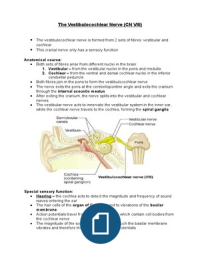
The vestibular nerve acts to innervate the vestibular system in the inner ear,
while the cochlear nerve travels to the cochlea, forming the spiral ganglia
Special sensory function:
Hearing – the cochlea acts to detect the magnitude and frequency of sound
waves entering the ear
The hair cells of the organ of Corti respond to vibrations of the basilar
membrane
Action potentials travel from the spiral ganglia, which contain cell bodies from
the cochlear nerve
The magnitude of the sound determines how much the basilar membrane
vibrates and therefore the frequency of action potentials
The vestibulocochlear nerve is formed from 2 sets of fibres: vestibular and
cochlear
This cranial nerve only has a sensory function
Anatomical course:
Both sets of fibres arise from different nuclei in the brain:
1. Vestibular – from the vestibular nuclei in the pons and medulla
2. Cochlear – from the ventral and dorsal cochlear nuclei in the inferior
cerebellar peduncle
Both fibres join in the pons to form the vestibulocochlear nerve
The nerve exits the pons at the cerebellopontine angle and exits the cranium
through the internal acoustic meatus
After exiting the cranium, the nerve splits into the vestibular and cochlear
nerves
The vestibular nerve acts to innervate the vestibular system in the inner ear,
while the cochlear nerve travels to the cochlea, forming the spiral ganglia
Special sensory function:
Hearing – the cochlea acts to detect the magnitude and frequency of sound
waves entering the ear
The hair cells of the organ of Corti respond to vibrations of the basilar
membrane
Action potentials travel from the spiral ganglia, which contain cell bodies from
the cochlear nerve
The magnitude of the sound determines how much the basilar membrane
vibrates and therefore the frequency of action potentials