CLEP Western Civilization Exam 1 with Complete solution
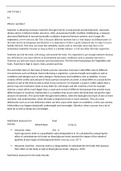
The Fertile Crescent – ANSWER An area of river valleys in the Near East where conditions are optimum for crop production. The Paleolithic Age (Old Stone Age) – ANSWER The age in which humans lived as nomads in small communities, hunting and gathering fruits for food and using fire and crude stone implements. The Neolithic Age (New Stone Age) – ANSWER The age in which stone tools were refined, animals were domesticated, and agriculture was developed as people transitioned from a nomadic to a more settled way of life. The Bronze Age – ANSWER The age in which cities were developed, and tools were increasingly made out of metal alloys rather than stone. Irrigation and writing began to be developed during this time. Sumer (Mesopotamia) – ANSWER The area within the Tigris-Euphrates river valley. Akkadians – ANSWER A semi-nomadic people, who spoke a Semitic language. Migrated from the deserts west of Mesopotamia and settled in the Tigris-Euphrates valley during the 4th millennium B.C.E. King Sargon – ANSWER An Akkadian king ( B.C.E., approximate) who led the Akkadians in conquering Sumerian city-states. Established an empire that unified Mesopotamia and reached beyond it into the Iranian plateau and as far west as Lebanon. His dynasty ruled Akkad and Sumer for about 200 years. The Third Dynasty of Ur – ANSWER Around 2100 B.C.E., the Sumerian city of Ur rose up in revolt against the Akkadian rule. The attained control of Mesopotamia and ruled for about 100 years. Amorites – ANSWER Re-unified Mesopotamia, and established their capital at Babylon, on the Euphrates. The Amorites (Old Babylonian Dynasty) ruled for about 300 years, from around B.C.E. Hammurabi - ANSWER ( B.C.E., approximate) The greatest king of the Old Babylonian Dynasty. Famous for his law code. Claimed to be a representative of the gods. Hammurabi's Code – ANSWER A law code that attempted to stabilize the hierarchical society. Presented like a pyramid: the slaves at the bottom, freemen such as peasants and merchants next, warrior aristocracy and priesthood, and the king at the top. Known for, "An eye for an eye, and a tooth for a tooth." Dealt with legislation regarding the family, ownership of land, and commercial transactions. Hittites – ANSWER from Anatolia (Asia Minor). Attacked the Old Babylonian Empire around 1600 B.C.E. and plundered them. Kassites – ANSWER From the region that is now Iran. Attacked the Old Babylonian Empire around 1600 B.C.E. and established themselves as rulers for 300 years. Hurrians – ANSWER Established the kingdom of Mitanni in the upper Tigris-Euphrates valley around 1500 B.C.E. which lasted for 100 years, until they were conquered by the Hittites. Cuneiform – ANSWER The earliest form of writing, made by wedge-shaped marks impressed on clay tables using a stylus. Initially pictographs (representing objects), but later included ideograms (representing ideas). Began around 3000 B.C.E. Ziggurats – ANSWER Multi-level, pyramid-like constructions by the people of Mesopotamia. Demonstrate practical engineering skills. Gilgamesh – ANSWER A Sumerian epic poem inscribed around 2000 B.C.E. on twelve cuneiform tablets. Describes the quest of the hero Gilgamesh, king of Uruk, in search of immortality. Includes an account of a great flood. Enuma Elish – ANSWER A Sumerian epic poem describing the story of creation. The Egyptian Archaic Period – ANSWER The first two dynasties of Egypt governed from about B.C.E. Unified the Nile Valley. Under centralized government, the economy was carefully planned and agriculture was efficient. The Old Kingdom – ANSWER The Old Kingdom in Egypt lasted from about B.C.E., during the 3rd to the 6th dynasties, when the power of the pharaohs was supreme. Pharaohs were viewed as gods. The greatest pyramids were constructed at this time, particularly during the 4th dynasty. The belief in an afterlife for the pharaohs led to the practice of embalming, or mummification. The First Intermediate Period – ANSWER From about B.C.E., the pharaohs in Egypt failed to assert their power effectively, and in this way the nobles gained control of the government. The decentralization of power led to civil wars between the nobles, or "nomarchs," and to the lack of coordination in agriculture which resulted in widespread famine. The Middle Kingdom – ANSWER From about B.C.E., centralized government was restored in Egypt under the 11th and 12th dynasties. However, the period of stability ended when foreigners, known as the Hyksos, invaded the Nile Delta and conquered the Egyptian army. The Second Intermediate Period – ANSWER the Hyksos people dominated Egypt from about B.C.E. They were expelled by a nobleman named Ahmose, who founded the 18th dynasty and began the era known as the New Kingdom. The New Kingdom – ANSWER From about 1550-11
Written for
- Institution
- CLEP Western Civilization
- Module
- CLEP Western Civilization
Document information
- Uploaded on
- August 25, 2022
- Number of pages
- 21
- Written in
- 2022/2023
- Type
- Exam (elaborations)
- Contains
- Questions & answers
Subjects
-
clep western civilization
-
the fertile crescent
-
clep western civilization exam 1
-
clep western civilization exam 1 with complete solution
-
the paleolithic age old stone age
-
the neolithic age new stone