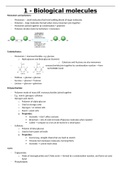
1 - Biological molecules
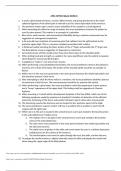
Monomers and polymers:
- Monomers – small molecules that form building blocks of larger molecules
- Polymers – large molecules formed when many monomers join together
- Monomers joined together by condensation = polymers
- Polymers broken down by hydrolysis = monomers
Carbohydrates:
- Monomers = monosaccharides, e.g. glucose
o Alpha glucose and Beta-glucose (isomers)
o Galactose and fructose are also monomers
- Disaccharides -> formed when 2 monosaccharides join together by condensation reaction -> form
GLYCOSIDIC bond
- Maltose -> glucose + glucose
- Sucrose -> glucose + fructose
- Lactose -> glucose + galactose
Polysaccharides:
- Polymers mode of many diff. monosaccharides joined together
- E.g. starch, glycogen, cellulose
- Glycogen and starch:
o Polymers of alpha-glucose
o Used as storage carbs
o Glycogen = in animal cells
o Starch = plant cells
o Properties:
Insoluble -> don’t affect osmosis
Branched -> lots of ends to break off glucose molecules when needed
Coiled -> compact so a lot can be stored in a small space
- Cellulose:
o Polymer of beta-glucose
o Used to form plant cell walls
o Properties:
Forms long, straight chains that are hard to stretch
H-bonds form between molecules, forming fibrils
Insoluble -> cannot wash away
Lipids:
- Triglycerides:
o Made of monoglycerides and 3 fatty acids -> formed by a condensation reaction, and forms an ester
bond
- Phospholipids:
Monomers and polymers:
- Monomers – small molecules that form building blocks of larger molecules
- Polymers – large molecules formed when many monomers join together
- Monomers joined together by condensation = polymers
- Polymers broken down by hydrolysis = monomers
Carbohydrates:
- Monomers = monosaccharides, e.g. glucose
o Alpha glucose and Beta-glucose (isomers)
o Galactose and fructose are also monomers
- Disaccharides -> formed when 2 monosaccharides join together by condensation reaction -> form
GLYCOSIDIC bond
- Maltose -> glucose + glucose
- Sucrose -> glucose + fructose
- Lactose -> glucose + galactose
Polysaccharides:
- Polymers mode of many diff. monosaccharides joined together
- E.g. starch, glycogen, cellulose
- Glycogen and starch:
o Polymers of alpha-glucose
o Used as storage carbs
o Glycogen = in animal cells
o Starch = plant cells
o Properties:
Insoluble -> don’t affect osmosis
Branched -> lots of ends to break off glucose molecules when needed
Coiled -> compact so a lot can be stored in a small space
- Cellulose:
o Polymer of beta-glucose
o Used to form plant cell walls
o Properties:
Forms long, straight chains that are hard to stretch
H-bonds form between molecules, forming fibrils
Insoluble -> cannot wash away
Lipids:
- Triglycerides:
o Made of monoglycerides and 3 fatty acids -> formed by a condensation reaction, and forms an ester
bond
- Phospholipids: