WGU C725 STUDY GUIDE NOTES QUESTIONS WITH ANSWERS ALL CORRECT
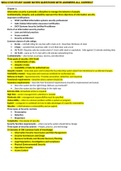
Chapter 1: Information security is primarily a discipline to manage the behavior of people. Confidentiality, integrity, and availability represent the three objectives of information security. Important certifications: CISSP (certified information systems security professional GIAC (Global Information Assurance Certification SSCP (Systems Security Certified Practitioner Parts of an information security practice: Laws and ethical practices Access controls Security architecture Common classes of safe ratings: B-rate – catchall rating for any box with a lock on it. Describes thickness of steel C-Rate – variable thick steel box with 1 inch thick door and a lock UL TL-15 - Requires safe be constructed of 1-inch solid steel or equivalent. Safe against 15-minute working time UL TL-30 – same as TL-15, but with a 30-minute networking time Confidentiality – also known as privacy, secrecy, and discretion Three goals of security: (CIA Triad) Confidentiality of data Integrity of data Availability of data for authorized use Integrity models – keep data pure and trustworthy by protecting system data from intentional or accidental changes. Availability models – keep data and resources available for authorized use. Defense in Depth – layered security. Provides prevention, detection, and response Functional requirements – describe what a system should do Assurance requirements – describe how functional requirements should be implemented and tested. Does the system do the right things (behave as promised)? Does the system do the right things in the right way Extreme Risk- Immediate action is required High Risk – senior management’s attention is needed Moderate risk – management responsibility must be specified Vulnerability – refers to a known problem within a system or program Exploit – a program or cookbook on how to take advantage of a specific vulnerability Attacker – a link between a vulnerability and an exploit. Three types of Security controls: Preventative Detective Responsive Complexity – the enemy of security Security function requirements – what a security system should do by design Three types of security controls – People, process, and technology 10 domains of CBK (common body of knowledge) Information Security Governance and Risk Management Security Architecture and Design Business Continuity and Disaster Recovery Planning Legal Regulations, Investigations and Compliance Physical (Environmental) Security Operations Security Access Control WGU C725 STUDY GUIDE NOTES QUESTIONS WITH ANSWERS ALL CORRECT Cryptography Telecommunications and Network Security Software Development Security Governance and Risk Management –set of executive support and management define an IT security program Policies – high-level statements, beliefs, goals, and objectives. the most crucial element in a corporate information security infrastructure. Contains: Title, Purpose, Authorizing individual, Author/Sponsor, Reference to other policies Scope, Measurement expectations, Exception process, Accountability, Compliance management and measurements description, Effective/expiration dates, Definitions The Four types of policies: Program-level policies – needs to establish a security program, assign program-management responsibilities, state an organization-wide security purpose and objectives and establish a basis for policy compliance. Components: Purpose, Scope, Responsibilities, Compliance Program framework policies – provide an organization-wide direction for areas of program implementation. Examples: Business continuity planning framework , Physical security requirements framework for data centers, Application development security
Written for
- Institution
- Western Governors University
- Module
- C725
Document information
- Uploaded on
- November 12, 2022
- Number of pages
- 12
- Written in
- 2022/2023
- Type
- Exam (elaborations)
- Contains
- Questions & answers
Subjects
-
wgu c725 study guide notes questions with answers all correct

Also available in package deal