ASWB LMSW Prep Exam with complete solutions
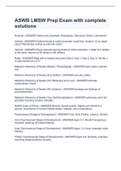
Nominal - ANSWER-Name only (example: Republican, Democrat, Green, Libertarian) Ordinal - ANSWER-Ordered levels or ranks (example: small 8oz, medium 12 oz, large 32oz) *Remember ordinal sounds like order* Interval - ANSWER-Equal intervals among levels or ranks (example: 1 dollar to 2 dollars is the same interval as 88 dollars to 89 dollars) Ratio - ANSWER-Data with a natural zero point (Day 0, Day 1, Day 2, Day 3) *let the o in ratio remind you of 0* Maslow's Hierarchy of Needs (Bottom, Physiological) - ANSWER-food, water, warmth, rest Maslow's Hierarchy of Needs (2nd, Safety) - ANSWER-security, safety Maslow's Hierarchy of Needs (3rd, Belonging and Love) - ANSWER-intimate relationships, friend Maslow's Hierarchy of Needs (4th, Esteem) - ANSWER-prestige and feelings of accomplishment Maslow's Hierarchy of Needs (Top, Self-Actualization) - ANSWER-achieving one's full potential including creative activities NASW Code of Ethics - ANSWER-Service, Social Justice, Dignity and Worth of a person, Importance of Human Relationships, Integrity, and Competence Psychosexual Stages of Development - ANSWER-Oral, Anal, Phallic, Latency, Genital Oral, Psychosexual Stage of Development - ANSWER-Ages 0-1, Mouth/Tounge/Lips, example: weaning off breast feeding Anal, Psychosexual Stage of Development - ANSWER-Ages 1-3, Anus, example: toilet training Phallic, Psychosexual Stage of Development - ANSWER-Ages 3-6, Genitals, example: resolving oedipus/electra complex Latency, Pyschosexual Stage of Development - ANSWER-Ages 6-12, n/a, example: developing defense mechanisms Gential, Pyschosexual Stage of Development - ANSWER-Ages 12+, Genitals, example: reaching full sexual maturity Psychosocial Development Stages - ANSWER-Trust vs mistrust, autonomy vs shame, initiative vs guilt, industry vs inferiority, ego identity vs role confusion, intimacy vs isolation, generativity vs stagnation, ego identify vs dispair Trust vs Mistrust - ANSWER-Infancy, ages 0-1.5, basic virtue is hope Autonomy vs Shame - ANSWER-Early Childhood, ages 1.5-3, basic virtue is will Initiative vs Guilt - ANSWER-Play Age, ages 3-5, basic virtue is purpose Industry vs Inferiority - ANSWER-School Age, ages 5-12, basic virtue is competency Ego Identity vs Role Confusion - ANSWER-Adolescence, ages 12-18, basic virtue is fidelity Intimacy vs Isolation - ANSWER-Young Adult, ages 18-40, basic virtue is love Generativity vs Stagnation - ANSWER-Adulthood, ages, 40-65, basic virtue is care Ego Integrity vs Dispair - ANSWER-Maturity, ages 65+, basic virtue is wisdom Operant Conditioning - ANSWER-B. F. Skinner, Positive & Negative Reinforcement and Positive & Negative Punishment Positive Reinforcement - ANSWER-Add a pleasant stimulus to increase or maintain behavior Negative Reinforcement - ANSWER-Remove an aversive stimulus to increase or maintain behavior Positive Punishment - ANSWER-Add an aversive stimulus to decrease behavior Negative Punishment - ANSWER-Remove a pleasant stimulus to decrease behavior Piaget's Stages of Cognitive Development - ANSWER-Sensorimotor, Preoperational, Operational, Concreate Operations, Formal Operations Sensorimotor, Stage of Cognitive Development - ANSWER-Ages 0-2, Learns by doing: looking, touching, sucking. Child understands cause and effect. Preoperational, Stage of Cognitive Development - ANSWER-Ages 2-7, Child uses language and symbols, including letters and numbers. Concrete Operations, Stages of Cognitive Development - ANSWER-Ages 7-11, Child demonstrates conservation, reversibility, serial ordering, and a maturity of cause an effect. Thinking is concrete. Formal Operations, Stages of Cognitive Development - ANSWER-Ages 12+, the individual demonstrates abstract thinking, logic, deductive reasoning, comparison and classification. Common Depression Medications - ANSWER-Zoloft, Prozac, Celexa, Lexapro, Paxil, Wellbutrin Common Anxiety Medications - ANSWER-Xanax, Klonopin, Valium, Ativan, Buspar Common ADHD Medications - ANSWER-Vyvanse, Ritalin, Adderall Common Bipolar Disorder Medications - ANSWER-Seroquel, Risperdal, Abilify, Topamax, Tegretol Common Sleep Medications - ANSWER-Restoril, Ambien, Lunesta HIPAA - ANSWER-Health Insurance Portability and Accountability Act of 1996 Neurodevelopmental Disorders - ANSWER-Intellectual Disability, Global Development Disorder, Unspecified Intellectual Disability, Language Disorder, Speech Sound Disorder, Childhood-Onset Fluency Disorder, Social Communication Disorder, Unspecified Communication Disorder, Autism Spectrum Disorder, Attention Deficit-Hyperactivity Disorder, Other Specified ADHD, Unspecified ADHD, Specific Learning Disorder, Developmental Coordination Disorder, Stereotypic Movement Disorder, Tourettes Disorder, Persistant Motor or Vocal Tic Disorder, Provisional Tic Disorder, Other Specified Tic Disorder, Unspecified Tic Disorder, Other Specified Neurodevelopmental Disorder, Unspecified Neurodevelopmental Disorder Schizophrenia Spectrum Disorders - ANSWER-Delusional Disorder, Brief Psychotic Disorder, Schizophreniform Disorder, Schizophrenia, Schizoaffective Disorder, Substance/Medication-Induced Psychotic Disorder, Psychotic Disorder Due to Another Medical Condition, Catatonia Associated With Another Mental Disorder, Catatonic Disorder Due to Another Medical Condition, Unspecified Catatonia, Other Specified Schizophrenia Spectrum and Other Psychotic Disorder, Unspecified Schizophrenia Spectrum and Other Psychotic Disorder Bipolar and Related Disorders - ANSWER-Bipolar 1 Disorder, Bipolar 2 Disorder, Cyclothymic Disorder, Substance/Medication Induced Bipolar and Related Disorder, Bipolar and Related Disorder Due to Another Medical Condition, Other Specified Bipolar and Related Disorder, Unspecified Bipolar and Related Disorder Depressive Disorders - ANSWER-Major Depressive Disorder, Persistent Depressive Disorder (Dysthymia), Premenstral Dysphoric Disorder, Substance/Medication Induced Depressive Disorder, Depressive Disorder Due to Another Medical Condition, Other Specified Depressive Disorder, Unspecified Depressive Disorder Anxiety Disorders - ANSWER-Separation Anxiety Disorder, Selective Mutism, Specific Phobia, Social Anxiety Disorder, Panic Disorder, Agoraphobia, Generalized Anxiety Disorder, Substance/Medication Induced Anxiety Disorder, Anxiety Disorder Due to Another Medical Condition, Other Specified Anxiety Disorder, Unspecified Anxiety Disorder Obsessive Compulsive and Related Disorders - ANSWER-Obsessive Compulsive Disorder, Body Dysmorphic Disorder, Hoarding Disorder, Trichotillomania Disorder, Excoriation Disorder, Substance/Medication Induced Obsessive Compulsive and Related Disorder, Obsessive Compulsive and Related Disorder Due to Another Medical Condition, Other Specified Obsessive Compulsive and Related Disorder, Unspecified Obsessive Compulsive and Related Disorder Trauma and Stressor Related Disorders - ANSWER-Reactive Attachment Disorder, Disinhibited Social Engagement Disorder, Posttraumatic Stress Disorder, Acute Stress Disorder, Adjustment Disorder, Other Specified Trauma and Stressor Related Disorder, Unspecified Trauma and Stressor Related Disorder Dissociative Disorders - ANSWER-Dissociative Identity Disorder, Dissociative Amnesia, Depersonalization/Derealization Disorder, Other Specified Dissociative Disorder, Unspecified Dissociative Disorder Somatic Symptom and Related Disorders - ANSWER-Somatic Symptom Disorder, Illness Anxiety Disorder, Conversion Disorder, Psychological Factors Affecting Other Medical Conditions, Factitious Disorder, Other Specified Somatic Symptom and Related Disorder, Unspecified Somatic Symptom and Related Disorder Feeding and Eating Disorders - ANSWER-Pica, Rumination Disorder, Avoidant/Restrictive Food Intake Disorder, Anorexia Nervosa, Bulimia Nervosa, Binge Eating Disorder, Other Specified Feeding and Eating Disorder, Unspecified Feeding and Eating Disorder Elimination Disorders - ANSWER-Enuresis, Encopresis, Other Specified Elimination Disorder, Unspecified Elimination Disorder Disruptive, Impulse Control, and Conduct Disorders - ANSWER-Oppositonal Defiant Disorder, Intermittent Explosive Disorder, Conduct Disorder, Pyromania, Kleptomania, Other Specified Disruptive/Impulse Control/Conduct Disorder, Unspecified Disruptive/Impulse Control/Conduct Disorder Neurocognitive Disorders - ANSWER-Delerium, Delerium Due to Another Medical Condition, Other Specified Delerium, Unspecified Delerium, Major and Mild Neurocognitive Disorders Personality Disorders - ANSWER-Paranoid Personality Disorder, Schizoid Personality Disorder, Schizotypal Personality Disorder, Antisocial Personality Disorder, Borderline Personality Disorder, Histrionic Personality Disorder, Narcissistic Personality Disorder, Avoidant Personality Disorder, Dependant Personality Disorder, Obsessive Compulsive Personality Disorder, Personality Changes Due to Another Medical Condition, Other Specified Personality Disorder, Unspecified Personality Disorder Cluster A Personality Disorders - ANSWER-Paranoid Personality Disorder, Schizoid Personality Disorder, Schizotypal Personality Disorder Cluster B Personality Disorders - ANSWER-Antisocial Personality Disorder, Borderline Personality Disorder, Histrionic Personality Disorder, Narcissistic Personality Disorder Cluster C Personality Disorders - ANSWER-Avoidant Personality Disorder, Dependant Personality Disorder, Obsessive Compulsive Personality Disorder Bipolar 1 Disorder - ANSWER--MUST include a manic episode lasting at least one week -does NOT have to include a hypomanic episode -does NOT have to include a major depressive episode -MUST cause marked impairment in social or occupational functioning Bipolar 2 Disorder - ANSWER--MUST have a past or current hypomanic episode lasting at lease 4 consecutive days -MUST have a past or current major depressive episode -NOT severe enough to cause marked impairment in social or occupational functioning Cyclothymic Disorder - ANSWER--For at least 2 years, there have been numerous hypomanic and major depressive symptoms that do not meet the criteria for a hypomanic or major depressive episode -symptoms have been present for at least half of the two years and do not subside for more than two months -NEVER has met the criteria for Major Depressive Disorder, Manic Episode, or Hypomanic Episode -symptoms cause significant distress in impairment in social or occupational functioning. Disruptive Mood Dysregulation Disorder - ANSWER--Severe temper outbursts -outbursts inconsistent with developmental level -occur on average 3x/wk -not diagnosed before age 6 or after age 18 -symptoms occur before age 10 Major Depressive Disorder - ANSWER--symptoms occur in the same 2 week period -HAS to include depressed mood OR loss of interest or pleasure -often includes suicidal ideation, plan or attempt, but not required Persistent Depressive Disorder (Dysthymia) - ANSWER--depressed mood for most of the day, more days than not, for at least two years -symptoms do not subside for more than two months -causes significant impairment in social or occupational functioning Separation Anxiety Disorder - ANSWER--lasting at least 4 weeks in children and at least 6 months in adolescents -causes significant impairment in social or occupational functioning -may have physical symptoms such as headaches, stomachaches, nausea, or vomiting in anticipation of the separation Specific Phobias - ANSWER--Animal (spiders, insects, dogs) -Natural Environment (heights, storms, water) -Blood Injection-Injury (needles, surgeries) -Situational (airplanes, elevators, enclosed spaces) -Other (situations that lead to choking or vomiting, costumed characters) Social Anxiety Disorder (Social Phobia) - ANSWER-Marked fear or anxiety about one or more social situations in which the individual is exposed to scrutiny by others (example: meeting new people, having a conversation) Generalized Anxiety Disorder - ANSWER--occurring more days than not for at least six months -finds it difficult to control the worry -significant impairment in social or occupational functioning Obsessions - ANSWER--Recurrent and persistent thoughts, urges, or images that are experienced at some time during the disturbance -intrusive and unwanted -usually causes marked anxiety or distress -attempts to suppress thoughts, urges, or images -takes more than one hour per day Compulsions - ANSWER--repetitive behaviors such as hand washing, counting, or touching -acts are aimed at preventing or reducing anxiety -clearly excessive -takes more than one hour per day Reactive Attachment Disorder - ANSWER--Consistent pattern of withdrawn behavior toward adult caregivers -persistent emotional disturbance -child has experienced a pattern of extreme insufficient care -does not meet criteria for autism spectrum disorder -disturbance is evident before 5 years old -child must have a developmental age of at least 9 months Disinhibited Social Engagement Disorder - ANSWER--A pattern of behavior in which a child actively approaches and interacts with unfamiliar adults -child has experienced a pattern of extremes of insufficient care -child has a developmental age of at least 9 months PTSD - ANSWER--duration of the disturbance is more than one month -two separate diagnosis for adults ages six and up and children younger than six years old -Exposure to actual or threatended death, serious injury, or sexual violence -Intrusion symptoms occur after the traumatic event -Persistent avoidance of stimuli associated with the traumatic event(s) -Negative alterations in cognitions and mood
Written for
- Institution
- ASWB LMSW
- Module
- ASWB LMSW
Document information
- Uploaded on
- February 13, 2023
- Number of pages
- 10
- Written in
- 2022/2023
- Type
- Exam (elaborations)
- Contains
- Questions & answers
Subjects
-
aswb lmsw
-
democrat
-
green
-
medium 12 oz
-
large 32o
-
aswb lmsw prep exam with complete solutions
-
nominal name only example republican
-
libertarian
-
ordinal ordered levels or ranks example small 8oz

Also available in package deal