IGCSE PHYSICS – TOPIC 4
ENERGY RESOURCES AND ENERGY TRANSFER
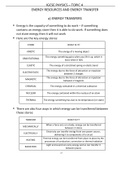
a) ENERGY TRANSFERS
• Energy is the capacity of something to do work – if something
contains an energy store then it is able to do work. If something does
not store energy then it will not work
• Here are the key energy stores:
STORE WHAT IS IT?
KINETIC The energy of a moving object
The energy something gains when you lift it up, which it
GRAVITATIONAL
loses when it falls
ELASTIC The energy of a stretched spring or elastic band
The energy due to the force of attraction or repulsion
ELECTROSTATIC
between 2 charges
The energy due to the force of attraction or repulsion
MAGNETIC
between 2 magnets
CHEMICAL The energy contained in a chemical substance
NUCLEAR The energy contained within the nucleus of an atom
THERMAL The energy something has due to its temperature (or state)
• There are also four ways in which energy can be transferred between
these stores:
TRANSFER WHAT IS IT?
When a force acts on a body, energy can be transferred
MECHANICALLY
between 2 stores
Electricity can transfer energy from one power source,
ELECTRICALLY
delivering it to components of a circuit
Thermal energy can be transferred from place to place by the
HEATING
proceesses of conduction, convection or thermal radiation
Light and sound can carry energy and so can transfer it
RADIATION
between places
23
, • The law of conservation of energy states that:
o ENERGY CAN NOT BE CREATED OR DESTROYED, IT CAN ONLY BE
MOVED FROM ONE STORE TO ANOTHER
o Meaning the total amount of energy in a closed system remains
CONSTANT, but can change how it is stored
o E.g. a gas cooker, heating food, takes energy from the CHEMICAL
STORE of gas and transfers it to the THERMAL STORE of the food
• EFFICIENCY – the percentage of energy transferred from the original
store that end up in the intended store
o Energy is either useful or wasted (thermal, light or sound
energy)
o Use the following equation to work out efficiency:
Efficiency = Useful Energy Output/ Total Energy Output x 100
• SANKEY DIAGRAMS – efficiency can be represented by a Sankey
diagram
o The arrow represents the transfer of energy
o The end of the arrow pointing forward represents the desired
store – the useful energy output
o The end that points down represents the wasted energy
o The width of each arrow is proportional to the amount of energy
going to each store:
24
ENERGY RESOURCES AND ENERGY TRANSFER
a) ENERGY TRANSFERS
• Energy is the capacity of something to do work – if something
contains an energy store then it is able to do work. If something does
not store energy then it will not work
• Here are the key energy stores:
STORE WHAT IS IT?
KINETIC The energy of a moving object
The energy something gains when you lift it up, which it
GRAVITATIONAL
loses when it falls
ELASTIC The energy of a stretched spring or elastic band
The energy due to the force of attraction or repulsion
ELECTROSTATIC
between 2 charges
The energy due to the force of attraction or repulsion
MAGNETIC
between 2 magnets
CHEMICAL The energy contained in a chemical substance
NUCLEAR The energy contained within the nucleus of an atom
THERMAL The energy something has due to its temperature (or state)
• There are also four ways in which energy can be transferred between
these stores:
TRANSFER WHAT IS IT?
When a force acts on a body, energy can be transferred
MECHANICALLY
between 2 stores
Electricity can transfer energy from one power source,
ELECTRICALLY
delivering it to components of a circuit
Thermal energy can be transferred from place to place by the
HEATING
proceesses of conduction, convection or thermal radiation
Light and sound can carry energy and so can transfer it
RADIATION
between places
23
, • The law of conservation of energy states that:
o ENERGY CAN NOT BE CREATED OR DESTROYED, IT CAN ONLY BE
MOVED FROM ONE STORE TO ANOTHER
o Meaning the total amount of energy in a closed system remains
CONSTANT, but can change how it is stored
o E.g. a gas cooker, heating food, takes energy from the CHEMICAL
STORE of gas and transfers it to the THERMAL STORE of the food
• EFFICIENCY – the percentage of energy transferred from the original
store that end up in the intended store
o Energy is either useful or wasted (thermal, light or sound
energy)
o Use the following equation to work out efficiency:
Efficiency = Useful Energy Output/ Total Energy Output x 100
• SANKEY DIAGRAMS – efficiency can be represented by a Sankey
diagram
o The arrow represents the transfer of energy
o The end of the arrow pointing forward represents the desired
store – the useful energy output
o The end that points down represents the wasted energy
o The width of each arrow is proportional to the amount of energy
going to each store:
24