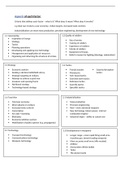
Aspects of each factor
Criteria that defines each factor – what is it? What does it mean? What does it involve?
e.g total war involves a war economy, civilian targets, increased state controls;
industrialisation can mean mass production, precision engineering, development of new technology
1.1 Generalship 1.2 Quality of soldiers
Inspiration of troops
Size of armies
Strategy
Training of soldiers
Tactics
Experience of soldiers
Planning operations
Morale of soldiers
Developing and applying new technology
Equipment of troops
Management and application of resources
Belief in reason for fighting (ideology, nationalism)
Organising and reforming the structure of armies
1.3 Strategy 1.4 Tactics
Economic warfare Frontal assaults Surprise/deception
Seeking a decisive battlefield victory Manoeuvre tactics
Strategic targeting of civilians Tech-based tactics
Attempt to achieve a quick war Scorched earth tactics
Invasions and opening fronts Defensive tactics
Attritional strategy Guerrilla tactics
Technology-based strategy Specialist tactics
1.6 Total War 2.1 Industrialisation
Total war economy Mass production
Direct attacks on civilians Precision engineering
Increased state controls New + more advanced weapons
Conscription New technology (steam power, internal
Air raids + bombing combustion engine)
Blockades Industrial might – ability to sustain war
Economic/attrition warfare
Mobilisation of public opinion (e.g. propaganda)
2.1 Technology 2.2 Developments in weaponry
Transport technology Longer range + more rapid-firing small arms
Communications technology (machine gun, breech-loading weapons)
Weapons technology More accurate small arms (rifle musket)
Artillery
Ammunition (Minie bullet)
Tanks
The atomic bomb
, 2.3 Developments in communications 2.3 Developments in transport
Runners Marching
Semaphore Steam power
Electric telegraph Railways
Radio Steam ships
Field telephone Internal combustion engine
Tanks
Aircraft
Motor vehicles (lorries etc)
4.1 Organisation of the state 4.2 Conscription
Mobilisation of economy, industry and labour Reserve system
Mobilisation of manpower (conscription & Civilians in the military
recruitment) Larger armies
Repression/control of civilians
Economic management (taxes, new currencies)
Supplying/equipping of armies
Winning public support for war (propaganda)
4.3 Public opinion 4.4 Economic factors
Desire to enter, sustain or end wars Productive capacity
Desired objectives from war Mobilisation of total war economy
Support for/involvement in the war effort Economic + industrial development
Economic + industrial strength
Allocation of resources – providing for army and
civilians
Mobilisation of manpower
Criteria that defines each factor – what is it? What does it mean? What does it involve?
e.g total war involves a war economy, civilian targets, increased state controls;
industrialisation can mean mass production, precision engineering, development of new technology
1.1 Generalship 1.2 Quality of soldiers
Inspiration of troops
Size of armies
Strategy
Training of soldiers
Tactics
Experience of soldiers
Planning operations
Morale of soldiers
Developing and applying new technology
Equipment of troops
Management and application of resources
Belief in reason for fighting (ideology, nationalism)
Organising and reforming the structure of armies
1.3 Strategy 1.4 Tactics
Economic warfare Frontal assaults Surprise/deception
Seeking a decisive battlefield victory Manoeuvre tactics
Strategic targeting of civilians Tech-based tactics
Attempt to achieve a quick war Scorched earth tactics
Invasions and opening fronts Defensive tactics
Attritional strategy Guerrilla tactics
Technology-based strategy Specialist tactics
1.6 Total War 2.1 Industrialisation
Total war economy Mass production
Direct attacks on civilians Precision engineering
Increased state controls New + more advanced weapons
Conscription New technology (steam power, internal
Air raids + bombing combustion engine)
Blockades Industrial might – ability to sustain war
Economic/attrition warfare
Mobilisation of public opinion (e.g. propaganda)
2.1 Technology 2.2 Developments in weaponry
Transport technology Longer range + more rapid-firing small arms
Communications technology (machine gun, breech-loading weapons)
Weapons technology More accurate small arms (rifle musket)
Artillery
Ammunition (Minie bullet)
Tanks
The atomic bomb
, 2.3 Developments in communications 2.3 Developments in transport
Runners Marching
Semaphore Steam power
Electric telegraph Railways
Radio Steam ships
Field telephone Internal combustion engine
Tanks
Aircraft
Motor vehicles (lorries etc)
4.1 Organisation of the state 4.2 Conscription
Mobilisation of economy, industry and labour Reserve system
Mobilisation of manpower (conscription & Civilians in the military
recruitment) Larger armies
Repression/control of civilians
Economic management (taxes, new currencies)
Supplying/equipping of armies
Winning public support for war (propaganda)
4.3 Public opinion 4.4 Economic factors
Desire to enter, sustain or end wars Productive capacity
Desired objectives from war Mobilisation of total war economy
Support for/involvement in the war effort Economic + industrial development
Economic + industrial strength
Allocation of resources – providing for army and
civilians
Mobilisation of manpower