EDF 6226 Exam 2 2023/2023 Solved 100% Correct
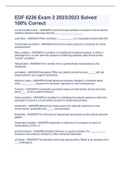
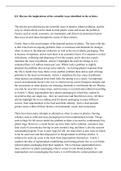
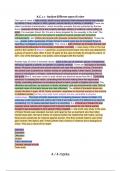
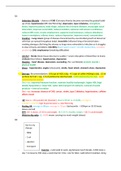
envrionmental events - ANSWER-A function based defintion is based on the functional relations between responses and the __________ __________. Look likes - ANSWER-What a behavior ______ _____ is a topography-based definition Functionally equivalent - ANSWER-Servers the same purpose or produces the same consqeuences Play condition - ANSWER-A condition in a traditional functional analysis in which a participant is in a room with free access to reinforcing activities (also known as the "control" condition). Independent - ANSWER-The variable that is systematically manipulated by the researcher correlated - ANSWER-Descriptive FBAs can identify events that are _____ with the target behavior and suggest hypotheses behavior cusps - ANSWER-Pivotal behaviors produce changes in untrained areas, while _____ _____ expose the individual's repertoire to new contingencies. Function - ANSWER-Functionally equivalent means an intervention should serve the same ____ as the problem behavior Alone condition - ANSWER-A condition in a traditional functional analysis in which the participant is alone in a room without access to reinforcing activities. reinforcers - ANSWER-Behaviroal cusps expose the indivuals repertoire to new environments, especially new _____ and punishers. Reactivity - ANSWER-The influence of assessment procedures on the clinets behavior pattern Dependent variable - ANSWER-measured to determine if it changes as result of manipulations of the I.V. pivotal behavior - ANSWER-Imitative behavior is a good example of a ______ _____ because it can produce changes in other untrained responses. contrived - ANSWER-The thearpist reinforcing waving with a Skittle is an example of an ___ contingency Modifications - ANSWER-A pivotal behavior produces corresponding ___ or covariations in other ada[tive untrained behaviors Naturally - ANSWER-A contrived contingency does not occur ____. Behavioral cusps - ANSWER-Crawling is a good example of a ______, because crawling can expose the learner to new reinforcers and punishers Escape - ANSWER-Functional analysis has three test conditions: contingent attention, contigent _______, and alone. Widespread - ANSWER-Pivotal behaviors appear to result in _______ positive changes in a number of areas Environmental events - ANSWER-An FBA obtains info. about relations among specific types of ___ ____ and behaviors Descriptive - ANSWER-There are three methods of FBA, indirect ____, and functional analysis Checklists - ANSWER-Indirect FBAs can be structured interviews, ______, rating scales, or questionnaires. Intervention - ANSWER-The independent variable is also callled the ___ or thr treatment variable Analog - ANSWER-Functional anaysis is soemtimes called ___ because of the arrangement of variables functionally equivalent - ANSWER-The therapist creates an intervention that is ____ ___ to the current contingency, it gives access to the same functions Consequences - ANSWER-Different behaviors are functionally equivalent if they produce the same Untrained - ANSWER-Produces corresponding modifications or covariations in other adaptive untrained behaviors Subjective - ANSWER-The term behavioral cusp is _____ and not a universally agreed upon term Naturally existing contingency - ANSWER-Contrived contingencies should be used only when _____ ____ are not available Escape condition - ANSWER-A condition in a traditional functional analysis in which participant behavior is reinforced with escape from demands FBA (Functional Behavior Assessment) - ANSWER-An assessment that obtains information about the functions a behavior serves for an organism. functional analysis - ANSWER-an FBA where antecedents and consqeuences are arranged so thier effects can be observed and measured. Tangible Condition - ANSWER-a condition in a functional analysis that tests if the behavior is maintained by access to specific items Source - ANSWER-An FBA is used to idenitfy the type and ___ of reinforcement for behaviors Direct observation - ANSWER-Indirect observations are "indirect" because they dont involve ____ _____ of the behavior Behavioral cusps - ANSWER-Expose the individual's repertoire to new contingencies, new responses, and new stimulus controls. High - ANSWER-In a descriptive assessment, events that have a ____ degree of correlation with the target behavior suggest a functional hypothesis. Functional analysis - ANSWER-The thearpist is assessing the fucntion of behavior by systematically presenting antecedent and consquent conditions. Descriptive FBA - ANSWER-The therapist is assessing the function of behavior by observing and recording in the natural environment. contrived contingency - ANSWER-Any contingency of reinforcement (or punishment) designed and implemented by a behavior analyst or practitioner to achieve the acquisition, maintenance, and/or generalization of a targeted behavior change. Indirect FBA - ANSWER-An assessment that obtains information from persons who are familiar with the organism emitting the target behavior. independent variable - ANSWER-When measuring the effects of mand training on spontaneous mands, mand training is the ____ _____. Attention Condition - ANSWER-A condition in a traditional functional analysis in which participant behavior is reinforced with attention. Dependent variable - ANSWER-When measuring the effects of mand training on spontaneous mands, spontaneous mands are the ____ ____. Indirect FBA - ANSWER-The therapist conducts an FBA where they interview the client's parents about the behavior. Descriptive FBA - ANSWER-An assessment that includes direct observation in naturally occurring conditions Can we assume problem behaviors are a symptom of autism? - ANSWER-no probelm behavios can be seen in any individuals ABC continous recording - ANSWER-an observer records occurences of the targeted problem behaviors and selected environmental events in the natural routine during a period of time. may reveal events that occur in close temporal promisxty to the target behavior. Conditional Probability - ANSWER-the likelihood that a target behavior will occur in a given circumstance. can be misleading contingency space analysis - ANSWER-Identify contingent relations from descriptive data. Probability is specified for two sets of behavior classes: (1) the target problem behavior, and (2) other behaviors. ABC Narrative Recording - ANSWER-data are collected only when behaviors of interest are observed; recording is open ended scatterplot recording - ANSWER-A procedure for recording the extent to which a target behavior occurs more often at particular times than others; involves dividing the day into blocks of time, and using different symbols on an observation form to indicate the level of the target behavior (e.g., a lot, some, or not at all). Primary advantage of scatterplot recording - ANSWER-identify time periods during which the problem behavior occurs. Can we control behavior - ANSWER-No, we cannot, but we can manipulate environmental factors surrounding the behavior an we can control units of behavior: we can control responses, and we can predict choice. Purpose of a functional anslysis - ANSWER-the ability to yield a clear demonstaration of the variable or variables(function) that influence the occurence of a problem behavior repetition - ANSWER-In ABA therapy, one of the principles is to repeat things the same way each time so the child has a better chance to learn the skill correctly, but in developmental approaches we observe that children don't tend to adapt to new situations with the new skills Brief Functional Analysis - ANSWER-Conducting a functional analysis in a short period of time. Each condition is run for 5-10 mins. Each condition, except alone, must include an MO & SD that signal reinforcement is available. Trial Based Functional Analysis - ANSWER-An analysis in which a series of trials is interspersed among classroom activities. Each trial consists of two 1-minute components: (a) the establishing operation and contingency for problem behavior (test condition), and (b) continuous access to the reinforcer (control condition). Synthesized Functional Analysis - ANSWER-in the test condition mutliple contingencies are implemented simultanesouly when the problem behavior is demonstrated. in the control condition the same reinforcers are presented noncontingently and continously. latency-based functional analysis - ANSWER-An analysis in which each session is terminated as soon as a problem behavior occurs. The index of problem behavior is the latency from onset of the establishing operation to the first occurrence of the problem behavior. functional analysis of precursors - ANSWER-Conduct the functional analysis on a behavior that reliably precedes the target behavior. verification - ANSWER-is showing that dependent variables (DVs) would not change without intervention (independent variables: IVs). prediciton - ANSWER-involves anticipating what you think will happen in the future. replication - ANSWER-involves taking away the intervention, reintroducing it, and obtaining similar outcomes. Determinism - ANSWER-the philosophy that holds that every event, action, and decision results from something independent of the human will( the world is a lawlfully and orderly place) Empiricism - ANSWER-the view that knowledge originates in experience and that science should, therefore, rely on observation and experimentation Baseline logic - ANSWER-a term sometimes used to refer to the experimental reasoning inherent in single subject experimental designs; entails three elements: prediction, verification, and replication. relevance of behavior rule - ANSWER-holds that only behaviors likely to produce reinforcement in the person's natural environment should be targeted for change parisomy - ANSWER-The simplest theory. All simple & logical explanations must be ruled out first before complex explanations.
Written for
- Institution
- EDF 6226
- Module
- EDF 6226
Document information
- Uploaded on
- April 5, 2023
- Number of pages
- 6
- Written in
- 2022/2023
- Type
- Exam (elaborations)
- Contains
- Unknown
Subjects
-
edf 6226
-
envrionmental events
-
edf 6226 exam 2 20232023
-
edf 6226 exam 2 20232023 solved 100 correct
-
what a behavior is a topography based definition
-
servers the same purpose or produces

Also available in package deal