CSET subtest 1 (world history) Question with complete solution 2023
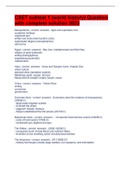
CSET subtest 1 (world history) Question with complete solution 2023Mesopotamia tigris and euphrates river cuneiform (writing) organized gov. written law code (hammurabi's code) systemized religion (zoroastrianism) astronomy Egypt Nile river, mediterranean and Red Sea religion of gods (pharaoh) writing (hieroglyphics) engineering (pyramids) mathematics India Indus and Ganges rivers, Arabian Sea urban culture planned cities (sanitation system) Metallurgy (gold, copper, bronze) Measurement (weight, height, length, mass) China Yellow River writing commerce government Sumerian facts Sumerians were the creators of mesopotamia (3000B.C) - large-scale irrigation system - invented the wheel - ziggurat= temple, treasury - Sargon established the first empire (2371B.C) Babylonian facts - conquered Sumeria/new empire (2300B.C) - code of hammurabi (1750B.C) - centralized gov./algebra and geo. The Hitties (B.C) - conquered much of Asia Minor and northern Meso - invention of iron smelling, which revolutionized warfare The Assyrians (911-550B.C0 - military techniques include siege warfare, iron weapons, and intimidation - centralized gov, postal service, library, and a system of highways The Chaldeans (605-538B.C) - conquered Mesopotamia, Syria, and Palestine - developed astrology, astronomy, advanced gov. bureaucracy, and architectural "Hanging Gardens of Babylon" The Persians - attempted to unify the entire Near East under one rule (500sB.C) - Persia established an international gov. - Zoroastrianism was an ethical religion based on concepts of good and evil - Persia was conquered by Alexander the Great (334-331B.C) The Phoenicians - first explorers, traders, and colonizers - invented the first true alphabet - dominated the Mediterranean commerce, exported manufactured glass and purple dye The Lydians - reached its zenith under King Croesus (golden kind) - responsible for the first coinage of money The Israelistes - established the first lasting monotheism - Saul established the first kingdom in Palestine (1030B.C) - after death of Solomon, Hebrews divided into two kingdoms (Israel and Judah) - disunity and conquest resulted in destruction of Israel/Judah (722/586B.C) Significant aspects of Egyptian civilizations: - dominated by concern for the afterlife, religion, and the pharaoh - medical advance and specialized surgery - invented hieroglyphic writing system - commerce flourished throughout Arabia, India and Africa - agriculture was the basis of economy - monumental architecture - annual flooding of the Nile was the basis for the sustained economy Greek contributions 1. organized warfare 2. literacture (poetry, Iliad, Odyssey) 3. History (persian and peloponnesian wars) 4. architecture (columns, parthenon) 5. arts (theatre, sculpture, pottery) 6. government (democracy, oligarchy, bureaucracy) The Aegean include: Minoan and Mycenaean civilizations Minoan civilization of Crete (4000B.C) based is prosperity on extensive commerce Mycenaean civilization (2000B.C) developed fortified cities and based its prosperity on trade and warfare - Dorians conquered the Peloponnesus which brought the "dark ages" of violence and instability Athens and Sparta -direct democracy - Sparta developed a totalitarian and military state dependent on slave labor to sustain its agricultural system The Peloponnesian War (431B.C) devastated both Athens and Sparta - Sparta was victorious but unable to unite the Greek city-states - greek individualism was a catalyst in the collapse Alexander the Great (356B.C) established the Hellenic Age - he conquered Asia, Persia, Egypt and established a world empire - bureaucracy replaced the city-state form of gov. Contributions of Greek World - founded philosphical schools, scientific method - established democracy and a system of law to improve society - advances in shipbuilding and commerce - architecture, sculpture, art, literature Roman Contributions 1. roman law (equality, civil and contract law codes) 2. engineering and architecture (arches, concrete, roman roads, aqueducts, monumental buildings) 3. culture (history, rhetoric) The Roman Republic - divided into patricians (propertied class), plebeians (main citizens), and slaves - roman gov. was based on consuls, the Senates and the Centurial Assembly -roman army became the most powerful military organization in the world Punic Wars with Carthage (146B.c) resulted in Rome becoming the most dominant power in the Mediterranean - economic/political decline and repeated civil wars ravaged the roman republic - Cesar was assassinated in 44B.C - Augustus became the first emperor of the Roman Empire in 27B.C The Roman Empire -lasted 5c. - Pax Romana (roman peace lasted 2c. without war) 27B.C-A.D180) - Constantine took over and the empire split into Western and Eastern Roman Empires - Barbarian invasions by the Goths, Huns devastated Rome and it fell in A.D 476 Causes for the fall of Rome 1. continuous barbaric invasion 2. political instability, decreasing farm production, inflation, taxation, and the decline of military 3. rise of Christianity divided the Empire Roman Contributions: 1. field of law 2. revolutionized building construction, engineering and road construction 3. monumental buildings Rise of Christianity 6B.C Jesus was born - Paul (jewish convert to christianity brought the gospel to non-jews) - christianity met resistance in the Roman world due rome's fall - adopted as the official religion by Constantine's A.D 313 Reason for the spread of Christianity: - St. Augustine became the first great Christian philosopher - efficiency and organization of the early church administration - doctrines that stressed equality and immortality - conversion of Constantine to Christianity (A.D 313) - official roman religion - establishment of the Pope Early Byzantine Civilization - Emperor Constantine founded the Byzantine Empire by establishing Constantinople as a "New Rome" in A.D. 476 - based on trade and Roman law lasted until A.D. 1453 Byzantine Accomplishments: 1. greek language 2. center for world trade and exchange of culture 3. Eastern church converted Slavic people into Christianity 4. new focus and glorification of Christianity Byzantine Success: 1. Constantinople was strategical located with defensible boarders in A.D330 2. was at a crossroads of world trade 3. lasted 1,000 yrs 4. economic prosperity was based on the commercial trade routes (silk trade) 5. excellent use of diplomacy and geographically distant from invasions Reasons for decline of the Byzantine Empire 1. its proximity to the Arabs, Slavs, Turks 2. loss of commercial dominance over the Italians 3. religious controversy and split with the Roman Catholic Church 4. sack of Constantinople during 4th Crusade 5. fall of Constantine (A.D 1453) Achievements of the Byzantine Empire 1. preserved the heritage of Greco-Roman civilization 2. spread civilization to all E. Europe 3. preserved the E. Orthodox Church 4. stability of its money economy Muslim Empire - based on the teachings of Mohammed - Koran became the center for the islamic moral and ethical conduct - ruled by Arab caliphs - Arabs conquered Byzantine and Persian empires 1. Battle of Tours (A.D. 732) resulted in Franks halting Muslim expansion 2. Muslim Spain lasted until A.D 1031 Muslim Empire divided - Abbasids overthrew the Umayyads- the capital moved to Baghdad - Iberian and N. Africa muslims broke from Baghdad's control - Turks assumed leadership of Muslim world Islamic Civilization 1. gov. and religion developed a framework for prosperity 2. trade helped spread Islamic culture (=high standard of living) 3. science and the arts flourished (military expansion) The Early Middle Ages (A.D 500-1000) - with the collapse of Rome, Europe entered a time of chaotic political, economic, and urban decline - the Middle Ages was a time of struggle back toward stability - the Christian Church and local nobles used their authority to form a new kind of society Feudalism ical- hierarchical and interdependent (church, lords, vassals, knights, and peasants) 2. economic- manor estates owned by lords 3. outcomes- political stability and foundation for nation-states, economic self-sufficiency, christian value system Dark Ages the result of the destruction of Rome from (A.D 500-800) The Franks dominant Germanic tribe - domestic feuds and civil war broke out among the Merovingians - political power shifted away from the monarchy - Charles Martel halted Muslim advance into Europe at the Battle of Tours (A.D. 732) his victory helped preserve western civilization The Carolingians replaced the Franks as legitimate rulers - Pepin the Short appointed the Pope as King and established the Papal States - Charlemagne (A.D 768) dominated the political structure of the Middle Ages - he was crowned "Emperor of the Romans" and revived the concept of the Holy Roman Empire and established authority over secular rulers The Frankish system The Treaty of Verdun (A.D. 871-99) divided Charlemagne's empire among his 3 grandsons - Carolingian rule ended in the 10c. bc of the decline in central authority and the invasion of Scandinavian tribes The Vikings -invaded and pillaged the coasts of Europe in the 8c. - The Danes were responsible for the major invasions in England - Alfred the Great established the English kingdom after stemming the Danish invasions - in France, Carolingian king was forced to cede Normandy to the Vikings Society in the Middle Ages under feudalism, political authority was dominated by the landed nobility - manoralism was the agricultural organization and economic foundation of feudalism The Later Middle Ages (c.) time of transition for Europe, included Greek and Roman classical culture= new modern Europe Nation-states of France the rise of feudal monarchs, France became a European power -conflicts with the Pope resulted in an increase in the authority of the monarch - The Hundred Years War () between England and France resulted in the English being driven out of most of France The Norman Conquest impact on culture, language, and the judicial system of England - Battle of Hastings (1066) ended Anglo-Saxon rule - c.12 England common law established - Magna Carta (125) limited the power of the king, most important document in english law English Parliament c.14 was established - gained power at the expense of the king - House of Lords and Commons composed Parliament Spain/ Portugal during Middle Ages The Reconquista reestablished Christianity control over Muslim Spain in 1492 - Spanish state had absolutist rule - the monarch instituted inquisitions and expelled the Jews Holy Roman Empire during Middle Ages Pope was dominant in religious matters, the monarch in secular matters Medieval Civilizations in Middle Ages -society was based on strict class division: clergy and nobility (privileged class), peasant and artisans (work force), serfs (tied to land) - decline of feudalism and manorialism Commercial Revival led to the rise of towns - true middle class emerged - guild system= economic activities (craft and merchant guilds) - The Crusades led to the revival of international trade Magna Carta (1215) - king's authority limited by law -respect for legal procedures - rights of the king's subjects declared (habeas corpus= be taken to court) - everyone including the king was subject to law Education in the Middle Ages -theology influenced religion/politics - universities were created (Oxford) - Latin was the language of intellectual Europe - Philosophy dealt with The Renaissance () - c.14 the move towards secularization was predominant (religion loses social/cultural significance) - humanism stressed the importance of the individual - classical arts General characteristics of the Renaissance - emphasis on man rather than god (progress through rational thought) - reawakening of classical models (realism= art emphasized on lives of everyday people) - ideal of the "universal man" The Reformation - Renaissance secularism created tension between princely kingdoms and the authority of the church - causing the rise of Protestant faith and religious warfare Reason for the Reformation - dissatisfaction with the church ritual - human emphasized man's needs and concerns - the printing press allowed mass communication - Calvinism became a revolutionary anti-catholic movement English Reformation - the Act of Supremacy (1534) marked the beginning of the reformation - king of England became head of church - pope's refusal of Henry VII marriage to Catherine initiated the break - the counter reformation attempted to halt the spread of Protestantism Effects of the Reformation - medieval political unity of Europe was replaced by the spirit of modern nationalism - authority of the state was strengthened - middle class was strengthened - calvinism gave capitalism its base - religious wars reflected the times The Age of Enlightenment () - disintegration of traditional feudal loyalties, rise of powerful monarchies, and collapse of single religious doctrine - philosophy influenced by the Age of Reason, proper function of government defined by Voltaire, Locke and Rousseau (led to French Revolution) - "laissez fair" (things take their own course without interference) Scientific Revolution - Copernicus= challenged the church doctrine of a geocentric (earth-centered) universe - Galileo= telescope provided first observational evidence in support of Copernicus - Newton= laws of motion and gravity The French Revolution began as an attempt of the industrial and commercial classes to end the injustices of the French monarchy - "Liberty, Equality, and Fraternity" Background to the French Rev. - unequal class structure was the basic cause - disorganized legal system and no representative assembly added to the problems of the gov. - bankruptcy of the French treasury Napoleon and the First Empire (1804) -domestic reforms resulted in a more sufficient gov. - no tax exemptions were allowed for lineage - the Code of Napoleon modernized French Law (equality before law) - continental system was a failed French attempt to close the continent to British trade in hopes in destroying British economy - Battle of Waterloo (1815) ended in defeat for Napoleon and ended the French Empire and he was sent to exile in St. Helena
Written for
- Institution
- CSET
- Module
- CSET
Document information
- Uploaded on
- April 13, 2023
- Number of pages
- 10
- Written in
- 2022/2023
- Type
- Exam (elaborations)
- Contains
- Questions & answers
Subjects
-
cset subtest 1 world history question with complete solution 2023
-
mesopotamia tigris and euphrates river cuneiform writing organized gov written law code hammurabis code systemized religion

Also available in package deal