Food Handler's Study Guide Latest Update Graded A+
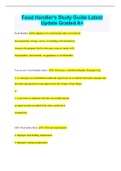
Food Handler's Study Guide Latest Update Graded A+ Food Handler an employee of a food facility who is involved in the preparation, storage, service, or handling of food products. Anyone who prepares food or who may come in contact with food products, food utensils, or equipment is a food handler. You are not a food handler unless: 1. Possesses a valid Food Handler Training Card, 2. is working in an establishment under the supervision of a certified food safety manager and has taken and passed an exam approved by the County of San Diego, or 3. is an owner or employee who has successfully passed an approved and accredited food safety certification examination. CDC Food Safety Risks 1. Poor personal hygiene 2. Improper food holding temperatures 3. Improper cooking temperatures 4. Contaminated equipment 5. Foods from unsafe sources Types of Germs/Pathogens These germs include viruses, protozoa, parasites, and bacteria Hepatitis A - Virus - Not washing hands after using the restroom Germs/Pathogens Germs are very small living organisms (viruses and bacteria). If eaten, germs can make you sick. You need a microscope to see these tiny organisms and they are almost everywhere. Toxins Toxins are poisons produced by bacteria. Toxins are not living organisms and are hard to destroy. It's important to destroy bacteria before they make toxins. Chemicals Chemicals are substances that can be dangerous if eaten. They can get into food by accident. Some chemicals often found in kitchens are cleansers,bleaches, sanitizing agents, and insecticides. Danger Zone (41°F or below), and hot food hot (135°F or higher). Bacteria produce Toxins #1 Cause of Spread of Germs FOOD HANDLERS Ways Food Handlers Can Spread Disease Not washing hands Skin lesions Nasal discharge or respiratory illness (sneezes/coughs) Working with food or utensils while ill with diarrhea, and/ or fever, vomiting, and stomach cramps Poor personal hygiene No Jewelry Except: Plain wedding band Washing Hands Warm Water Soap Dispenser (not bar) 10-15 seconds Rinse in warm running water Dry with a single-use towel or air dry Water Temp for hand washing should be: 100 F Hand Sanitizers should only be used After hand washing Gloves Wash hands before putting on gloves Change often PIC should ______ if sick Report to Department of Environmental Health, exclude a food handler is they have illness Cooked, ready to eat foods should be stored ____ raw foods Above Never add ______ to fresh fruits and vegetables, meat, fish, poultry Sulfites Raw foods prepared separate from Cooked foods Store Chemicals In original containers Dry, locked, cabinets Properly stored and labeled with name of contents and hazards Don't store toothpicks or inedible garnishes On shelves above food storage or preparation areas Protective Shields Over Food storage, produce display, and preparation areas Hot Holding 135 F or higher Cold Holding 41 F or less Except salad bars and buffets Salad Bars and Buffets 41-45 F for not more than 12 hours in one day. After 12 hours - DISPOSE Raw eggs in shell and unopened containers of pasteurized milk 41-45 F Place thermometer in WARMEST part of the refrigerator Usually near the door on the top shelf Refrigeration STOPS growth of germs Cooking to right temperature KILLS germs in food Cold and hot food holing checked every 2 hours and logged Record temp of reheated potentially hazardous foods to make sure it reaches internal temp of 165 or above Calibrate thermometer Once a week Ice Point Method (30 seconds until temp indicator stops moving, should read 32 F/0 C) Boiling Point method 212 F or 100 C What kind of thermometers to check internal temp of cooked food? PROBE or Digital Thermometer BEST for internal temp of hamburgers? Thermocouple Fruit and Veggie Internal Temp 135 F Shell Eggs, Fish, Single pieces of Meat 145 F for 15 seconds Comminuted Meat, injected meats, raw eggs for later servies 155 F for 15 sec Poultry, stuffed items 165 F for 15 sec Roasts (beef, pork and ham) 130 F or as specified in the CA Retail Food Code Internal Temp is not the Oven temp It is internal temp of food after cooked After Heating, Cooking, or hot holding foods must be rapidly cooled from 135 to 70 F within 2 hours Then: 70-41 within 4 hours Large portions of food should be DIVIDED into smaller containers to ensure rapid cooling Rapid Cooling Methods 1. Placing the food in shallow pans. 2. Separating the food into smaller or thinner portions. 3. Using rapid cooling equipment. 4. Using containers that facilitate heat transfer. 5. Adding ice as an ingredient. 6. Using ice paddles. 7. Inserting containers in an ice bath and stirring frequently. Food Containers used for COOLING should: Be kept loosely covered or uncovered if protected from overhead contamination and stirred if necessary 4 approved methods of THAWING 1. In the refrigerator 2. Completely submerged under running water at a water temperature of 70°F or below for not more than 2 hours (must be able to flush food particles away) 3. In the microwave 4. While cooking Reheating Food Use cooking equipment or microwave to an internal temperature of 165 F WITHIN 2 HOURS NEVER reheat food from IN THE STEAM TABLE If food is reheated in microwave Reheat all parts of the food to an internal temperature of 165 F and rotate or stir the food, keep it covered, and allow it to stay covered for TWO minutes after reheating Commercially processed ready to eat PHF (canned vegetable, etc.) Reheated to an internal temp of 135 or above WITHIN TWO HOURS Consumer Advisory NOT required for Sashimi, seared Ahi Tuna, and steak tartare because it is common knowledge that these items are served raw. A consumer advisory is not required when a customer specifically orders food raw or undercooked (i.e., rare steak or soft boiled eggs). Consumer Advisory REQUIRED for If a food facility serves raw or undercooked beef, pork, poultry, fish, eggs, or foods containing raw or undercooked eggs (i.e., Cesar Salad Dressing or Hollandaise Sauce), an advisory either orally (at the time of ordering) or in writing (on the menu) has to be given to the customer stating that the food is raw or undercooked Food must be from an Approved Source Acceptable to Department of Health Permitted, licensed or registered (USDA, FDA, or State of CA) Food cannot be prepared in a PRIVATE HOME Cheese must be purchased from a licensed distributor. The label must have the manufacturer name, address, processing plant number, ingredients and expiration date. Packaged Foods must be Labeled Tags for Shellfish must be kept with the container they are stored in until it is empty. The tags also have to be kept on file at the facility for at least 90 days. Between months of April and October Raw Gulf Coast Oysters can't be served or sold without a copy of a certificate that says they are treated. Between the months of November 1 to March 31 If raw Gulf Coast Oysters are served or sold, warning signs have to be posted for untreated Gulf Coast Oysters Hot water in Sink 110 F Sanitize - Contact for 30 seconds in 180 F water - Contact for 30 seconds with a warm water solution of 100 ppm chlorine - Contact for 60 seconds with a warm solution of 220 ppm quaternary ammonium - Contact for 60 seconds with a warm water solution of 25 ppm Iodone Meat Grinders Take apart, clean, and sanitize MEAT GRINDERS at least every 4 HOURS and between processing different types of food - Clean daily if in refrigerated room DELI SLICERS Clean every 4 hours or in between raw foods Fly can carry 6 million germs Vomit on food to make it soft and then suck it up
Written for
- Institution
- Food handlers
- Module
- Food handlers
Document information
- Uploaded on
- April 19, 2023
- Number of pages
- 12
- Written in
- 2022/2023
- Type
- Exam (elaborations)
- Contains
- Questions & answers
Subjects
-
storage
-
service
-
food handlers study guide latest update graded a
-
food handler an employee of a food facility who is involved in the preparation
-
or handling of food products anyone who prepare

Also available in package deal