PHIL-447N Week 5 Discussion Question 1 – Working With Categorical Syllogisms (graded)
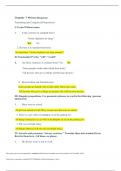
PHIL-447N Week 5 Discussion Question 1 – Working With Categorical Syllogisms (graded) Chapter 7 Written Response Translating into Categorical Propositions I) Terms Without nouns 1. Is th is sentence in standard form? “Some elephants are large.” Yes No 2. Rewrite it in standard form here: Or translated: “Some elephants are large animals” II) Nonstandard Verbs: “will”, “would” 1. Are these sentences in standard form? Yes No “Some people would rather flunk than study.” “All persons who go to college will become doctors.” 2. Rewrite them and Translate here: Some people are people who would rather flunk than study. All persons who go to college are people who will become doctors. III) Singular propositions. Use parameter phrases to rewrite the following. (persons identical to) 1. Mary went to school. All persons identical with Mary are persons that went to school. 2. There is a car with its headlights on in the parking lot. All things identical to a car with its headlights on are in the parking lot. 3. The sun is bright today. All things identical with the sun are bright today. IV) Adverbs and pronouns: “always, nowhere.” Translate these into standard from. Rewrite them here. (All times, no places). 1. He always wears a suit to work. All times he goes to work are times he wears a suit. 2. Nowhere on earth are there any ghosts. No ghosts are on earth. V) Non-Standard Quantifiers:” all are not; few; a few.” Note: “all...are not” translates to “no” or “some are not”. 1. Translate and rewrite the next three statements: 2) All dogs are not cats.” No dogs are cats. 3) “Few patriots have enemies.” (translation uses both I or O propositions) Some patriots are patriots that have enemies. 4) "A few lizards have lumps.” Some lizards are lizards that have lumps. VI) Conditional Statements: Note: If the antecedent and consequent refer to the same thing then translate as universal. Conditionals with a negated consequent translate to E proposition: Rewrite and Translate: 1. “If it’s a mouse then it’s a mammal.” All mice are mammals. 2. “If it’s a turkey then it’s not a mammal.” All turkeys are not mammals. VII) Exclusive Statements: Note: “only, only if, none but” always signal the predicate. Rewrite and Translate: 1.“None but the brave deserves the fair.” All of the brave people are people that deserve the fair. VIII) Note: “The only” signals the subject. Translate it as “all”. 1. Translate: “The only animals that live in this canyon are skunks.” All animals that live in this canyon are skunks
Written for
- Institution
- Chamberlain College Of Nursing
- Module
- PHIL 447N
Document information
- Uploaded on
- May 20, 2023
- Number of pages
- 3
- Written in
- 2022/2023
- Type
- Other
- Person
- Unknown
Subjects
-
working with categorical syllogisms graded chapter 7 written response translating into categorical propositions i terms without nouns 1 is th is sentence in standard form “some elephants are larg

Also available in package deal