Summary IB Chemistry Topic 7/17: Equilibrium
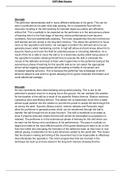
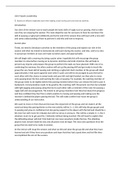
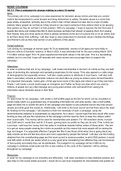
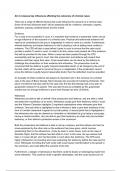
IB Chemistry Topic 7/17: Equilibrium Equilibrium is a fundamental topic in chemistry that focuses on understanding the dynamic balance between reactants and products in a chemical reaction. It involves the study of factors that influence the position of equilibrium, Le Chatelier's principle, and the calculation of equilibrium constants. 1. Dynamic Equilibrium: Dynamic equilibrium is achieved when the rates of the forward and reverse reactions in a chemical system become equal. At equilibrium, the concentrations of reactants and products remain constant over time, although the reactions continue to occur. 2. Equilibrium Constant (Kc): The equilibrium constant (Kc) is a mathematical expression that quantifies the extent of a chemical reaction at equilibrium. It represents the ratio of product concentrations to reactant concentrations, each raised to their stoichiometric coefficients. 3. Factors Affecting Equilibrium: Several factors can influence the position of equilibrium: - Concentration: Changing the concentration of reactants or products shifts the equilibrium towards the side with a lower concentration. - Temperature: Altering the temperature can shift the equilibrium either towards the exothermic (heat-releasing) or endothermic (heat-absorbing) direction. - Pressure (for gaseous reactions): Changing the pressure by altering the volume affects equilibrium only if the reaction involves a different number of moles of gas on each side. 4. Le Chatelier's Principle: Le Chatelier's principle states that if a system at equilibrium is subjected to a stress, it will respond by shifting the equilibrium position to minimize the effect of the stress. For example: - Increasing the concentration of a reactant or product shifts the equilibrium away from the added component. - Increasing the pressure (or decreasing the volume) of a gaseous system shifts the equilibrium towards the side with fewer moles of gas. 5. Calculations and Equilibrium Expressions: Equilibrium expressions are used to calculate the concentrations of reactants or products at equilibrium. These expressions are derived from the balanced chemical equation and the stoichiometric coefficients. Understanding equilibrium is crucial for predicting the behavior of chemical reactions, optimizing reaction conditions, and designing industrial processes. It provides insights into reaction rates, concentrations, and the establishment of steady states in chemical systems.
Written for
- Institution
-
Imperial College London (ICL)
- Study
- Unknown
- Module
-
Chemistry
Document information
- Uploaded on
- June 27, 2023
- Number of pages
- 4
- Written in
- 2021/2022
- Type
- SUMMARY
Subjects
- equilibrium law
-
equilibrium