OUPV NAVIGATION GENERAL|UPDATED&VERIFIED|100% SOLVED|GUARANTEED SUCCESS
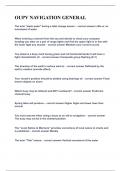
The term "slack water" during a tidal change means: Little or no movement of water When entering a channel from the sea and decide to check your compass heading you steer on a pair of range lights and find the upper light is in line with the lower light you should: Maintain your current course You observe a buoy mark having green and red horizontal bands it will have a light characteristic of: Composite group flashing (2+1) The direction of the earth's surface wind is: Deflected by the earth's rotation (coriolis effect) Your vessel's position should be plotted using bearings of: Fixed known objects on shore Which buoy may be lettered and NOT numbered? Preferred-channel buoy Spring tides will produce: Higher highs and lower lows than normal You must assume when using a buoy as an aid to navigation: The buoy may not be in the charted position The "Local Notice to Mariners" provides corrections of local nature to charts and is published: Weekly The term "Tide" means: Vertical movement of the water When plotting a voyage, you should: Never rely on a floating buoy to maintain its exact position the difference in height between high tide and low tide: Range of tide From seaward the IALA Region B red and green horizontally-banded buoys refer to: Preferred channels Determining the heights of the land features on most charts unless otherwise stated the "reference datum" is: Mean high water Red or green lights may appear on: Horizontally banded buoys The depth of the water on the chart is the: Vertical distance from the chart sounding datum to the ocean bottom A North Hemisphere wind which shifts in a counter clockwise motion is called a: Backing wind A vessel's position acquired by using at least three or more bearings are called a: Fix Mean lower low water (MLLW) is the reference plane used for: Sounding on the U.S. east and west coasts A single line of position combined with a dead-reckoning position results in a(n): Estimated position The sun and moon align twice each month--what type of tides can be expected? Spring A buoy mark with a composite group-flashing light indicated a: Preferred channel On the U.S. east and west coasts charted depths are taken from: Mean lower low water A weather forecast expects a "backing" wind. In the Northern Hemisphere, this would indicate that it will: Shift in a counter clockwise manner What type of tides occur when the sun and moon are at right angles (90 degrees) to each other? Neap If lighted preferred-channel buoy will show a: Composite group-flashing (2+1) red or green light A weather forecast expects a "veering" wind. In the Northern Hemisphere, this would indicate that it will: Shift in a clockwise manner The length of a lunar day is: About 50 minuted longer than the solar day A lighted preferred-channel buoy may show a: Composite group-flashing light To determine the depth of the water--what should you apply to your depth finder reading? Add the draft of the vessel
Written for
- Institution
- OUPV NAVIGATION GENERAL\'
- Module
- OUPV NAVIGATION GENERAL\'
Document information
- Uploaded on
- July 25, 2023
- Number of pages
- 10
- Written in
- 2022/2023
- Type
- Exam (elaborations)
- Contains
- Questions & answers
Subjects
-
oupv navigation general|updatedampverified|100 solv

Also available in package deal