Management Questions and Answers 100% correct
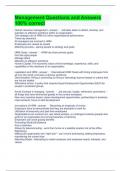
Human resource management - answer Activities taken to attract, develop, and maintain an effective workforce within an organization
The strategic role of HRM is to drive organizational performance
Three key elements
All managers are involved in HRM
Employees are viewed as assets
Matching process - pairing people to strategy and goals
HRM Goals - answer HRM has three primary goals:
Find the right people
Manage talent
Maintain an effective workforce
Human Capital: The economic value of the knowledge, experience, skills, and capabilities of the members of an organization
Legislation and HRM - answer International HRM: Deals with hiring employees from all over the world, promotes a diverse workforce
Discrimination: Hiring or promoting (or firing or demoting) anyone based on criteria that are not job related
Affirmative Action: A policy that requires Equal Employment Opportunities (EEO) for people in protected groups
Social Contract is changing - answer Job security, loyalty, retirement, promotions - all things that have diminished greatly in the current workplace
Now very incentive based, career development opportunities, partnerships in business improvements, focus on skill development
Innovations of HRM - answer Becoming an employer of choice
Employers have to demonstrate that they are desirable to work for
Utilization of temporary and part-time employees
Organizations can contract out, use virtual workers, or contingent workers (people who work for an organization but not permanently or full-time)
Employers can avoid paying benefits
Promoting Work/Life Balance
Key to retention
Allows for telecommuting - work from home or a satellite location not at the office
Rightsizing
Making the organization the "right size" - can involve downsizing, adding employees, maintaining the current size
Matching Model - Attempting to match employer and employee needs, interests, and values
Human resource management - answer Activities taken to attract, develop, and maintain an effective workforce within an organization
The strategic role of HRM is to drive organizational performance
Three key elements
All managers are involved in HRM
Employees are viewed as assets
Matching process - pairing people to strategy and goals
HRM Goals - answer HRM has three primary goals:
Find the right people
Manage talent
Maintain an effective workforce
Human Capital: The economic value of the knowledge, experience, skills, and capabilities of the members of an organization
Legislation and HRM - answer International HRM: Deals with hiring employees from all over the world, promotes a diverse workforce
Discrimination: Hiring or promoting (or firing or demoting) anyone based on criteria that are not job related
Affirmative Action: A policy that requires Equal Employment Opportunities (EEO) for people in protected groups
Social Contract is changing - answer Job security, loyalty, retirement, promotions - all things that have diminished greatly in the current workplace
Now very incentive based, career development opportunities, partnerships in business improvements, focus on skill development
Innovations of HRM - answer Becoming an employer of choice
Employers have to demonstrate that they are desirable to work for
Utilization of temporary and part-time employees
Organizations can contract out, use virtual workers, or contingent workers (people who work for an organization but not permanently or full-time)
Employers can avoid paying benefits
Promoting Work/Life Balance
Key to retention
Allows for telecommuting - work from home or a satellite location not at the office
Rightsizing
Making the organization the "right size" - can involve downsizing, adding employees, maintaining the current size
Matching Model - Attempting to match employer and employee needs, interests, and values