Cognitive Psychology:
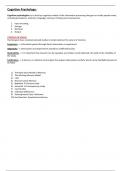
Cognitive psychologists try to build up cognitive models of the information processing that goes on inside people minds,
including perceptions, attention, language, memory, thinking and consciousness.
1. Input encoding
2. Storage
3. Retrieval
4. Output
4 features of science:
Psychologists have creatively devised studies to empirically test the nature of memory:
Empiricism --> information gained through direct observation or experiment
Objectivity --> observations and experiments should be unaffected by bias
Replicability --> it is important that research can be repeated, and similar results obtained, this adds to the reliability of
the study
Falsification --> A theory is a collection of principles that explain observations ad facts which can be falsifiable (proved to
be false)
1) The Multi Store Model of Memory
2) The Working Memory Model
3) LTM
4) Reconstructive Memory
5) Baddeley à Classical study
6) Schmolck à Contemporary study
7) Case Studies
8) Individual Differences
9) Developmental Case: Alzheimer
10) Key Question: Eyewitness testimony
, The Multi-store model of memory (Atkinson and Shiffrin, 1968)
MSS à The multi-store memory was created by Richard Atkinson and
Richard Shiffrin (1968). He attempts to explain how the whole memory
system works. They suppose memory is made up of 3 distinct of separate
types of stores.
STM à a temporary place for storing information received through the
senses where it has received attention
LTM à the type of memory responsible for the storage of information for an
extended period of time
Nature of Nature of A study that has Strengths and weaknesses of the Nature of A study that has Strengths and weaknesses of the
memory STM investigated this study LTM investigated this study
Capacity: 7+/- 2 Serial digit span study: Strength: Unlimited Brady (2008): Strength:
à Alternative explanation à Showed 2500 objects àHigh internal validity
à Done by miller in à Ethical over 5.5 hours àConfounding variables such as how
1956 à Reliability / research meaningful pictures were to people
à Validity à Internal validity was àLater shown pairs of à Situation variables controlled
à Using a high - confounding variable such as objects and were asked
tachistoscope, noise and distraction were the same to identify which of the Weakness:
participants were for all participants two they had seen àLow ecological validity àThe study
presented with used artificial stimulus material
numbers increasing in Weakness: àNovel object - 92% which people don’t tend to do in real
length that they would à Generalisability (low ecological correct life activities
have to report back in validity, low mundane realism) à àExemplar object - 88% àConstruct Validity àPoor
order. Ecological validity was low - the correct operationalisation, measuring short-
study was used artificial stimulus àDifferent angle - 87% LTM memory
à Miller observed that material which people don’t tend to correct
pieces of information do in real life activities, and it was
tended to come in 7 controlled in a lab
Duration: 15- Trigram Experiment: Strength: Up to a Very Long-term Memory Strength:
30seconds à Alternative explanation lifetime Experiment: à High mundane realism
àPeterson and à Ethical à Generalisability à Ecological
Peterson (1959) à Reliability / research à Bahrick Et Al (1975) validity was high - the study used
à Validity à Internal validity was naturally occurring form of
àAsking subjects to high - confounding variable such as àTo test LTM using information so avoided the
remember a single noise and distraction were the same naturalistic materials artificiality often present in memory
nonsense syllable of for all participants studies
three consonants à 392 American ex high
Weakness: school student ages 17- Weakness:
àGiving them a àGeneralisability à Ecological 74 years tested for recall à Low population validity
distractor task to stop validity was low - the study was of classmates (ethnocentric)
rehearsing the trigram used artificial stimulus material à Not standardised
which people don’t tend to do in à Participants could still à Low internal validity à
àTesting there recall real life activities recall memories up to 34 Confounding variables such as how
after 3,6,9,12,15, or 18 years often participants have referred back
seconds to their yearbook not controlled
à 47 years there was in
a dip in their recall
à Three tests: free
recall, name recognition,
recognition of photos
Encoding: Sounds Baddeley (1966): Strength: Sounds Baddeley (1996): Strength:
(acoustically) à Internal validity was high à (semantically) à Internal validity was high à
à The STM encodes Cofounding variable such as noise àThe LTM encodes Cofounding variable such as noise
acoustic information and distraction were the same for semantic information and distraction were the same for all
all participants participants
Weakness: Weakness:
à Ecological validity was low à à Ecological validity was low àThe
The study used artificial stimulus study used artificial stimulus material
material which people don’t tend to which people don’t tend to do in real
do in real life activities à life activities à Controlled lab
Controlled lab experiment experiment
, Supporting Evidence:
- Glanzer & Cunitz research (serial position effect – primacy and receny effect)
• Glanzer and Cunitz found that participants who were asked to remember a series of words could remember
the first and last few items but the ones in the middle were more difficult due to limited capacity and duration.
• The primacy effect is where the first items in the list have been stored in LTM because there was enough
capacity and duration to rehearse and transfer to LTM.
• The recency effect is where the last words from the list are still in the STM (seen less than 30 seconds) and
therefore remembered too.
• When an interference task of 30seconds was given to the participants, there was no recency effect because the
interference task displaced items from the STM (over 30 seconds, great than 5-9 items).
=> This research support gives validity to the MSM claim that there are 3 distinct and separate stores.
- Clive Wearing & HM
• Clive wearing who suffered from the herpes encephalitis virus inside his brain which damaged his hippocampus
causing a condition called anterograde amnesia. HM contracted the same condition after surgery to correct
epilepsy. He could not store new long-term memories after the virus.
• The transfer processes had eased. He appeared to have a normal functioning STM though.
=> This was a case study of one person we can’t generalize to everyone as the behaviours and symptoms may be due to
individual differences.
=> This gives the MSM validity because of the confirmed transfer process from the STM to LTM.
Opposing Evidence:
- Not unitary stores – dual task performance
• The multi store model doesn’t describe the complexity of the processes involved - it assumes a single, unitary
STM store
• A patient known as KF suffered brain damage in a motorcycle accident. KF had problems with verbal information
in his STM - his memory for visual information was largely unaffected.
• This shows that there are sperate STM components for visual information (VSS) and verbal information
(phonological loop)
=> This suggests that there is more than one type of STM store and therefore the MSM is reductionist.
- Over emphasizes rehearsal (levels of processing)
• The multi-store model of memory over-emphasis the role of rehearsal in memory.
• The model suggests information must be repeated over and over to be remembered, however.
• Craik & Lockhart's levels of processing theory suggests information is remembered if its meaningful and doesn’t
need to be rehearsed.
• Deep processing (meaning) is better than shallow processing (physical) in retaining LTM
=> This renders the MSM reductionist as it doesn’t consider the important of emotion and relevance of material to
individuals
Cognitive psychologists try to build up cognitive models of the information processing that goes on inside people minds,
including perceptions, attention, language, memory, thinking and consciousness.
1. Input encoding
2. Storage
3. Retrieval
4. Output
4 features of science:
Psychologists have creatively devised studies to empirically test the nature of memory:
Empiricism --> information gained through direct observation or experiment
Objectivity --> observations and experiments should be unaffected by bias
Replicability --> it is important that research can be repeated, and similar results obtained, this adds to the reliability of
the study
Falsification --> A theory is a collection of principles that explain observations ad facts which can be falsifiable (proved to
be false)
1) The Multi Store Model of Memory
2) The Working Memory Model
3) LTM
4) Reconstructive Memory
5) Baddeley à Classical study
6) Schmolck à Contemporary study
7) Case Studies
8) Individual Differences
9) Developmental Case: Alzheimer
10) Key Question: Eyewitness testimony
, The Multi-store model of memory (Atkinson and Shiffrin, 1968)
MSS à The multi-store memory was created by Richard Atkinson and
Richard Shiffrin (1968). He attempts to explain how the whole memory
system works. They suppose memory is made up of 3 distinct of separate
types of stores.
STM à a temporary place for storing information received through the
senses where it has received attention
LTM à the type of memory responsible for the storage of information for an
extended period of time
Nature of Nature of A study that has Strengths and weaknesses of the Nature of A study that has Strengths and weaknesses of the
memory STM investigated this study LTM investigated this study
Capacity: 7+/- 2 Serial digit span study: Strength: Unlimited Brady (2008): Strength:
à Alternative explanation à Showed 2500 objects àHigh internal validity
à Done by miller in à Ethical over 5.5 hours àConfounding variables such as how
1956 à Reliability / research meaningful pictures were to people
à Validity à Internal validity was àLater shown pairs of à Situation variables controlled
à Using a high - confounding variable such as objects and were asked
tachistoscope, noise and distraction were the same to identify which of the Weakness:
participants were for all participants two they had seen àLow ecological validity àThe study
presented with used artificial stimulus material
numbers increasing in Weakness: àNovel object - 92% which people don’t tend to do in real
length that they would à Generalisability (low ecological correct life activities
have to report back in validity, low mundane realism) à àExemplar object - 88% àConstruct Validity àPoor
order. Ecological validity was low - the correct operationalisation, measuring short-
study was used artificial stimulus àDifferent angle - 87% LTM memory
à Miller observed that material which people don’t tend to correct
pieces of information do in real life activities, and it was
tended to come in 7 controlled in a lab
Duration: 15- Trigram Experiment: Strength: Up to a Very Long-term Memory Strength:
30seconds à Alternative explanation lifetime Experiment: à High mundane realism
àPeterson and à Ethical à Generalisability à Ecological
Peterson (1959) à Reliability / research à Bahrick Et Al (1975) validity was high - the study used
à Validity à Internal validity was naturally occurring form of
àAsking subjects to high - confounding variable such as àTo test LTM using information so avoided the
remember a single noise and distraction were the same naturalistic materials artificiality often present in memory
nonsense syllable of for all participants studies
three consonants à 392 American ex high
Weakness: school student ages 17- Weakness:
àGiving them a àGeneralisability à Ecological 74 years tested for recall à Low population validity
distractor task to stop validity was low - the study was of classmates (ethnocentric)
rehearsing the trigram used artificial stimulus material à Not standardised
which people don’t tend to do in à Participants could still à Low internal validity à
àTesting there recall real life activities recall memories up to 34 Confounding variables such as how
after 3,6,9,12,15, or 18 years often participants have referred back
seconds to their yearbook not controlled
à 47 years there was in
a dip in their recall
à Three tests: free
recall, name recognition,
recognition of photos
Encoding: Sounds Baddeley (1966): Strength: Sounds Baddeley (1996): Strength:
(acoustically) à Internal validity was high à (semantically) à Internal validity was high à
à The STM encodes Cofounding variable such as noise àThe LTM encodes Cofounding variable such as noise
acoustic information and distraction were the same for semantic information and distraction were the same for all
all participants participants
Weakness: Weakness:
à Ecological validity was low à à Ecological validity was low àThe
The study used artificial stimulus study used artificial stimulus material
material which people don’t tend to which people don’t tend to do in real
do in real life activities à life activities à Controlled lab
Controlled lab experiment experiment
, Supporting Evidence:
- Glanzer & Cunitz research (serial position effect – primacy and receny effect)
• Glanzer and Cunitz found that participants who were asked to remember a series of words could remember
the first and last few items but the ones in the middle were more difficult due to limited capacity and duration.
• The primacy effect is where the first items in the list have been stored in LTM because there was enough
capacity and duration to rehearse and transfer to LTM.
• The recency effect is where the last words from the list are still in the STM (seen less than 30 seconds) and
therefore remembered too.
• When an interference task of 30seconds was given to the participants, there was no recency effect because the
interference task displaced items from the STM (over 30 seconds, great than 5-9 items).
=> This research support gives validity to the MSM claim that there are 3 distinct and separate stores.
- Clive Wearing & HM
• Clive wearing who suffered from the herpes encephalitis virus inside his brain which damaged his hippocampus
causing a condition called anterograde amnesia. HM contracted the same condition after surgery to correct
epilepsy. He could not store new long-term memories after the virus.
• The transfer processes had eased. He appeared to have a normal functioning STM though.
=> This was a case study of one person we can’t generalize to everyone as the behaviours and symptoms may be due to
individual differences.
=> This gives the MSM validity because of the confirmed transfer process from the STM to LTM.
Opposing Evidence:
- Not unitary stores – dual task performance
• The multi store model doesn’t describe the complexity of the processes involved - it assumes a single, unitary
STM store
• A patient known as KF suffered brain damage in a motorcycle accident. KF had problems with verbal information
in his STM - his memory for visual information was largely unaffected.
• This shows that there are sperate STM components for visual information (VSS) and verbal information
(phonological loop)
=> This suggests that there is more than one type of STM store and therefore the MSM is reductionist.
- Over emphasizes rehearsal (levels of processing)
• The multi-store model of memory over-emphasis the role of rehearsal in memory.
• The model suggests information must be repeated over and over to be remembered, however.
• Craik & Lockhart's levels of processing theory suggests information is remembered if its meaningful and doesn’t
need to be rehearsed.
• Deep processing (meaning) is better than shallow processing (physical) in retaining LTM
=> This renders the MSM reductionist as it doesn’t consider the important of emotion and relevance of material to
individuals