Summary Abnormal Psychology (Chapters 1-7) class notes lates
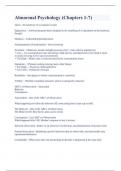
Abnormal Psychology (Chapters 1-7) Genes - the hardware of a computer system Epigenetics, - Software/program that's designed to do something (it is dependent on the hardware though) Diathesis - Vulnerability/predisposition Norepinephrine (Noradrenaline) - Stress hormone Serotonin - • Behavior, moods, thought processes (low = more risk for impulsivity) • Low--- it's concentration issues and energy, high anxiety, and depression (your mind is spent so much on trying to levy up your emotions) • Too High--- Manic state, overly elevated mood, concentration issues Dopamine - • Pleasure seeking (among many other things) • Too High---- Psychosis (Schizophrenia), • Too Little--- Parkinson's Disease Reliability: - the degree to which a measurement is consistent Validity: - Whether something measures what it is designed to measure ABC's of Observation - Antecedent Behavior Consequence Antecendent - One of the ABC's of Observation. What happened just before the behavior (IE: mom asking boy to put cup in sink) The Behavior - One of the ABC's of Observation. The Behavior (IE: Boy throws glass across room) Consequence - Last ABC's of Observation What happened after? (IE: Mother's response to boy's actions) Informal observation - Relies on an observer's recollection, and interpretation of factual events Formal observation - Identifying specific behaviors that are observable, and measurable (aka operational definition) Comorbidity - When more than one psychological disorder is diagnosed at the same time False Positives - When a test shows no problem when it does exist. False Negatives - When a test shows a problem although no difficulty is present. Generalized biological vulnerability - Example: Tendency to be uptight or high-strung based on birth/familiy heritable contribution to negative affect (irritable, driven/ glass is half empty) Generalized psychological vulnerability - Example: You might grow up believing the world is a dangerous place and not be able to cope when things go wrong for you... Physical sensations are potentially dangerous Specific psychological vulnerability - Example: You learn early experience such as being taught by your parents, that some objects are very dangerous (even if they actually aren't) Sense that events are uncontrollable/unpredictable GAD (Generalized Anxiety Disorder) - At least 6 months of excessive anxiety and worry and that it's difficult to turn off or control the process of worrying.. *** This is what is a pathological worrier not just normal 2/3 are FEMALE It is CHRONIC Anxiety Treatments: Psychological - Designated treatments that force patients to face their anxious feelings head on. Teaching patients how to relax deeply to combat tension. They teach them to counteract and work through the worry process. They teach acceptance instead of avoidance of these anxious thoughts and feelings. Anxiety Treatments: Benzodiazepines - Carry the risk: people aren't alert on them. (adults fall a lot and fracture hips...); seem to produce psych/physical dependence making it difficult for people to stop when on them So they are the most effective when used short time during a particularly stressful event: such as family problem/death etc. Drugs are effective but psychological treatments are more effective long term. (actually helping them feel the anxiety rather than avoiding it) Panic Disorder - Severe panic attacks; start at usually mid-teens to about 40 years of age 75% or more are women. Agoraphobia - The fear of these panic attacks; They try to put themselves in a place that is the safest around the safest people in fear that they might have a panic attach. Fear and avoidance of situations in which a person feels unsafe or unable to escape in the event of a developing panic symptoms/physical symptoms (they never know when it's going to happen) they never want to leave their house because of it. Or go anywhere. They are so afraid of not being in control so they never want to leave anywhere. Typical places/situations avoided by people with agoraphobia: Shopping malls, cars, buses, trains, subways, wide streets, tunnels, restaurants, theaters, escalators, elevators, planes, crowds, stores, supermarkets, waiting in line, staying at home alone, being far from home. **These people avoid anything that might even create an anxious sensation: some even avoid exercise because it increases heart rate and sweat which scares them. 2/3 of patients are women. **** Panic attacks are the AVOIDANCE OF : - Interoceptive: sensations Agoraphobia: places Four major sub-classifications of phobias - 1. Blood/injection/injury type phobia 2. Situational type (planes, enclosed places, elevators etc.) 3. Environment type (heights, storms, water etc.) 4. Animal type 5. "other" (phobias that don't fit into any other type) Claustrophobia is a ______ phobia - Situational Phobia You are afraid of water, heights or storms you have a ______ phobia - Environment Phobia How is a phobia created? - 1. Traumatic conditioning experience (even hearing about a frightening moment can do it for some people) 2. Inherit tendency 3. Must believe that it is possible to happen again SAD (Social Anxiety Disorder) - #2 Anxiety disorder in the world. * as many as 12.1% of population suffer from SAD at some point (Sex ratio 50:50) Selective Mutism - Rare childhood disorder, with a lack of speech in one or more settings in which speaking is socially expected. Example: they can speak in the home, but they can't speak in public settings like school. *100% of the children in the study met criteria for SAD too. PTSD - Exposure to traumatic experiences witnessing death, or threatened death, actual or threatened serious injury, or actual or threatened sexual violation. ******Cannot be diagnosed until a month after the incident Acute Stress Disorder - This is PTSD, but the first wave of it within the first month of the incident. It is the severe immediate reaction. 50% of those who have Acute Stress Disorder develop into PTSD. ... - Attachment Disorders Children are unable or unwilling to form relationships with caregiving adults. (due to inadequate or abusive child-rearing practices- such as multiple homes/families/foster parents etc. )*** a high stressing situation Reactive Attachment Disorder: - child very seldom seeks caregiver for protection, support or nurturance and doesn't respond when caregiver does give these things. Disinhibited Social Engagement Disorder: - Early persistent harsh punishment; pattern of behavior which child shows no inhibitions whatsoever to approaching adults; child shows complete willingness to accompany any adult no matter how unfamiliar somewhere without ever checking with the parent/guardian. OCD - The devastating accumulation of anxiety disorders; they may be experiencing all of the symptoms of the above anxieties; danger is an event in a thought, image or impulse that the client attempts to avoid as completely as someone with a snake phobia voids snakes. Obsessions - Intrusive nonsensical thoughts images or urges that individual tries to eliminate or resist Compulsions - Are the thoughts or actions used to suppress the obsessions and provide relief; usually "magical" they have nothing to do with the obsession. **BUT they are believed to reduce stress or prevent a dreaded event OCD ratios - M/F 1:1, but with children slightly more males--- ( males onsets between 13 & 15, and in females 20-24... once developed it becomes CHRONIC) How does OCD begin? - Has to spring from the Anxiety of having these unwanted intrusive obsessive thoughts. *They're afraid that if they think these things they might happen, and then it would be their fault if they did happen. Believing certain thoughts are unacceptable and must be suppressed put people at risk for OCD. Body Dysmorphic Disorder - "imagined ugliness"; an imagined defect of someone who looks quite normal; literally believing that your social anxiety comes because everyone is looking at a specific awful part of you--- your head is square for example. 24% suicide rate--- after surgery the distress either did not change or increased.
Written for
- Institution
- Abnormal Psychology
- Module
- Abnormal Psychology
Document information
- Uploaded on
- August 25, 2023
- Number of pages
- 11
- Written in
- 2023/2024
- Type
- Summary
Subjects
-
reliability the
-
abnormal psychology chapters 1 7 class notes lat
-
epigenetics softwareprogram thats designed to
-
low its concentration issues and energy hi
-
too high psychosis schizophrenia

Also available in package deal