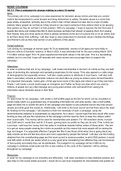
TF-CBT - 基礎 (1)|2023/24 UPDATE|GRADED A+
How often should TF-CBT treatment sessions be conducted? a. At least 1 session per month b. Once a week or more frequently c. Never less than 1 session every 2 weeks d. Once a week with the child and once every two weeks with the parent/caregiver e. Two sessions per week b. Once a week or more frequently Weekly sessions are the TF-CBT standard, and treatment can be delivered more frequently if circumstances make that possible. What is the typical length of a full course of TF-CBT? a. 6-12 sessions b. 8-50 sessions c. 12-25 sessions d. 18-40 sessions e. 25-30 sessions c. 12-25 sessions A typical course of TF-CBT should take somewhere between 3-5 months of regular weekly sessions. For what age range of children has TF-CBT been found to be effective? a. 10-18 years b. 7-17 years c. 5-12 years d. 3-10 years e. 3-18 years e. 3-18 years Research demonstrating TF-CBT's efficacy has included children as young as 3 and as old as 18. Which of the following statements is NOT true for TF-CBT? a. All children who have experienced at least one potentially traumatic event are good candidates for TF-CBT b. Supportive parents/caregivers participate in all sessions of TF-CBT c. Emphasizing self-efficacy is a key principle of TF-CBT d. Gradual Exposure is part of every component and every session of TF-CBT e. Constructing and processing the trauma narrative should take one-third of the total treatment sessions. a. All children who have experienced at least one potentially traumatic event are good candidates for TF-CBT Simply experiencing a trauma does not make a child a good candidate for TF-CBT; trauma-related symptoms must be present, as well. Lila is a 10-year-old girl referred to you by a school counselor due to misbehavior in school and decreased academic performance that both have become serious problems over the past 3 months. Your trauma assessment revealed that she had been in a serious car crash about three years ago, suffering some minor physical injuries. Neither she nor her parents report any other traumatic events. Her mother reported no difficulties related to the car crash and Lila's score on a standardized measure of PTSD symptoms was in the low normal range. Is Lila a good treatment candidate for TF-CBT and why? a. Yes, she probably is avoiding all thoughts and feelings related to the car crash, and treatment is needed. b. No, she does not have clinically significant trauma-related problems that require trauma-focused treatment. c. Yes, all children who have experienced any traumatic event should receive TF-CBT d. No, children who score in the normal range on a standardized measure of PTSD should never receive TF-CBT. e. Yes, all children can benefit from the stress management components of TF-CBT. b. No, she does not have clinically significant trauma-related problems that require trauma-focused treatment. TF-CBT should be provided to kids who have experienced trauma AND who report some symptoms of PT
Written for
- Institution
- TF-CBT
- Module
- TF-CBT
Document information
- Uploaded on
- August 28, 2023
- Number of pages
- 5
- Written in
- 2023/2024
- Type
- Exam (elaborations)
- Contains
- Questions & answers
Subjects
-
tf cbt 1202324 updategraded a

Also available in package deal