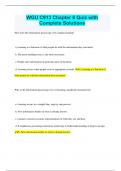
WGU C913 Chapter 8 Quiz with Complete Solutions
WGU C913 Chapter 8 Quiz with Complete Solutions How does the information-processing view explain learning? a. Learning is a function of what people do with the information they encounter. b. The more intelligent one is, the more one learns. c. People store information in particular parts of the brain. d. Learning occurs when people receive appropriate rewards. a. Learning is a function of what people do with the information they encounter. Why is the information-processing view of learning considered constructivist? a. Learning occurs in a straight line, step-by-step process. b. New information builds on what is already known. c. Learners construct accurate representations of what they see and hear. d. It emphasizes presenting material in small steps to build understanding of larger concepts. b. New information builds on what is already known. What steps reflect the information-processing view of learning? a. Attend to and recognize a stimulus. b. Reject any stimulus that is not already encoded. c. Transform the stimulus into a mental representation. d. Compare the stimulus with information already in memory. e. Assign meaning to the stimulus and act on it in some fashion. a. Attend to and recognize a stimulus. c. Transform the stimulus into a mental representation. d. Compare the stimulus with information already in memory. e. Assign meaning to the stimulus and act on it in some fashion. The multi-store model of information processing hypothesizes that memory stores: a. vary in processes required to move information in and out. b. vary in how much information they hold. c. correspond to exact brain locations. d. include a sensory register, short-term store, and long-term store. e. vary in how long they hold information. a. vary in processes required to move information in and out. b. vary in how much information they hold. d. include a sensory register, short-term store, and long-term store. e. vary in how long they hold information. Why do the authors caution readers about "brain-based" methods of teaching and learning? a. The brain is not efficient at processing information. b. Research on how neurological functions relate to classroom learning is lacking. c. As one becomes proficient, brain activity decreases. d. Different tasks activate different parts of the brain. b. Research on how neurological functions relate to classroom learning is lacking. What control processes govern how information is encoded and flows between memory stores? a. recognition b. retrieval c. sensory register d. maintenance rehearsal e. elaborative rehearsal a. recognition b. retrieval d. maintenance rehearsal e. elaborative rehearsal Why are control processes important to the multi-store model of information processing? a. Control processes determine the quantity of information stored and retrieved. b. Control processes can make learning less efficient. c. The learner decides whether, when, and how to employ control processes. d. Control processes determine the quality of information stored and retrieved. e. The learner rehearses information before it enters long-term memory. a. Control processes determine the quantity of information stored and retrieved. c. The learner decides whether, when, and how to employ control processes. d. Control processes determine the quality of information stored and retrieved. What determines which stimuli people attend to? a. sights and sounds in the environment b. knowledge schemes already in memory c. the size of the sensory register d. attentional capacity b. knowledge schemes already in memory How does short-term memory (STM) or working memory function? a. Chunking increases the capacity of short-term memory. b. STM holds five to nine unrelated bits of information for 20 seconds. c. STM includes encoding, organizing, and retrieving information. d. Working memory is that aspect of STM that actively processes information. e. Differences in working memory are unrelated to differences in basic skills. a. Chunking increases the capacity of short-term memory. b. STM holds five to nine unrelated bits of information for 20 seconds. c. STM includes encoding, organizing, and retrieving information. d. Working memory is that aspect of STM that actively processes information. Which statement about maintenance rehearsal and elaborative rehearsal is accurate? a. Maintenance rehearsal results in the transfer of information to long-term memory. b. Maintenance rehearsal is based on the organization of information in the brain. c. Elaborative rehearsal meaningfully relates new information with old. d. Elaborative rehearsal results in information overload. c. Elaborative rehearsal meaningfully relates new information with old. What makes distributed practice better than massed practice? a. Massed practice creates disorganized representations in long-term memory. b. Distributed practice uses regular intervals to consolidate memories. c. Quizzes provide feedback that stimulates recall and retention. d. Massed practice is better than distributed practice. e. Young children have insufficient schemata in long-term memory to "cram." . Massed practice creates disorganized representations in long-term memory. b. Distributed practice uses regular intervals to consolidate memories. c. Quizzes provide feedback that stimulates recall and retention. Younger children possess limited awareness of how their cognitive processes work and when to use metacognitive skills. a. True b. False a. True What processes are included in metacognitive skills? a. determining and setting learning goals b. controlling and guiding effective learning goals c. creating plans for achieving learning goals d. monitoring progress toward learning goals e. evaluating how well learning goals have been achieved a. determining and setting learning goals c. creating plans for achieving learning goals d. monitoring progress toward learning goals e. evaluating how well learning goals have been achieved How may technology best be used to assist information processing? a. having students use computers to design a virtual environment b. coping with information-processing limitations c. presenting text and pictorial information d. letting students participate in virtual environments b. coping with information-processing limitations From an information-processing standpoint, what recommendations are made for using technology tools to teach science and math? a. Students should spend more time manually calculating and plotting data. b. Students should use technology to summarize, interpret, and evaluate data. c. Use the WISE website to help students memorize scientific information. d. Create word clouds in mathematics. b. Students should use technology to summarize, interpret, and evaluate data. Information-processing theory rests on what assumptions? a. The absolute amount of information that humans can learn is limitless. b. The amount of information that can be processed at any stage is unlimited. c. The human information-processing system is interactive. d. Perception and attention influence what information is stored. e. Long-term memory influences what we attend to and encode. a. The absolute amount of information that humans can learn is limitless. c. The human information-processing system is interactive. d. Perception and attention influence what information is stored. e. Long-term memory influences what we attend to and encode According to information-processing theory, why might two different students learn different things from a lesson? a. The teacher did not properly plan the lesson. b. Some students do not pay attention to a lesson. c. Students are influenced by what they already know. d. Boys learn differently than girls. c. Students are influenced by what they already know. The sensory register (SR): a. is the portion of the brain where sensory stimuli are stored. b. can be compared to a camera snapshot or short video. c. is where recognized sensory stimuli are transferred directly to long-term memory. d. holds information between one and three minutes. e. records environmental stimuli, such as visual, auditory, and tactile experiences. a. is the portion of the brain where sensory stimuli are stored. b. can be compared to a camera snapshot or short video. e. records environmental stimuli, such as visual, auditory, and tactile experiences. When a stimulus is encountered, what cognitive process results in recognition? a. relating key features to already-stored memories b. noticing the physical features of the stimulus c. accessing relevant prior knowledge of physical features d. recalling the stimulus from long-term memory a. relating key features to already-stored memories David Ausubel defines meaningful learning as a conscious association of new stimuli with experiences and ideas accumulated in long-term memory. a. True b. False a. True What is the basic idea behind dual coding theory? a. Concrete information is remembered better than abstract information because it is encoded in two ways. b. New information takes twice as long to encode as familiar information. c. Abstract ideas are better remembered than concrete ideas because they take twice as long to encode in long-term memory. d. Learning ideas in pairs produces faster learning than learning them one at a time. a. Concrete information is remembered better than abstract information because it is encoded in two ways. What instructional implications are derived from research on metacognition? a. Elementary school students have extensive metacognitive knowledge and skills. b. Preschool children understand how their mind works. c. Students can be encouraged to develop metacognitive skills and knowledge. d. Metacognitive knowledge and skills are beyond the reach of school-age children. c. Students can be encouraged to develop metacognitive skills and knowledge Metacognitive knowledge, what one knows about one's own thinking, is made up of maintenance, elaborative, and organizational components. a. True b. False b. False From an information-processing standpoint, what recommendations are made for using technology tools to teach writing? a. The prewriting phase is the most important one. b. Sharing ideas online gives students reasons to write. c. Blogs induce students to produce low quality writing. d. Blogs contain plagiarism and persuasive prose. b. Sharing ideas online gives students reasons to write. What recommendations are made for using technology tools to teach reading? a. Listening to a CD-ROM storybook significantly increases vocabulary. b. Interactively clicking on words and illustrations enhances story comprehension. c. Electronic support systems are used around the world to improve reading. d. Online resources are available through the American Library Association. e. Electronic pronunciation and word definitions do not affect comprehension. a. Listening to a CD-ROM storybook significantly increases vocabulary. b. Interactively clicking on words and illustrations enhances story comprehension. c. Electronic support systems are used around the world to improve reading. d. Online resources are available through the American Library Association.
Written for
- Institution
- WGU C913
- Module
- WGU C913
Document information
- Uploaded on
- September 16, 2023
- Number of pages
- 13
- Written in
- 2023/2024
- Type
- Exam (elaborations)
- Contains
- Questions & answers
Subjects
-
wgu c913 chapter 8 quiz with complete solutions

Also available in package deal