Medca Study Guide Test questions and answers
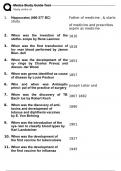
1. Hippocrates (460-377 BC) Father of medicine , & starts study of medicine and prescribes asprin as medicine 2. When was the invention of the stetho- scope by Rene Laennec 3. When was the first transfusion of hu- man blood performed by James Blun- dell 4. When was the development of the sy- ringe by Charles Pravaz and Alexan- der Wood 5. When was germs identified as cause of disease by Louis Pasteur 6. Who and when was Antiseptic princi- pal of the practice of surgery 7. When was the discovery of TB Bacil- lus by Robert Koch 8. When was the discovery of anti- toxins and development of tetanus and diphtheria vaccines by E. Von Behring 9. When was the introduction of the sys- tem to classify blood types by Karl Landsteiner 10. When was the development of the first vaccine for tuberculosis 11. When was the development of the first vaccine for influenza 1816 1818 1853 1857 Joseph Lister and 1890 1901 1927 1945 12. 1953 When did Francis Crick and James Watson work on structure of DNA molecules 13. When was the first development of the first vaccine for measles 14. When was the first vaccine for pneu- monia 1964 1977 15. The DEA has to approve Medicine 16. In order for patients to obtain certain medications Prescriptions are written 17. topical administration Onto the skin ( epicutaneous ) 18. Enternal administration By swallowing ( oral route ) 19. parenteral administration Into veins ( intravenous ) 20. injection beneath the skin is called Subcutaneous administration 21. analgesic drugs Medications that reduce/alleviate pain 22. antianxiety drugs Medication used to suppress anxi- ety and relax muscles 23. Antibiotics Stops the infection from producing organisms- PENICILLIN is a com- mon medicine 24. Anti fungal drug Used to treat infections caused by fungus such as ringworm 25. anti-inflammatory Non steroidal anti inflammatory drugs (NASIDs) 26. Sleeping Aids Used to help with sleeping disor- ders AMBIEN - common medicine 27. anesthetics medicines that cause the loss of feeling ANESTHESIA 28. Common anesthesia Novocaine 29. active records patients who have been seen within the past 2-5 years 30. New Patient You havent been seen in the office in 3years 31. Open booking Gives patients times to come to the office to be seen 32. Methods of filing By Subject & By Date (of receipt) 33. Duties of medical assistant scheduling appointments, updating medical records, vital statics 34. When obtaining medical record infor- mation patients should be Discouraged to give irrelevant infor- mation 35. Co-pay Collected each time a patient is seen 36. Insurance Should be updated each visit 37. Super bill Document used to determine pay- ment due 38. ICD-9 Codes used to identify patient diag- nosis 39. HMO (Health Maintenance Organiza- tion) Patient pay fixed amount or periodic fee for medical care providers be- longing to HMO 40. Who offers more cost advantages when compared with traditional pay- ment plans HMO (Health Maintenance Organi- zation) 41. Taking vital signs means Recording body temperature, blood pressure, respiration and pulse 42. Normal vital signs can change due to Age, Sex, Weight, Exercise and health conditions 43. Average temp for healthy adult 97.8 - 99.1 F 44. Average BP for healthy adult 120/80
Written for
- Institution
- Chamberlain College Nursing
- Module
- Medca
Document information
- Uploaded on
- September 22, 2023
- Number of pages
- 24
- Written in
- 2023/2024
- Type
- Exam (elaborations)
- Contains
- Questions & answers
Subjects
-
medca study guide
-
medca study guide test questions and answers

Also available in package deal