TNCC final exam test 2022 open book
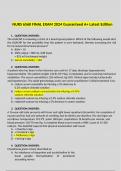
TNCC final exam test 2022 open book Why is a measure of serum lactate obtained in the initial assessment of the trauma patient? Answer: c - ANS-a) to measure oxygenation and ventilation b) to quantify the base deficit for the adequacy of cellular perfusion c) *to gauge end-organ perfusion and tissue hypoxia ** d) to determine the underlying cause of shock A trauma patient is restless and repeatedly asking "where am I?" vital signs upon arrival were BP 100/60 mm Hg, HR 96 beats/min, and RR 24 breaths/min. Her skin is cool and dry. Current vital signs are BP 104/84mm Hg, HR 108, RR 28 breaths/min. The patient is demonstrating signs and symptoms of which stage of shock? Answer: A - ANS-A) compensated ** B) Progressive C) irreversible D) decompensated An elderly patient with a history of anticoagulant use presents after a fall at home that day. she denies any loss of consciousness. She has a hematoma to her forehead and complains of headache, dizziness, and nausea. Which is a most likely cause of her symptoms? Answer: D - ANS-A) epidural hematoma B) diffuse axonal injury C) post-concussive syndrome D) subdural hematoma *** EMS brings a patient who fell riding his bicycle. Using the American College of Surgeons screening guidelines, which assessment finding would prompt the nurse to prepare the patient for radiologic spine clearance? Answer: D - ANS-A) Alert with no neurologic deficits B) Multiple abrasions to the extremities C) Multiple requests of water D) Smell of alcohol on breath *** Which of the following occurs during the third impact of a motor vehicle crash? Answer: C - ANS-A) The driver of the vehicle collides with the steering wheel B) the vehicle collides with a tree C) the aorta is torn at its attachment with the ligamentum arteriosum D) the airbag deploys and strikes the front seat passenger A patient arrives with a large open chest wound after being assault ed with a machete, Prehospital providers placed a nonporous dressing over the chest wound and tapes it on 3 sides. He is now showing signs of anxiety, restlessness, severe respiratory distress, cyanosis, and decreasing blood pressure. Which of the following is the MOST appropriate interventions? Answer: C - ANS-A) needle decompression B) tube thoracostomy C) dressing removal ** D) surgical repair A patient is found lying on the floor after falling 13 hours ago. Which of the following lab values is expected with a musculoskeletal complication associated with this presentation? Answer: A - ANS-A) elevated creatine kinase *** B) decreased potassium level C) decreased WBC D) elevated GFR A 56-year- male patient involved in a MVC is brought to the ED of a rural critical access facility. He c/o neck pain, SOB, and diffuse abd pain. His GCS is 15. His vitals are as follows: BP 98/71 HR 125 beats/min RR 26 breaths/min SpO2 94% on high flow O2 via NRB mask which of the following is the priority intervention for this patient? Answer: C - ANS-A) Expedite transport to the CT scanner B) prepare the patient for spinal radiographs C) expedite transfer to the closest trauma center *** D) notify the patients family Caregivers carry a 2-year old into the ED who fell out of 2nd story window. The patient is awake and crying with increased work of breathing and pale skin. which of the following interventions has the highest priority? Which of the following is possible complication of positive-pressure ventilation? Answer: A - ANS-A) worsening pneumothorax B) worsening flail chest C) reabsorption of pleural air D) negative intrapleural pressure Which of the following is NOT considered goal-directed therapy of cardiogenic shock? Answer: C - ANS-A) controlled fluid boluses B) antidysrhythmic administration C) pericardiocentesis *** D) cardiac cath What bedside monitoring parameters are used to assess for adequacy of oxygenation and effectiveness of ventilation? Answer: A - ANS-A) pulse oximetry and capnogaphy ** B) respiratory rate and capnography C) pulse oximetry and respiratory rate D) capnography and capnometry Which if the following values indicates the need for alcohol withdrawal interventions? Answer: A - ANS-A) CIWA-Ar of 36 *** B) GCS 13 C) ETCo2 of 48 mm Hg D) heart rate of 45 beats/min An unresponsive trauma patient has an oropharyngeal airway in place, shallow and labored respiratory, and dusky skin. the trauma team has administered medications for drug assisted intubation and attempted intubation but was unsuccessful. What is the most appropriate immediate next step? Answer: A - ANS-A) Ventilate with a BVM *** B) Prepare for cricothyroidotomy C) administer reversal medications D) contact anesthesia for assistance The trauma nurse knows that placing a bariatric patients in a "ramped position" provides better visualization during the insertion of which device? Continues...
Written for
- Institution
- TNCC
- Module
- TNCC
Document information
- Uploaded on
- September 27, 2023
- Number of pages
- 11
- Written in
- 2023/2024
- Type
- Exam (elaborations)
- Contains
- Questions & answers
Subjects
-
tncc
-
tncc final exam test 2022 open book

Also available in package deal