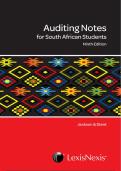
, AUDITING NOTES
FOR
SOUTH AFRICAN
STUDENTS
NINTH EDITION
JACKSON AND STENT
, PREFACE TO THE NINTH EDITION
This ninth edition of the book has been compiled specifically to assist students at tertiary institutions in South Africa
with their studies in auditing. The book is not designed to be used on its own and will swork bests when used in
conjunction with the Companies Act 2008 and its Regulations 2011, the International Standards on Auditing and the
(SAICA) Code of Professional Conduct. Extensive reference is made to these and other pronouncements.
The primary reason for the ninth edition is to bring the text right up to date. A number of ISAs have been revised
and some changes in the SAICA (and IRBA) Code of Professional Conduct have been made. These changes are not
major but needed to be dealt with.
With the increase in the number of independent review and compilation engagements which are now being
undertaken by practitioners, International Standards of Review Engagements ISRE 2400 – Engagements to Review
Financial Statements and International Standards on Related Services ISRS 440 – Compilation Engagements, have
taken on new significance. Both of these statements have been revised and re-issued, and are covered in depth in the
ninth edition.
Changes have also been made in many other chapters, mainly to address a change in legislation, provide a better
illustrative example or simply to improve explanations.
Our intention has been to 'simplify' what has proved to be a difficult subject for many generations of auditing
students. We hope that we have achieved this. Any comments or suggestions to improve subsequent editions would
be most welcome, especially from students who use the book.
R D C Jackson B.Acc (Natal), M.Com (Rhodes), CA(SA)
Former Professor in the School of Accounting, University of KwaZulu-Natal, Durban.
W J Stent B.Com (Hons) (Rhodes), M.Com (RAU), HDE (Rhodes), PhD (Massey), CA(SA), CISA.
Former Senior Lecturer in the School of Accounting, University of KwaZulu-Natal, Durban.
Copyright subsists in this work. No part of this work may be reproduced in any form or by any means without the
publishers written permission. Any unauthorised reproduction of this work will constitute a copyright infringement
and render the doer liable under both civil and criminal law.
© 2014 LexisNexis
215 North Ridge Road
Morningside, Durban. 4001
www.lexisnexis.co.za
Telephone: 031 2683111
NINTH EDITION
ISBN 978 0 409 05726 3
, CONTENTS
Please see the end of the book for detailed chapter by chapter index
Chapter 1 Introduction to Auditing 1/1 - 1/24
Chapter 2 Professional Conduct 2/1 - 2/53
Chapter 3 Statutory Matters 3/1 - 3/93
* Companies Act 2008 and Regulations
* Close Corporations Act 1984
* Auditing Profession Act 2005
Chapter 4 Corporate Governance 4/1 - 4/38
Chapter 5 General Principles of Auditing 5/1 - 5/33
* Internal control
* Audit evidence
* The auditor’s toolbox
* Audit sampling
Chapter 6 An Overview of the Audit Process 6/1 - 6/23
Chapter 7 Important Elements of the Audit Process 7/1 - 7/44
Chapter 8 Computer Audit - The Basics 8/1 - 8/50
Chapter 9 Computer Audit - Networks and Related Concepts 9/1 - 9/35
Chapter 10 Revenue and Receipts Cycle 10/1 - 10/72
Chapter 11 Acquisitions and Payments Cycle 11/1 - 11/52
Chapter 12 Inventory and Production Cycle 12/1 - 12/29
Chapter 13 Payroll and Personnel Cycle 13/1 - 13/43
FOR
SOUTH AFRICAN
STUDENTS
NINTH EDITION
JACKSON AND STENT
, PREFACE TO THE NINTH EDITION
This ninth edition of the book has been compiled specifically to assist students at tertiary institutions in South Africa
with their studies in auditing. The book is not designed to be used on its own and will swork bests when used in
conjunction with the Companies Act 2008 and its Regulations 2011, the International Standards on Auditing and the
(SAICA) Code of Professional Conduct. Extensive reference is made to these and other pronouncements.
The primary reason for the ninth edition is to bring the text right up to date. A number of ISAs have been revised
and some changes in the SAICA (and IRBA) Code of Professional Conduct have been made. These changes are not
major but needed to be dealt with.
With the increase in the number of independent review and compilation engagements which are now being
undertaken by practitioners, International Standards of Review Engagements ISRE 2400 – Engagements to Review
Financial Statements and International Standards on Related Services ISRS 440 – Compilation Engagements, have
taken on new significance. Both of these statements have been revised and re-issued, and are covered in depth in the
ninth edition.
Changes have also been made in many other chapters, mainly to address a change in legislation, provide a better
illustrative example or simply to improve explanations.
Our intention has been to 'simplify' what has proved to be a difficult subject for many generations of auditing
students. We hope that we have achieved this. Any comments or suggestions to improve subsequent editions would
be most welcome, especially from students who use the book.
R D C Jackson B.Acc (Natal), M.Com (Rhodes), CA(SA)
Former Professor in the School of Accounting, University of KwaZulu-Natal, Durban.
W J Stent B.Com (Hons) (Rhodes), M.Com (RAU), HDE (Rhodes), PhD (Massey), CA(SA), CISA.
Former Senior Lecturer in the School of Accounting, University of KwaZulu-Natal, Durban.
Copyright subsists in this work. No part of this work may be reproduced in any form or by any means without the
publishers written permission. Any unauthorised reproduction of this work will constitute a copyright infringement
and render the doer liable under both civil and criminal law.
© 2014 LexisNexis
215 North Ridge Road
Morningside, Durban. 4001
www.lexisnexis.co.za
Telephone: 031 2683111
NINTH EDITION
ISBN 978 0 409 05726 3
, CONTENTS
Please see the end of the book for detailed chapter by chapter index
Chapter 1 Introduction to Auditing 1/1 - 1/24
Chapter 2 Professional Conduct 2/1 - 2/53
Chapter 3 Statutory Matters 3/1 - 3/93
* Companies Act 2008 and Regulations
* Close Corporations Act 1984
* Auditing Profession Act 2005
Chapter 4 Corporate Governance 4/1 - 4/38
Chapter 5 General Principles of Auditing 5/1 - 5/33
* Internal control
* Audit evidence
* The auditor’s toolbox
* Audit sampling
Chapter 6 An Overview of the Audit Process 6/1 - 6/23
Chapter 7 Important Elements of the Audit Process 7/1 - 7/44
Chapter 8 Computer Audit - The Basics 8/1 - 8/50
Chapter 9 Computer Audit - Networks and Related Concepts 9/1 - 9/35
Chapter 10 Revenue and Receipts Cycle 10/1 - 10/72
Chapter 11 Acquisitions and Payments Cycle 11/1 - 11/52
Chapter 12 Inventory and Production Cycle 12/1 - 12/29
Chapter 13 Payroll and Personnel Cycle 13/1 - 13/43