NURS611 Maryville University: Patho Q&A VERIFIED AND ALREADY PASSED WITHRATIONALES
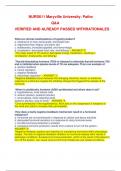
NURS611 Maryville University: Patho Q&A VERIFIED AND ALREADY PASSED WITHRATIONALES What are clinical manifestations of hypothyroidism? a. intolerance to heat, tachycardia, and weight loss b. oligomenorrhea, fatigue, and warm skin c. restlessness, increased appetite, and menorrhagia d. constipation, decreased heart rate, and lethargy - ANSWER *D *The lower levels of TH result in decreased energy metabolism, resulting in constipation, bradycardia, and lethargy. Thyroid-stimulating hormone (TSH) is released to stimulate thyroid hormone (TH) and is inhibited when plasma levels of TH are adequate. This is an example of: a. positive feedback b. neural regulation c. negative feedback d. physiologic regulation - ANSWER *C *Negative feedback occurs because the changing chemical, neural, or endocrine response to a stimulus negates the initiating change that triggered the release of the hormone. Where is antidiuretic hormone (ADH) synthesized and where does it act? a. hypothalamus, renal tubular cells b. anterior pituitary, posterior pituitary c. renal tubules, renal collecting ducts posterior pituitary, loop of henle - ANSWER *A *Once synthesized in the hypothalamus, ADH acts on the vasopressin 2 receptors of the renal duct cells to increase their permeability. How does a faulty negative-feedback mechanism result in a hormonal imbalance? a. hormones are not synthesized in response to cellular and tissue activities b. decreased hormonal secretion is a response to rising hormone levels c. too little hormone production is initiated d. excessive hormone production results from a failure to turn off the system - ANSWER *D *Negative-feedback systems are important in maintaining hormones within physiologic ranges. The lack of negative-feedback inhibition on hormonal release often results in pathologic conditions. Excessive hormone production, which is the result of the failure to turn off the system, can cause various hormonal imbalances and related conditions. What imbalance lessens the rate of secretion of parathyroid hormone a. Increased serum calcium levels b. Decreased serum magnesium levels c. Decreased levels of thyroid-stimulating hormone d. Increased levels of thyroid-stimulating hormone - ANSWER *A *The overall effect of PTH is to increase serum calcium and decrease serum phosphate. If calcium levels are increased, the rate of secretion of PTH will be low. Which condition may result from pressure exerted by a pituitary tumor? a. Hypothyroidism b. Diabetes insipidus c. Hypercortisolism d. Insulin hypo-secretion - ANSWER *A *If the tumor exerts sufficient pressure, then thyroid and adrenal hypofunction may occur because of lack of thyroid-stimulating hormone (TSH) and adrenocorticotropic hormone (ACTH). These result in the symptoms of hypothyroidism and hypocortisolism. Graves disease develops from a(n): a. Viral infection of the thyroid gland that causes overproduction of thyroid hormone. b. Autoimmune process during which lymphocytes and fibrous tissue replace thyroid tissue. c. Thyroid-stimulating immunoglobulin that causes overproduction of thyroid hormones. d. Ingestion of goitrogens that inhibits the synthesis of the thyroid hormones, causing a goiter. - ANSWER *C *The pathologic features of Graves disease indicates that normal regulatory mechanisms are overridden by abnormal immunologic mechanisms that result in the stimulation of excessive TH. Pathologic changes associated with Graves disease include: a. High levels of circulating thyroid-stimulating immunoglobulins b. Diminished levels of thyrotropin-releasing hormone c. High levels of thyroid-stimulating hormone d. Diminished levels of thyroid-binding globulin - ANSWER *A *The only option that correctly describes the changes associated with Graves disease identifies high levels of circulating thyroid-stimulating immunoglobulins that are found in more than 95% of individuals diagnosed with the disease. The signs of thyrotoxic crisis include: a. Constipation with gastric distention b. Hyperthermia and tachycardia c. Bradycardia and bradypnea d. Constipation and lethargy - ANSWER B
Written for
- Institution
- NURS 611
- Module
- NURS 611
Document information
- Uploaded on
- October 2, 2023
- Number of pages
- 19
- Written in
- 2023/2024
- Type
- Exam (elaborations)
- Contains
- Questions & answers
Subjects
-
nurs611 maryville university patho qa verified

Also available in package deal