LEO Test #1 Questions with Complete Solutions Graded A+
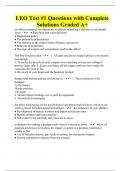
an officers minimal considerations to address in making a decision to use deadly force: - ♦ State laws and court decisions Department policy The proximity of bystanders The distance to the suspect (time, distance, and cover) Behavior of perpetrator The type of weapon and ammunition used by the officer The four firearms rules: - 1. All guns are always loaded and are to be treated accordingly 2. Never let the muzzle of your weapon cover anything you are not willing to destroy (laser rule) 3. Keep your finger off the trigger until you have made the conscious decision to fire 4. Be aware of your target and the backstop beyond Range rules include and are not limited to: - 1. Three positions of the handgun In the holster Ready position On target 2. Holster before bending over to pick up equipment 3. Absolutely no horseplay the effect training has on the psychological and physiological forces, which occur when a person feels threatened with danger. - ♦ Confidence in your abilities Development of muscle memory and improved reaction time Mental alertness and concentration Self-control over emotions and reactions to stress techniques for making a handgun safe when it is stored at home. - ♦ Use of mechanical devices for locking the trigger or action in a position rendering it unable to fire Use of lockable drawer, gun vault, or cabinet for storing the weapon Storing ammunition separate from the weapon techniques for proper care and cleaning of their duty weapons. - ♦ Field strip the weapon Identify areas to be cleaned Identify areas to be oiled Discuss proper cleaning techniques and supplies ♦ Properly reassemble the weapon the importance of performing a weapon function check after reassembly. - ♦ Action cycles and locks properly Trigger resets properly All safeties/de-cockers function properly Slide returns to battery every time the action is cycled how to safely dry-fire, including proper locations for dry-firing and time constraints associated. - ♦ Always visually and physically clear the weapon first Remove all ammunition from the room Use a target or aiming point as a reference Have a proper backstop such as brick, basement, concrete, etc. Work with a partner for trigger reset and critique ♦ Do not dry fire for more than 15 minutes at a time general areas to inspect when performing a "safety check" on weapons. - ♦ Barrel clear of obstructions No excessive lead build up in barrel Manual and internal safeties functioning Front and rear sights secure and un-damaged All screws, fasteners, and pins secure Grips and other accessories do not interfere with the safe operation of the weapon Weapon is free from cracks or other defects Weapon has had a function check performed every time it has been field stripped for cleaning/inspection the methodology of reality based training to include the following: - ♦ Practical application for knowledge gained in classroom Opportunity for cadets to demonstrate decision making ability Allows for mistakes to be made in a controlled training environment rather than in the field with the public Evaluation opportunity for staff to gauge cadet progress and individual needs Immediate feedback and correction for cadets Improved learning and concept retention through "hands-on" training safety procedures when participating in scenario training: - ♦ No "real" weapons of any type are allowed in the training area during scenarios (sterile environment) • Guns • Knives • Batons • Pepper Spray • Tasers or any electronic control device • Live ammunition Mandatory safety equipment used by participants in scenario training - • Simunition mask • Throat protection • Groin protection Optional safety equipment may be used by participants in scenario training - • Gloves • Long sleeve shirts • Ballistic vest safety procedures when participating in scenario training: - ♦ Vehicle use/care and safe driving practices during scenarios Command for terminating a given scenario is "Out of role!" Use only reasonable force (do not brutalize role-players) proper handling and care of equipment used for reality based training. - ♦ Care and cleaning of mandatory safety equipment Care and cleaning of Simunition Guns Care and cleaning of facilities used for training Care and use of hand-held radios Care and cleaning of duty gear the key components of an investigation and take comprehensive field notes in order to complete an investigative report, to include: - ♦ Names of suspects, victims, and witnesses Date/time of occurrence Locations Circumstances of crime or incident Additional relevant information an effective investigative/incident report, to include the following required components: - ♦ Facts needed to establish a crime has been committed Six primary questions (who, what, when, where, how, & why) to be answered in an investigative report Fundamental content elements that are common within effective investigative reports: - • Initial information • Identification of the crime • Identification of involved parties • Victim/witness statements • Crime scene specifics • Property information • Officer's actions and legal basis for actions taken an officer's responsibilities when encountering a civil dispute. - ♦ Keep the peace Determine if a crime has been committed Provide safety to individuals and property Attempt to help find solutions without giving legal advice or getting involved Summons - • A call issued by a court or administrative authority to appear, come, or do something • Notice summoning a defendant to appear in court • Notice summoning a person to report to court as a juror or witness Writs of replevin - • An order or writ issued to recover an item of personal property Attachment and garnishment - • An order to withhold non-exempt personal property or money owed to third party • Withhold wages or property Temporary restraining order - • Order issued by a court restraining the conduct of a person and protecting a victim from the activities of an abusive person • Ordinarily issued after an "ex parte appearance" (an appearance in court by one party without the other being present) • An order of the court that states a person is to refrain from particular acts and to stay away from particular places Protective order - • Order issued by a court meant to protect a person from harm or harassment • An order to: Stay away from petitioners home, job, vehicle, or school Not contact or harass Not possess gun or other weapons Establish temporary custody of children Notice of Eviction - • Removal of a tenant from rental property by the landlord
Written for
- Institution
- LEO
- Module
- LEO
Document information
- Uploaded on
- November 16, 2023
- Number of pages
- 31
- Written in
- 2023/2024
- Type
- Exam (elaborations)
- Contains
- Questions & answers
Subjects
-
leo test 1
-
leo
-
leo test 1 questions with complete solutions

Also available in package deal